Pomegra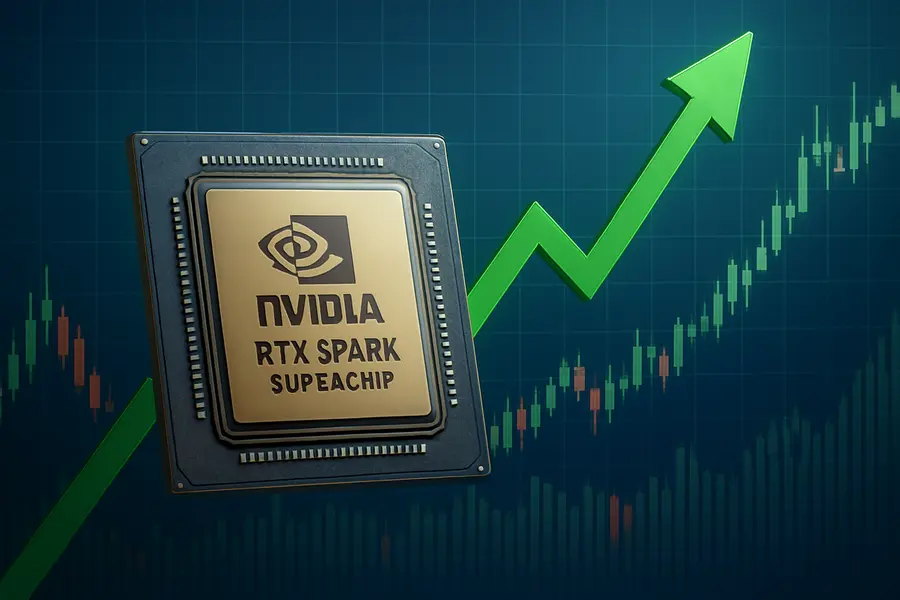
Nvidia's unveiling of the RTX Spark AI PC chip at Computex 2026 sent NVDA stock surging 5%, rattled Qualcomm, and reignited the broader tech market rally around next-gen AI hardware.
- NVDA jumped roughly 5% to ~$222 on June 1 after CEO Jensen Huang revealed the RTX Spark superchip at Computex 2026 in Taipei.
- The Nvidia AI PC chip pairs a 20-core Grace CPU with a Blackwell RTX GPU, delivering up to 1 petaflop of on-device AI compute and 128GB unified memory.
- Qualcomm slid ~7% as markets priced competitive pressure on its Snapdragon X PC franchise from Nvidia's direct entry into the AI-powered PC segment.
Lead
Shares of Nvidia (NVDA) climbed roughly 5% to approximately $222 on Monday, June 1, 2026, after CEO Jensen Huang used his keynote address at Computex 2026 in Taipei, Taiwan to unveil the RTX Spark — a purpose-built superchip that plants Nvidia squarely inside the consumer PC for the first time and triggers a broad tech market rally centered on next-gen AI hardware. The move sent ripples across the semiconductor landscape, lifting allied names while punishing rivals exposed to the newly contested AI-powered PC market.
What Happened
Jensen Huang took the stage in Taipei and declared that Nvidia, alongside Microsoft, intends to "reinvent the PC." The product behind that ambition is RTX Spark, a system-on-chip designed from the ground up for what the company calls the era of personal AI agents — machines that function less as tools and more as active collaborators.
RTX Spark fuses a 20-core Nvidia Grace CPU with a Blackwell RTX GPU containing 6,144 CUDA cores and fifth-generation Tensor Cores with FP4 precision. The two dies are connected via Nvidia's NVLink-C2C chip-to-chip interconnect and share a unified pool of up to 128GB of LPDDR5X memory on a single TSMC 3nm process node. The platform is rated at up to 1 petaflop of FP4 AI compute — enough to run 120-billion-parameter language models entirely on-device, without cloud dependency.
The chip is co-developed with MediaTek and targets Windows on Arm, cementing a deepened alliance with Microsoft that Huang described as the foundation of a new PC architecture. Devices from Asus, Dell, HP, Lenovo, Microsoft, and MSI, with Acer and Gigabyte to follow, are scheduled to arrive in fall 2026.
Market Reaction
The RTX Spark announcement instantly reshaped sector positioning. NVDA stock opened sharply higher, trading near $222 in midday action — up from Friday's close of approximately $211, a gain of roughly 5% and an extension of the stock's year-to-date advance. Volume was elevated above the 30-day average.
The session's dominant loser was Qualcomm (QCOM), whose shares dropped roughly 7% to approximately $234, touching an intraday low near $227. Traders moved quickly to price in competitive erosion of Qualcomm's Snapdragon X PC franchise, which had led Windows on Arm adoption through 2024 and 2025 with only nominal competition from x86 incumbents.
Intel (INTC) and Advanced Micro Devices (AMD) both posted modest declines, reflecting anxiety about margin pressure and market-share displacement in the consumer PC segment. The news also drove Cathie Wood's ARK funds to snap up 300,017 shares of NVDA on June 1 while simultaneously offloading 110,207 shares of AMD — a capital rotation visible in real time.On the positive side of the ledger, Arm Holdings (ARM), IBM (IBM), Hewlett Packard Enterprise (HPE), and ServiceNow (NOW) all rallied, benefiting from their exposure to the Windows-on-Arm ecosystem, enterprise AI infrastructure, and the broader platform build-out that RTX Spark accelerates.
Strategic Context
Nvidia's entry into the PC silicon market is the culmination of a multi-year vertical integration strategy. Having established dominance in data-center GPUs, the company is now extending its CUDA software moat into the client computing layer — meaning the same developer tools, inference runtimes, and AI frameworks that run on Nvidia's cloud hardware will now also run natively on consumer laptops and desktops powered by RTX Spark.
The chip consolidates three decades of Nvidia IP: CUDA, RTX ray tracing, DLSS AI upscaling, TensorRT inference optimization, and G-SYNC display synchronization are all integrated at the silicon level. For software developers, the value proposition is a unified target across edge and cloud — a significant incentive for application builders deploying AI-powered workflows.
The MediaTek partnership broadens Nvidia's manufacturing and distribution reach in Asia, while the Microsoft alignment ensures that the Windows AI agent stack — which Microsoft has been building toward since the Copilot rollout — is optimized first and most deeply on RTX Spark hardware.
AI and Technology Angle
What distinguishes RTX Spark from prior AI-at-the-edge efforts is raw capability at the local level. The ability to run 120-billion-parameter models without a network connection resolves the latency, privacy, and cost constraints that have limited enterprise adoption of AI PCs. Locally executed inference means sensitive corporate data never leaves the device — a consideration that has slowed cloud-dependent AI deployments in regulated industries including finance, healthcare, and government.
At the content and creative layer, Nvidia claims RTX Spark can handle 12K 4:2:2 video editing, render 3D scenes exceeding 90GB in size, and sustain AAA gaming at 1440p above 100 frames per second — positioning it simultaneously as a professional workstation, creative studio, and AI inference node.
The platform's 128GB unified memory pool, shared seamlessly between CPU and GPU, eliminates the memory bottleneck that has historically forced AI workloads off consumer devices and onto servers. This architectural choice mirrors what Apple's M-series unified memory did for creative workflows — but with Nvidia's AI software ecosystem layered on top.
Geopolitical Dimension
The Computex stage in Taipei carries its own strategic weight. Nvidia's deepening collaboration with MediaTek — a Taiwan-headquartered firm — and its production dependence on TSMC's 3nm process underscore how thoroughly the next generation of AI hardware is anchored in Taiwan's semiconductor supply chain. That concentration amplifies the importance of ongoing U.S. policy efforts to diversify chip production, even as the most advanced consumer AI silicon continues to be fabbed in the Taiwan Strait corridor.
Outlook
The RTX Spark launch marks Nvidia's most consequential product expansion since the data-center GPU transition — moving the company from a B2B hardware supplier into a direct shaper of consumer computing architecture. With NVDA stock news reflecting a 5% single-session gain and fall 2026 device availability confirmed across major OEM partners, investor attention now turns to whether RTX Spark can generate the volume and attach rates needed to justify Nvidia's expanding valuation. Qualcomm faces the most immediate strategic reckoning as the Windows-on-Arm market it pioneered now has a formidably capitalized new entrant. For the broader tech market rally, RTX Spark reinforces the thesis that next-gen AI hardware investment cycles remain early and that the most durable AI infrastructure plays are those — like Nvidia — capable of controlling both the silicon and the software stack.
Mentioned tickers: NVDA, QCOM, AMD, INTC, ARM, IBM, HPE, NOW