Pomegra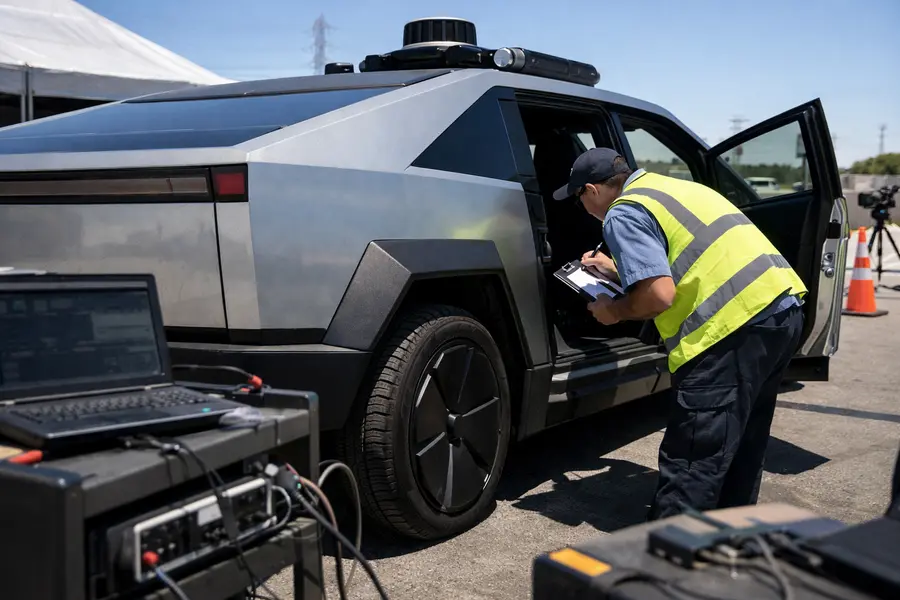
Federal regulators opened a formal certification audit into Tesla's Cybercab on September 3, 2026 - the same day the company began charging fares for its paid robotaxi service in Austin - raising legal questions over whether the pedal-less, mirror-less vehicle was properly cleared for U.S. public roads.
- NHTSA opened Audit Query AQ26002 on September 3, targeting roughly 1,000 Cybercabs deployed in Austin.
- Tesla self-certified the two-seat robotaxi under crash standards written for vehicles with steering wheels, pedals, and mirrors - none of which the Cybercab has.
- TSLA shares fell 6% the following session as regulatory uncertainty compounded investor concern over the launch.
Lead
The National Highway Traffic Safety Administration opened Audit Query AQ26002 on September 3, 2026 - hours after Tesla (TSLA) activated paid rides for its Cybercab fleet in Austin - covering approximately 1,000 vehicles. Regulators stated they would examine the process and technical data Tesla relied on when it self-certified the Cybercab as compliant with all applicable Federal Motor Vehicle Safety Standards, a designation Tesla claimed without seeking a formal regulatory exemption.
What Is NHTSA Questioning?
The audit targets a specific legal maneuver: Tesla's decision to self-certify the Cybercab by declaring most FMVSS rules inapplicable to a car with no human controls. The Cybercab carries no steering wheel, brake pedal, accelerator pedal, or mirrors - features around which most federal safety standards were written. Rather than file for a temporary exemption, which caps annual production at 2,500 units, Tesla determined those standards simply do not apply to an autonomous vehicle lacking the relevant hardware. NHTSA said it will scrutinize "the extent to which the company determined that certain Federal Motor Vehicle Safety Standards were not applicable to the vehicle" and whether that interpretation holds legal merit.
How Does This Compare to Other AV Deployments?
The audit does not evaluate the Cybercab's driving performance - it examines process and legal standing. Amazon's (AMZN) Zoox subsidiary navigated the same regulatory challenge differently, first self-certifying its steering-wheel-free shuttle and then securing a formal exemption covering up to 2,500 vehicles annually through July 2028. By bypassing the exemption route entirely, Tesla avoided the production ceiling but assumed the full legal risk of its own compliance reading. NHTSA had separately proposed in June 2026 to eliminate the federal requirement for manual brake pedals in fully autonomous vehicles - a rule change that, if finalized, would have resolved one of the central compliance questions now under review.
Market Reaction
TSLA fell 6% on September 4, the session following the dual announcements. The decline reflected two converging pressures: the audit introduced uncertainty over whether Tesla could sustain or expand the Austin fleet, and analysts flagged the launch presentation as underwhelming relative to prior guidance. Tesla plans to deploy approximately 2,500 Cybercabs in 2026, with consensus estimates projecting Cybercab revenues near $1 billion for the year - roughly 1.3% of total automotive sales.
How to Buy Tesla Stock
For retail investors tracking TSLA as one of the most widely held ai stocks, the near-term share trajectory now depends in part on NHTSA's timeline and findings. The agency has not disclosed a resolution date for Audit Query AQ26002, leaving the regulatory overhang open-ended heading into the fourth quarter.
Outlook
The NHTSA audit represents the most direct federal intervention to date in Tesla's autonomous vehicle ambitions. If regulators conclude the self-certification was procedurally improper, Tesla could face a recall order or be required to file for a formal exemption - either outcome constrains fleet expansion and delays the revenue ramp that underlies the Cybercab's financial case. The ruling carries sector-wide weight: Tesla's approach, if upheld, sets a scalable precedent for AV deployment without production caps; if rejected, it pushes every autonomous vehicle manufacturer toward the exemption pathway and its hard ceiling of 2,500 units per year.
Mentioned tickers: TSLA, AMZN