Pomegra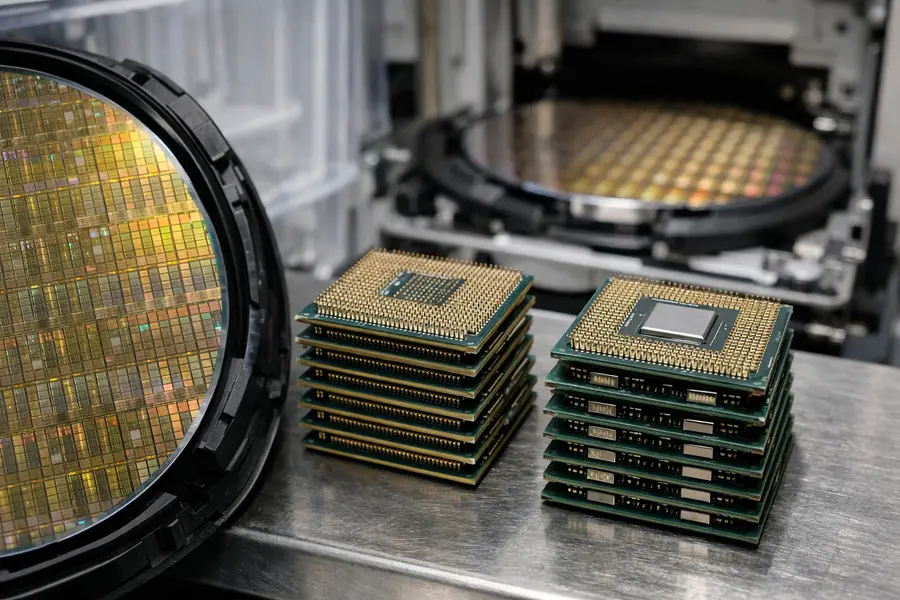
Intel rose 4% and AMD gained 3% Tuesday as chip stocks bounced back from an AI-safety selloff, outperforming a falling broader market on intact hyperscaler capex signals.
- Intel (INTC) climbed 4%, AMD rose 3%, and SMH advanced more than 1% Tuesday, outperforming a weakening broader market.
- The rebound followed Monday's rout in which INTC shed 7% and AMD dropped 6% after AI executives called for slower frontier model development.
- Hyperscalers are on pace to deploy roughly $730 billion in AI infrastructure in 2026, keeping chip demand forecasts intact.
Lead
Semiconductor stocks staged a selective recovery Tuesday, with Intel Corporation (INTC) gaining 4% and Advanced Micro Devices (AMD) adding 3% even as the S&P 500 and Nasdaq Composite declined. The VanEck Semiconductor ETF (SMH) climbed more than 1%, clawing back a portion of the prior session's steep losses. The session delivered a pointed verdict from institutional buyers: whatever pressure the AI-safety pacing debate applies to model deployment timelines, it does not erase the silicon procurement commitments hyperscalers have already made for 2026.What Triggered Monday's Rout - and Tuesday's Reversal?
Twenty-four hours earlier, the chip sector endured one of its sharpest single-session drawdowns of the year. Intel fell 7%, AMD sank 6%, and the Philadelphia Semiconductor Index tumbled roughly 6% after a coordinated wave of public statements from AI executives - including the leaders of Anthropic and OpenAI - urged a measured slowdown in frontier artificial intelligence development. Applied Materials (AMAT) and Lam Research (LRCX) each lost 6%, while ASML (ASML) declined 5%, with equipment names hit hardest on fears that slower model development could eventually trace back to reduced fab spending.
Tuesday's recovery suggests institutional buyers treated the selloff as a pricing dislocation rather than a genuine demand signal. Intel's foundry turnaround, led by CEO Lip-Bu Tan, and AMD's expanding data center footprint provided stock-specific floors, while the underlying hyperscaler capex cycle provided sector-wide support for ai stocks across the board.
Why Didn't the AI-Safety Debate Cancel Chip Orders?
The market's answer is that ethical and regulatory arguments about AI development pace operate on a different timeline than contracted silicon procurement. Microsoft (MSFT), Amazon (AMZN), Alphabet (GOOGL), and Meta Platforms (META) have collectively disclosed 2026 AI capital spending plans exceeding $200 billion - hardware already ordered and in production schedules, not a wish list subject to philosophical revision. Across the full hyperscaler cohort, AI infrastructure commitments for 2026 approach $730 billion. AMD's chief financial officer separately lifted the company's forecast for the total addressable market in AI chips toward $3 trillion, reinforcing that the demand runway extends well beyond the current debate.
Fundamentals: Earnings Still Driving the Tape
Intel's most recent quarter provided the cleanest evidence that the company's AI pivot is generating revenue, not just narrative. Revenue reached $16.13 billion, up 25.4% year-over-year, with Data Center and AI segment sales surging 59%. AMD reported quarterly revenue of $11.54 billion, up 50.1%, with Data Center revenue more than doubling. Those results frame the stock-specific reasons investors returned to semiconductor names Tuesday even as the macro backdrop remained unsettled.
Leveraged structures such as SOXL - the Direxion Daily Semiconductor Bull 3X ETF - experienced amplified swings in both directions across the two-day sequence, underscoring the volatility premium embedded in leveraged vehicles during sentiment-driven selloffs.
Rate Hike Adds a Second Headwind
The broader market decline Tuesday was partly driven by rising expectations for a Federal Reserve rate increase, with futures markets pricing the probability above 60% ahead of the Federal Open Market Committee decision due Wednesday. The 10-year Treasury yield held above 5%, keeping pressure on longer-duration growth assets. That semiconductor stocks advanced against both headwinds simultaneously - an AI narrative overhang and a tightening monetary policy outlook - signals investors weighted near-term revenue delivery more heavily than valuation sensitivity to rates.
What Comes Next for Semiconductor Stocks?
The next decisive inflection arrives in October, when Microsoft, Amazon, Alphabet, and Meta report third-quarter results and update capital expenditure guidance. Any revision to AI infrastructure spending would either confirm or undercut the thesis that drove Tuesday's recovery. Until those reports, the chip trade rests on the assumption that hyperscaler order books remain intact - an assumption Monday's rout briefly challenged and Tuesday's bounce provisionally restored.
NVIDIA (NVDA), which posted fiscal 2026 revenue of $215.9 billion - up 65% year-over-year - remains the sector's primary benchmark and the clearest gauge of whether the AI infrastructure cycle is accelerating or plateauing. NVIDIA ticked modestly higher Tuesday alongside INTC and AMD, signaling that the session's recovery was broad-based rather than confined to individual catalysts.Outlook
Chip stocks enter Wednesday with the Federal Reserve decision as the immediate swing factor. A hold on rates would remove one of the dual headwinds the sector is navigating; a hike or unexpectedly hawkish guidance would reintroduce valuation pressure on growth-heavy names. Beyond the rate decision, the AI-safety pacing debate remains an open policy question with no near-term resolution, but the two-day price sequence has now demonstrated that execution against existing hyperscaler contracts carries more weight with institutional investors than the rhetorical direction of AI ethics discourse.