Pomegra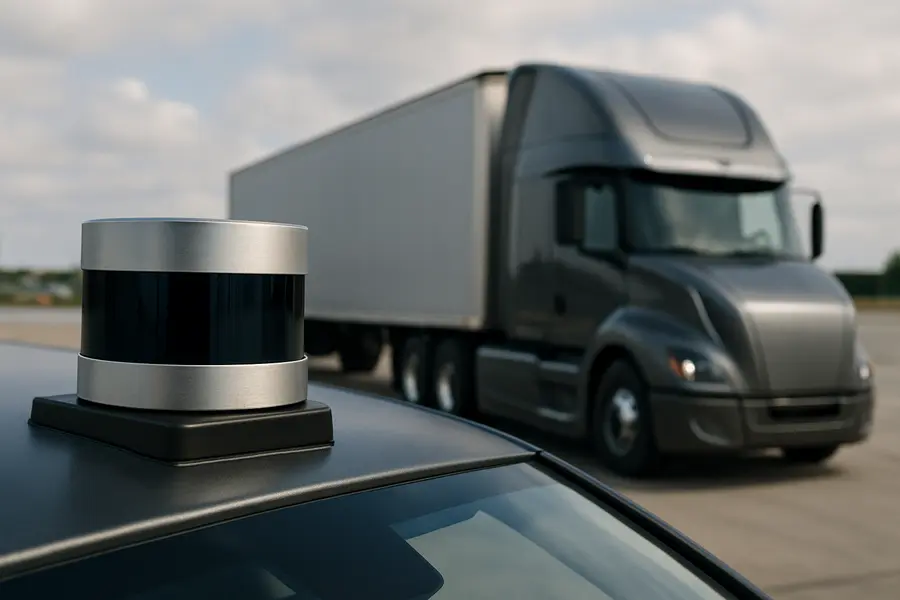
https://upload.wikimedia.org/wikipedia/commons/thumb/b/b9/Ferrexpo_autonomous_truck.jpg/1280px-Ferrexpo_autonomous_truck.jpg
- MicroVision and the world's leading construction and mining equipment manufacturer will jointly develop, validate, and commercialize lidar-powered autonomous hauling platforms.
- Initial deployment pairs two Iris lidar sensors per truck; the next-generation Halo sensor is designated as a backward-compatible upgrade path for the same fleet hardware.
- The development deal follows MicroVision's $33 million Luminar asset acquisition and a Q1 2026 revenue gain of 50% year-over-year.
MicroVision signs a Master Development Agreement to embed Iris lidar sensors in off-highway haul trucks for quarry and aggregate autonomous hauling operations.
Lead
MicroVision, Inc. (Nasdaq: MVIS) disclosed on June 10, 2026, the signing of a Master Development Agreement dated June 1 with the world's leading manufacturer of construction and mining equipment to advance MicroVision lidar technology for next-generation autonomous hauling solutions. The agreement establishes a joint framework to develop, validate, and commercialize advanced perception capabilities for off-highway trucks operating in demanding quarry and aggregate environments, marking the company's largest OEM-level engagement since repositioning its sensor portfolio.What Happened
The agreement creates a structured pathway to embed MicroVision's Lidar 2.0 perception stack into the OEM partner's next-generation autonomous haulage systems. Each off-highway truck in the initial program will carry two Iris lidar sensors — 1550-nanometer time-of-flight devices with detection range exceeding 250 meters, engineered to operate reliably under extreme vibration, dust, adverse weather, and variable lighting conditions inherent to quarry and aggregate operations.
The agreement also sets out an evaluation path for MicroVision's next-generation Halo lidar sensor, designed as a forward evolution of Iris with full backward system compatibility. The architecture allows fleet operators to upgrade sensor capability without redesigning existing truck installations, reducing the total cost of a technology transition for large equipment fleets.
Financial terms of the development deal were not disclosed. The OEM counterparty, described as the world's leading manufacturer of construction and mining equipment, was not named.
Strategic Context
The agreement is a direct commercial application of MicroVision's February 3, 2026 acquisition of lidar assets from Luminar Technologies (Nasdaq: LAZR) for $33 million. That transaction transferred intellectual property, sensor inventory, and associated technology for both the Iris and Halo platforms, repositioning MicroVision as a multi-vertical industrial autonomy supplier rather than an automotive-only lidar developer.
MicroVision's Q1 2026 financial results reflect the strategic repositioning in motion: revenue rose 50% year-over-year as industrial shipments ramped, and gross margin expanded from 7% to 39%, surpassing prior guidance. The company has reported revenue-generating deployments across autonomous trucking, hauling, and mining applications, with the June 10 announcement representing the most significant OEM partnership confirmed to date.
Autonomous hauling presents a compelling economic case for advanced sensor integration. Off-highway haul trucks are among the largest and most capital-intensive vehicles in industrial operations, and unplanned downtime or a collision in an active quarry or open-pit mine can cost hundreds of thousands of dollars per incident. Mining and aggregates operators have intensified investment in automated haulage systems to improve safety outcomes, asset utilization, and operational efficiency — conditions that demand long-range, all-weather perception performance well beyond standard automotive lidar specifications.
The Lidar Stocks Landscape
The global lidar market is valued at approximately $3.32 billion in 2026 and is projected to reach $7.79 billion by 2031, with North American demand forecast to grow at a 30.9% compound annual rate through 2030 on the back of accelerating deployments in mining, construction, logistics, and autonomous mobility.
Among lidar stocks, MicroVision competes alongside Ouster (Nasdaq: OUST) and Innoviz Technologies (Nasdaq: INVZ) for industrial and automotive perception contracts. Luminar, which divested its Iris and Halo assets to MicroVision, has refocused on its own long-range platform and software stack following a restructuring that targeted $50–65 million in annual cost reductions.
MVIS shares were trading near $0.62 on June 10, down approximately 6% on the session in thin volume. The stock had gained roughly 3.3% over the prior 30 days while carrying a trailing 12-month total return of -46.4%. Analyst coverage remains limited, with a consensus direction of Strong Buy and an average price target near $2.50.
Outlook
The Master Development Agreement with a globally dominant OEM validates MicroVision's pivot toward large-scale industrial autonomy at a pivotal phase for the company. The joint structure — spanning design, validation, and commercialization — indicates a multi-year engagement tied to equipment production timelines rather than a discrete sensor purchase order. Near-term execution will depend on field validation of the Iris platform under industrial duty cycles, successful integration with the OEM's autonomy software architecture, and progression toward volume production commitments. A move to series deployment would represent MicroVision's first large-scale OEM program since the Luminar asset acquisition reshaped its product portfolio.
Mentioned tickers: MVIS, LAZR, OUST, INVZTechnology