Pomegra
Microsoft's Azure cloud unit hit 43% quarterly growth and crossed $100 billion in annual revenue, triggering the largest single-day market capitalization gain in U.S. stock market history.
- MSFT added roughly $450 billion in market value on July 30, surpassing Nvidia's prior record of $441 billion set in April 2025.
- Azure revenue grew 43% in fiscal Q4 2026 — its fastest pace since early 2022 — beating Microsoft's own 39–40% guidance.
- Microsoft 365 Copilot surpassed 30 million paid seats as commercial backlog rose 84% to $678 billion.
Lead
Microsoft (MSFT) logged the single largest one-day gain in market capitalization in United States stock market history on July 30, 2026, adding approximately $450 billion in market value after a fiscal fourth-quarter earnings report showed Azure cloud growth accelerating sharply and capital spending holding steady. Shares of the Redmond, Washington-based company closed up roughly 15.5%, reaching approximately $451 per share, pushing Microsoft's total market capitalization to $3.35 trillion and erasing any lingering investor doubt about the return on its generative artificial intelligence investment cycle.What Happened
Microsoft reported fiscal fourth-quarter revenue of $90 billion on the evening of July 29, an 18% increase from the prior year and above the $87.7 billion consensus. Adjusted earnings per share of $4.74 exceeded the average analyst estimate of $4.24 by an unusually wide margin. Net income reached $35.8 billion, a 31% year-over-year increase.
The headline figure that moved markets most decisively was Azure's 43% revenue growth — its strongest quarterly acceleration since early 2022. Azure quarterly revenue reached $29.9 billion, up from $20.9 billion a year earlier, sailing past the company's own guidance range of 39–40%. For the full fiscal year 2026, Azure crossed $100 billion in annual revenue for the first time, a threshold long watched by cloud infrastructure investors as a proxy for enterprise AI adoption at scale.
Microsoft's total cloud revenue for fiscal 2026 reached $214 billion, up 27% from fiscal 2025. Full-year revenue came to $331.8 billion, with earnings per share of $17.95, a 32% increase year-over-year. Operating income for the full year exceeded $155 billion, up 21%.
Market Reaction
The stock's single-session move was the largest percentage gain for MSFT since 2008, and the raw dollar increase in market capitalization — approximately $450 billion — broke the record of $441 billion set by Nvidia (NVDA) on April 9, 2025. The gain is larger than the entire equity market capitalization of Turkey and represents a single-day addition roughly equivalent to the market cap of JPMorgan Chase or Visa.
The broader market responded in kind. The Nasdaq Composite surged nearly 3% on July 30, with Alphabet (GOOGL), Amazon (AMZN), and Meta Platforms (META) all rising as investors extrapolated the AI cloud demand signal. The S&P 500 rebounded alongside the Dow Jones Industrial Average, marking one of the stronger broad-market sessions of the year.
AI and Technology Angle
The earnings report served as concrete validation that Microsoft's AI infrastructure buildout is converting into measurable enterprise revenue rather than speculative capex. Microsoft 365 Copilot paid seats exceeded 30 million, crossing a threshold that signals the product has moved beyond early-adopter pilots into mission-critical enterprise deployment. Commercial remaining performance obligations — a forward-looking measure of contracted cloud spending — rose 84% to $678 billion, with sequential growth increasingly driven by companies outside the frontier AI lab cohort.
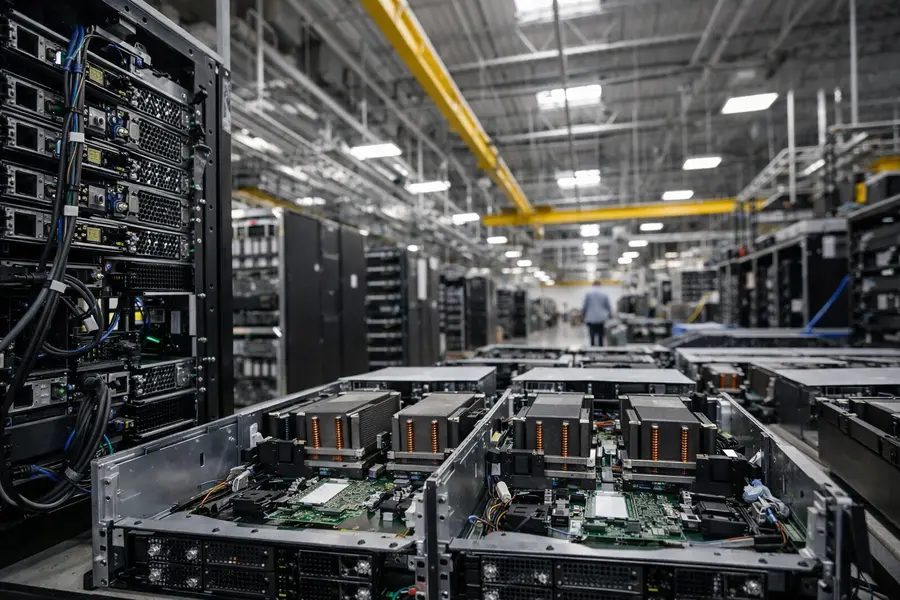
Capital expenditures and finance leases for the quarter reached $41 billion, up 69% year-over-year, reflecting continued investment in data center capacity, GPUs, and networking infrastructure. Crucially, the capex figure came in at or below prior guidance, reassuring investors who had feared runaway spending without proportional revenue follow-through. Roughly two-thirds of the quarterly capex flowed into short-lived compute assets — CPUs and GPUs — that depreciate quickly but generate revenue almost immediately, a mix that supports near-term margin visibility.
Microsoft also revised its calendar 2026 capex forecast modestly downward by extending the assumed useful life of office and data center properties from 15 to 25 years, a non-cash accounting adjustment that reduced reported capital commitments without signaling any slowdown in physical infrastructure deployment.
Strategic Context
The results reinforce a broader shift in how enterprise AI is being consumed. The early wave of generative AI adoption concentrated in a small cluster of frontier model developers. The 84% jump in commercial performance obligations — skewed toward non-AI-lab customers — indicates that Fortune 500 companies, financial institutions, healthcare systems, and government contractors are now committing to multi-year Azure AI contracts in volume.
Microsoft's integration of OpenAI models across Azure, Microsoft 365, GitHub Copilot, and the Dynamics 365 suite gives it a distribution advantage that pure infrastructure rivals cannot easily replicate. The Copilot seat count crossing 30 million reflects enterprise willingness to pay incremental per-user fees on top of existing Microsoft 365 subscriptions — a high-margin revenue stream with compounding growth characteristics.What Comes Next
For the fiscal first quarter of 2027, Microsoft guided Azure to grow 45% on a constant-currency basis, an acceleration from the 43% just reported. That guidance implies quarterly Azure revenue approaching or exceeding $35 billion, which would represent an annualized run rate well above the $100 billion annual threshold already crossed.
Outlook
Microsoft's July 30 trading session rewrote the record books for single-day wealth creation while simultaneously confirming the investment thesis that large-scale AI capital expenditure can generate proportionate cloud revenue within a compressed time horizon. With Azure growing faster than at any point in four years, Copilot monetization accelerating, and commercial backlog at an all-time high, the company enters fiscal 2027 as the clearest beneficiary of enterprise AI adoption at global scale. Whether the $3.35 trillion valuation holds will depend on whether the 45% Azure growth guidance materializes — and whether AI-driven margin expansion continues to outpace the $41 billion quarterly infrastructure bill.
Mentioned tickers: MSFT, NVDA, GOOGL, AMZN, META