Pomegra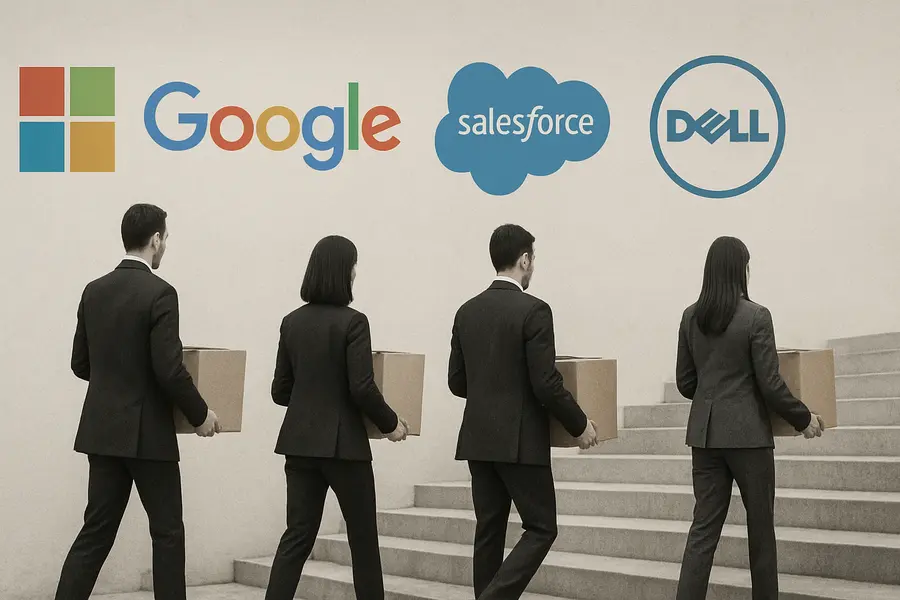
Microsoft, Alphabet, Salesforce, and Dell eliminated over 20,000 jobs in Q2 2026, redirecting payroll savings toward AI infrastructure and automation.
- Microsoft offered 8,750 voluntary buyouts in April 2026, its first such program, explicitly tied to an $80 billion AI capital expenditure plan.
- Dell shrank its workforce by roughly 11,000 employees in fiscal 2026 — a 10% reduction and the third consecutive year of comparable cuts — even as revenue hit a record $113.5 billion.
- Salesforce and Alphabet each trimmed approximately 1–2% of global headcount, with AI-driven automation cited as a direct substitute for eliminated roles.
Lead
Four of enterprise technology's largest employers — Microsoft (MSFT), Alphabet (GOOGL), Salesforce (CRM), and Dell Technologies (DELL) — executed fresh rounds of workforce reduction in the second quarter of 2026, collectively displacing more than 20,000 workers as the industry accelerates its pivot to artificial intelligence infrastructure. The moves extend a sector-wide contraction that has claimed more than 157,000 jobs across 420 technology companies in the first five months of the year alone.
What Happened
Microsoft layoffs took a distinctive form in April 2026, when the company offered 8,750 voluntary buyouts to U.S. employees — roughly 7% of its domestic workforce — under a Rule-of-70 program that pairs years of age and tenure. The action, the first of its kind in Microsoft's history, was explicitly linked to its $80 billion AI capital expenditure commitment, and followed a quieter reduction of approximately 9,000 roles in summer 2025 concentrated in gaming and devices divisions. Google layoffs in 2026 have unfolded without a single public announcement. Alphabet displaced an estimated 1,500 to 3,000 engineers through rolling performance reviews, a restructuring of its Platform and Devices unit, and a management delayering initiative. The separations represent roughly 1 to 2% of Alphabet's approximately 180,000-person global workforce, with cloud, cybersecurity, and digital threat intelligence teams among those most affected. Salesforce layoffs were announced February 9, 2026, when the company said it would eliminate approximately 1,000 positions — about 2% of its 83,334-person workforce as of January 31, 2026. The cuts targeted marketing, product management, data analytics, and notably the Agentforce AI product team, even as the company frames autonomous AI agents as the core of its future revenue model. Chief Executive Marc Benioff had telegraphed the direction in August 2025, disclosing that 4,000 customer support roles had been removed and replaced by AI-powered agents. Dell layoff activity has been the most sweeping in absolute terms. The company's fiscal 2026 annual report confirmed a reduction of roughly 11,000 employees, bringing total headcount to approximately 97,000 — down from 108,000 in fiscal 2025 and 120,000 in fiscal 2024. The 10% year-over-year decline marks the third consecutive year Dell has trimmed its workforce by a similar magnitude, representing a cumulative 27% contraction since 2023. The reductions were executed through limited external hiring, restructuring, and attrition rather than a single mass-event announcement.Strategic Context
Across all four companies, the stated rationale converges on a single theme: reallocating labor costs toward artificial intelligence infrastructure and capabilities. Microsoft's voluntary buyout structure reflects a calculated effort to reduce headcount among longer-tenured, higher-compensated employees while minimizing legal and reputational exposure. The Rule-of-70 design targets experienced workers whose salaries have grown with tenure, freeing capital for AI data center buildout.
For Dell, the workforce reduction paradoxically accompanies record financial results. The company reported fiscal 2026 total revenue of $113.5 billion, up 19% year-over-year, underscoring that the cuts are structural rather than reactive to deteriorating demand. The sustained headcount reduction is attributed to an accelerating shift toward AI-optimized server configurations and a leaner go-to-market model that relies more heavily on automation across the sales cycle.
Salesforce presents the starkest internal tension: the company is simultaneously cutting roles on the Agentforce product team while positioning autonomous AI agents as the primary engine of future customer relationship management. The layoffs signal a consolidation of development priorities rather than a retreat from the AI agent strategy, with Benioff having publicly projected that Agentforce will drive a significant portion of future incremental revenue. Alphabet's incremental approach reflects a deliberate effort to avoid the concentrated public backlash that accompanied its 12,000-person reduction announced in January 2023. By spreading separations across performance cycles and organizational restructurings, Google has trimmed headcount while maintaining a posture of selective hiring in AI research, model development, and cloud infrastructure.Industry Dimension
The four companies are not outliers. Technology sector layoffs in 2026 surpassed 157,000 across more than 420 firms through May, according to aggregated WARN filings and workforce monitoring data. Meta Platforms announced 8,000 cuts in early April, bringing combined potential separations from Meta and Microsoft alone above 20,000 in a single week. The pattern reflects a structural reallocation of labor spend: firms are simultaneously contracting traditional software engineering, sales, and customer support headcount while expanding AI research, infrastructure, and model deployment functions — often in different geographies and at different compensation levels than the roles eliminated.
What Comes Next
Microsoft's voluntary buyout window carries a defined timeline, and the $80 billion AI capital commitment signals that further efficiency measures remain possible if adoption of AI-native products such as Microsoft 365 Copilot does not accelerate revenue growth proportionally. Alphabet faces investor scrutiny over whether its incremental restructuring approach will be sufficient to offset rising AI infrastructure costs against a backdrop of growing regulatory pressure in the European Union. Salesforce's next earnings report will be closely watched for evidence that Agentforce bookings justify the simultaneous investment in and reduction of its AI development workforce. Dell's ability to sustain 19% revenue growth while approaching a headcount floor will test whether its AI infrastructure bet can offset margin pressure in traditional PC and enterprise hardware segments.
Outlook
The concurrent microsoft layoffs, google layoffs, salesforce layoffs, and dell layoff represent a structural inflection in how large-cap technology companies allocate human capital. Artificial intelligence is functioning not merely as an R&D cost center but as a direct, scalable substitute for categories of labor — from customer support and data analytics to software testing and middle management. The pace and breadth of reductions in Q2 2026 indicate the reallocation phase is accelerating, with implications for enterprise software pricing, customer service delivery models, and technical labor markets that are expected to persist well beyond the current fiscal cycle.