Pomegra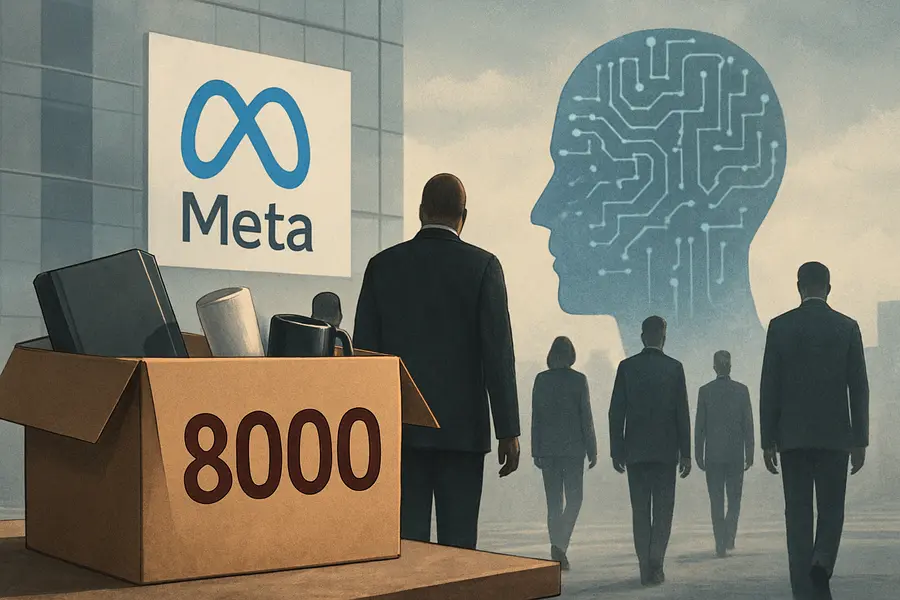
Meta Platforms cut 8,000 jobs on May 20, 2026 — 10% of its workforce — while redirecting 7,000 employees into AI as capital expenditure guidance climbed to $145 billion.
- Meta eliminated 8,000 positions on May 20, 2026 — its largest single-day reduction since the 2022–2023 "Year of Efficiency" campaign.
- The company cancelled 6,000 open requisitions and reassigned 7,000 employees into AI-focused teams, bringing total position impact to 21,000.
- Q1 2026 revenue reached $56.3 billion, up 33% year-over-year, even as full-year capex guidance climbed to $125–$145 billion.
Lead
Meta Platforms (NASDAQ: META) began notifying roughly 8,000 employees on May 20, 2026 that their roles had been eliminated — a 10% reduction of a workforce that stood at approximately 78,865 at year-end 2025. The company simultaneously cancelled 6,000 open requisitions and reassigned up to 7,000 surviving employees into newly created artificial-intelligence divisions, reorienting its entire human-capital strategy around a single declared priority: the race to general-purpose AI.What Happened
The meta layoff wave executed in a single day. Chief People Officer Janelle Gale confirmed the scope in an internal communication, detailing three new AI-focused organizational units: Applied AI Engineering, Agent Transformation Accelerator XFN, and Central Analytics. Affected employees are being reorganized into AI-focused "pods" operating under Meta Superintelligence Labs, a new division led by Alexandr Wang — the 28-year-old co-founder of Scale AI, for whose leadership Meta acquired a 50% stake in that company for $14.3 billion.
The meta layoffs follow approximately 1,500 cuts at Reality Labs in January 2026, bringing confirmed 2026 reductions to roughly 9,500 before planned second-half actions. When terminations, frozen requisitions, and internal reassignments are combined, the restructuring touches approximately 21,000 positions. Meta's post-cut workforce stands at an estimated 71,000 employees.
CEO Mark Zuckerberg framed the decision around competitive urgency, emphasizing to staff that in the AI race "success isn't a given" — and that lean, high-talent teams working alongside AI systems can accomplish what previously required entire departments.
Financial Context
The meta lay offs arrived against a backdrop of record performance. Meta reported first-quarter 2026 revenue of $56.3 billion, a 33% increase year-over-year and the company's largest quarterly revenue gain in five years. Non-GAAP earnings per share reached $7.31, exceeding analyst consensus.
Despite those results, the stock fell approximately 7% in extended trading after the Q1 earnings release and traded near $616, down from a pre-announcement level near $659, as investors processed a full-year capital expenditure forecast of $125 billion to $145 billion. That figure nearly doubles the $72.2 billion deployed in 2025 and is more than triple the $39.2 billion spent in 2024. Virtually all of the increase targets data centres, Nvidia GPUs, custom silicon, and infrastructure supporting the Llama model ecosystem and Meta's advertising recommendation engines.
Separately, six senior executives received stock option grants valued at up to $921 million each — a disclosure that drew scrutiny given the concurrent workforce reduction.
AI and Technology Angle
The metalayoffs reflect a structural reallocation rather than a cost-reduction exercise alone. Meta is exiting roles in middle management, support functions, and legacy product development while accelerating hiring in machine learning, infrastructure engineering, computer vision, and natural language processing — at base salaries ranging from approximately $62,000 for entry-level positions to more than $240,000 for senior AI research scientists.
Wang's Superintelligence Labs is the organizational centerpiece, consolidating Meta's most advanced AI research under a single command structure reporting directly to Zuckerberg. The company offered signing packages of up to $100 million to recruit senior researchers from competitors — an escalation in a talent competition that extends to Alphabet, Microsoft, and Amazon, all of which are simultaneously expanding AI headcount.
What Comes Next
Additional company-wide reductions are planned for the second half of 2026, with timing and scope unannounced. Total 2026 headcount actions could approach 20% of Meta's 2025 workforce. The restructuring is the most sweeping since Zuckerberg's 2022–2023 efficiency campaign, which eliminated approximately 21,000 positions and preceded the company's most profitable run in its history.
Outlook
Meta's 2026 strategy — eliminating legacy roles while concentrating capital and talent on AI infrastructure — represents the company's largest operational transformation since the shift to mobile advertising. The $125–$145 billion capex commitment and the formation of Superintelligence Labs signal that the restructuring is structural, not cyclical. Whether the infrastructure investment produces differentiated AI capabilities ahead of rivals, and before a potential slowdown in advertising revenue growth, remains the central variable shaping the company's trajectory through 2027.