Pomegra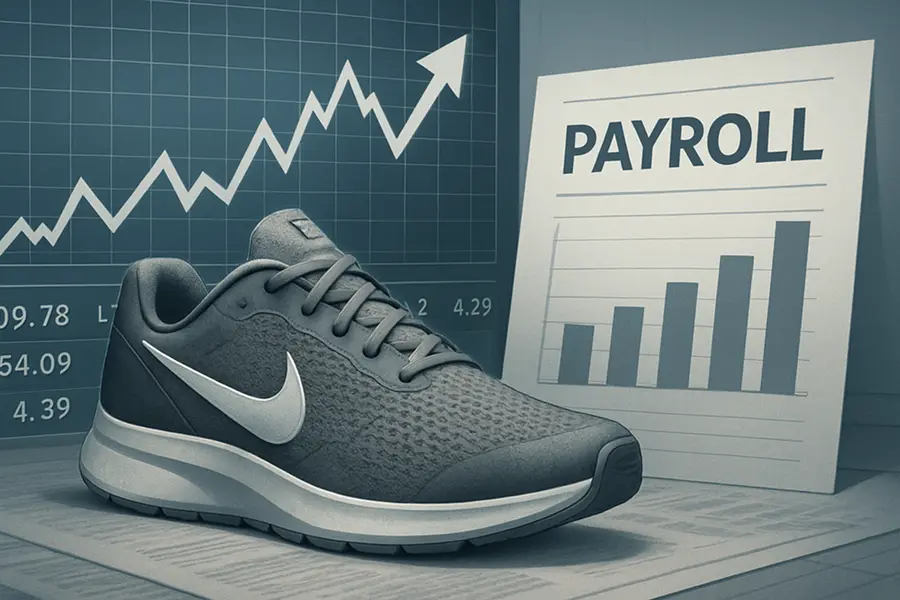
U.S. equities close the first half of 2026 with the S&P 500 up 9% year-to-date, as Nike's Q4 results and the June payrolls report emerge as the defining market catalysts shaping the second-half outlook.
- The S&P 500 gained roughly 9% in the stock market half-year 2026, crossing 7,600 for the first time in early June; the Nasdaq climbed approximately 16%.
- Nike reports Q4 fiscal 2026 results on June 30, with consensus calling for EPS of $0.12 on $10.85 billion in revenue, a roughly 2% year-over-year decline.
- The June payrolls report, due July 2, is forecast to show 110,000–115,000 jobs added, a step-down from May's 172,000 that will directly test Federal Reserve rate-hike expectations.
Lead
NEW YORK — U.S. equity markets reach the halfway point of 2026 with the S&P 500 roughly 9% ahead for the year, the Nasdaq up approximately 16%, and the Dow Jones Industrial Average advancing more than 7%. Two events bookending the holiday weekend — Nike's Q4 fiscal 2026 earnings after the close on June 30 and the Bureau of Labor Statistics' June employment situation report on July 2 — will frame early second-half positioning for institutional investors worldwide, making them the most closely watched market catalysts of the summer.
A Record-Setting First Half
The S&P 500 crossed 7,600 for the first time on June 2, extending a broad rally underpinned by exceptional corporate performance. Earnings-per-share across the index grew 27.9% on revenue growth of 11.7%. Approximately 85% of S&P 500 companies surpassed Wall Street estimates during the reporting season, well above the five-year average beat rate of 78%.
The Nasdaq Composite reached a high near 27,093 in early June before a four-session pullback — its longest losing streak since February — pulled the index modestly off its peak. Semiconductor names dominated the leadership table, with select memory chipmakers delivering year-to-date gains measured in multiples rather than percentages, reflecting surging demand for AI inference infrastructure.
The Dow Jones Industrial Average crossed 50,000 for the first time on February 6 and set a record close of 51,032.46 on May 29, underscoring broad participation beyond the mega-cap technology names that led in the opening months of the year.
The June Payrolls Catalyst
The June payrolls report, due at 8:30 a.m. ET on July 2, arrives as the first major piece of hard economic data for the second half. The May employment report showed 172,000 nonfarm jobs added — above consensus — with the unemployment rate holding at 4.3% for the fourth consecutive month. Upward revisions to March and April combined added a further 93,000 positions to the prior-period record.
For June, sell-side consensus clusters around 110,000–115,000 new positions, a meaningful deceleration reflecting slowing labor demand in interest-rate-sensitive sectors. Leisure and hospitality contributed 70,000 of May's headline gain; normalization in that category accounts for much of the projected step-down.
The stakes are elevated by the monetary policy backdrop. At its June meeting — the first under new chair Kevin Warsh — the Federal Reserve held rates unchanged while releasing a dot plot in which nine of eighteen participants penciled in at least one additional rate hike in 2026. Core PCE inflation remains above 3%. A June payrolls print significantly above 150,000 would strengthen the case for a 2026 hike; a reading near or below 100,000 would relieve that pressure and could extend the equity rally into Q3.
Nike Earnings: Turnaround Under Scrutiny
Nike enters its Q4 fiscal 2026 earnings print with shares down roughly 44% from their 52-week high, trading near $45. The consensus among analysts expects revenue of approximately $10.85 billion, a decline of about 2% year-over-year, consistent with management guidance of a 2%–4% top-line contraction for the quarter. Earnings per share are forecast at $0.12, down from $0.14 in the year-earlier period. Operating income is projected to fall approximately 21%, reflecting elevated marketing investment and restructuring charges.Management has flagged a particularly steep decline — approximately 20% — in Greater China revenues, attributed to a deliberate marketplace cleanup and reduced channel sell-in. Full-year fiscal 2026 EPS consensus stands at $1.49, a 31% decline from the $2.16 reported in fiscal 2025. Analysts project a partial recovery to roughly $1.85 in fiscal 2027 as restructuring benefits accrue and tariff headwinds moderate.
Chief executive Elliott Hill, who returned from retirement to lead the "Win Now" turnaround strategy, acknowledged recently that full results from the restructuring will not be visible until early calendar 2027. Hill backed his conviction with personal capital, purchasing approximately $2 million in company shares in April and an additional $1 million in subsequent weeks at an average of $42.27 per share.
For investors, the headline EPS figure matters less than forward commentary on three pressure points: whether new product launches are gaining traction with younger consumers, whether North American wholesale relationships are stabilizing, and whether Greater China's sell-in normalization is nearing completion. Clarity on any one of those dimensions could catalyze a relief rally after the extended drawdown.
Market Catalysts: A Compressed Window
The conjunction of Nike earnings and the June payrolls report within 72 hours typifies the pattern visible across the stock market half-year 2026 landscape: corporate and macro catalysts compressing into narrow windows that amplify volatility. Options markets have priced meaningful implied moves in NKE shares around the print, while Treasury futures have flagged elevated sensitivity to the Friday employment release.
Beyond the immediate data points, the second half will be shaped by the Fed's response function to incoming inflation and employment data, the trajectory of corporate capital expenditure tied to AI infrastructure, and the durability of consumer spending as pandemic-era savings buffers continue to erode.
Outlook
The stock market half-year 2026 closes with U.S. equities in firmly positive territory, driven by exceptional earnings execution and semiconductor-sector momentum. The path into the second half narrows to two near-term variables: whether Nike earnings provide evidence that one of the world's largest athletic brands is stabilizing after a prolonged restructuring, and whether June payrolls confirm that labor market cooling is proceeding at a pace that keeps the Federal Reserve on hold without triggering growth fears. Both prints arrive before the July 4 holiday weekend, concentrating a significant volume of market-moving information into a compressed window that will define positioning for July and set the directional tone for the remainder of 2026.
Mentioned tickers: NKE, ^GSPC, ^IXIC, ^DJI