Pomegra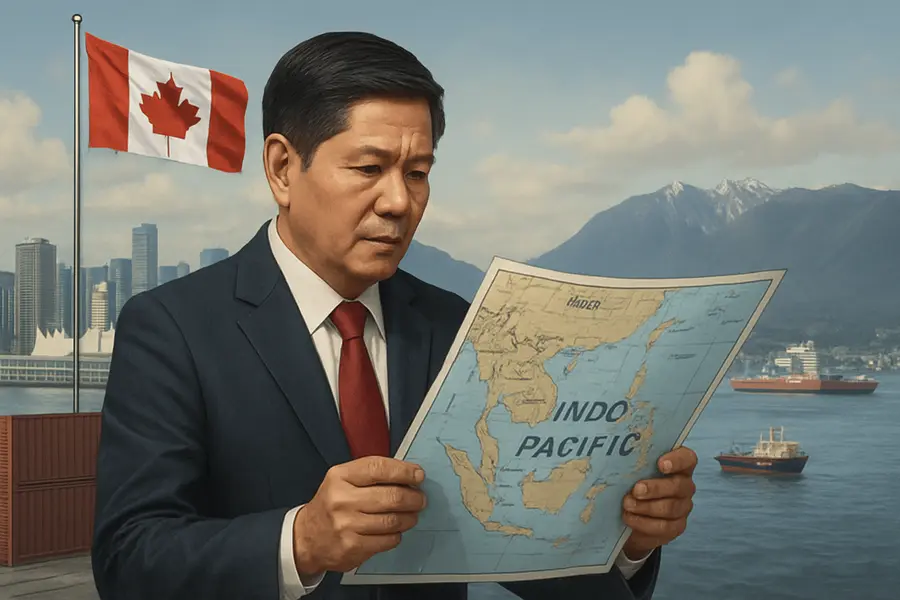
Philippine President Marcos arrives in Vancouver for his first state visit to Canada in 11 years, signing energy, trade, and defense accords with PM Mark Carney.
- Canada-Philippines bilateral merchandise trade reached $3.4 billion in 2025, up 7.4%, with both leaders targeting a bilateral FTA conclusion in 2026.
- Agreements signed span energy supply, critical minerals, labor mobility, and tourism — the broadest bilateral package since the early 2010s.
- Canada's 2025 Status of Visiting Forces Agreement with the Philippines — Ottawa's first with any Indo-Pacific country — underpins formal defense and maritime cooperation.
Lead
President Ferdinand Marcos Jr. arrived in Vancouver on July 1, 2026, for a four-day official visit — the first by a Philippine head of state to Canada in 11 years — meeting Prime Minister Mark Carney to witness the signing of bilateral accords spanning energy and natural resources, trade and investment, labor and immigration, and tourism, culture, and arts. The visit unfolds as Manila holds the 2026 ASEAN chairmanship and as both governments pursue a structured Indo-Pacific security partnership against a backdrop of South China Sea friction and supply-chain pressure created by ongoing Middle East energy disruptions.
What Happened
Marcos and Carney held a one-on-one bilateral meeting in Vancouver followed by an expanded session with both delegations. The two leaders affirmed a shared goal of concluding a standalone Philippines-Canada Free Trade Agreement in 2026, a negotiation running in parallel with the broader ASEAN-Canada Free Trade Agreement. Canada and ASEAN elevated their relationship to a Strategic Partnership in September 2023; a bilateral deal with Manila would deepen that framework and give Canadian exporters preferential access to a market of 115 million people.
The Manila Bulletin and The Manila Times reported ahead of the visit that energy supply would feature centrally on the agenda. The Philippines' ambassador to Canada flagged LNG and oil discussions as priorities, describing Manila as "very active" in diversifying its energy sources following disruptions to traditional supply lines linked to the Middle East conflict. Vancouver, as one of Canada's principal Pacific gateways, provided a fitting backdrop for negotiations with direct maritime and supply-chain significance.
Trade and Investment Agenda
Canada-Philippines bilateral merchandise trade totaled $3.4 billion in 2025, a 7.4 percent increase from $3.2 billion the prior year. Canadian merchandise exports to the Philippines accounted for $1.1 billion of that figure; Philippine exports — dominated by electronics, garments, and processed foods — reached $2.3 billion. Bilateral services trade added an estimated $2.6 billion in 2023, the most recent year for which comprehensive data are available.Marcos convened meetings with Canadian business leaders in Vancouver, pitching opportunities in critical minerals, nuclear energy, mining, telecommunications, IT and business process management, cybersecurity, and financial services. The Philippines holds substantial reserves of nickel and copper — inputs essential to electric-vehicle batteries and clean-energy infrastructure — and has been actively soliciting investment from mineral-importing countries seeking to reduce single-source supply dependencies.
Canada, which elevated critical minerals to a national strategic priority in its own domestic strategy, is a natural partner. A critical minerals MOU between the two governments was signed earlier in 2026. A Track 1.5 Canada-Philippines Dialogue on Economic Security convened in Manila in March 2026 had laid groundwork across digital technology, energy, and maritime security, effectively prefiguring the Vancouver agreements.
Security and Defense Dimension
Indo-Pacific security cooperation between the two countries has accelerated markedly over three years. Canada and the Philippines signed a Defence Co-operation Memorandum of Understanding in 2024. In 2025, they concluded a Status of Visiting Forces Agreement — Canada's first SOVFA with any Indo-Pacific nation — establishing the legal framework for each country's armed forces to train and operate on the other's territory. That agreement carries operational weight: it enables joint naval exercises in and around the South China Sea, a body of water the Philippines regards as central to its sovereignty and economic rights under a 2016 international arbitral ruling that China rejects.Philippine Defence Secretary Gilberto Teodoro had already visited Ottawa, where the two sides signed a Mutual Logistics Support Arrangement and agreed on a roadmap for closer cooperation in maritime security, joint exercises, and defense-industry development. Together, these instruments constitute the most extensive bilateral defense architecture Canada has assembled in the region.
Marcos is also using the Vancouver platform to advance Philippines diplomacy priorities as this year's ASEAN Chair, which include energy and food security, maritime cooperation, and the protection of ASEAN nationals abroad — a portfolio that maps closely onto Canada's own stated Indo-Pacific objectives.
Strategic Context
The visit exemplifies a deliberate recalibration by Ottawa toward Indo-Pacific middle powers. Prime Minister Carney has framed this engagement as middle-power diplomacy: building durable bilateral partnerships that in aggregate reduce strategic dependency and expand commercial reach for Canadian firms beyond traditional North Atlantic markets. The Philippines is a particularly useful node — a treaty ally of the United States with significant maritime exposure in the South China Sea, a large and skilled overseas labor force, and growing leverage in the critical-minerals supply chains that Canada, Japan, Australia, and the United States are collectively trying to restructure.
For Manila, the Philippines Canada trade and security relationship serves a parallel diversification logic. Caught between its largest economic partner China and its security treaty ally the United States, the Philippines has strong incentives to widen its diplomatic and commercial circle with partners — such as Canada — that bring deep mining expertise, clean-technology capability, and no competing territorial agenda in the South China Sea.
Outlook
The Vancouver visit marks a structural turning point in a bilateral relationship that has historically underperformed its economic and strategic potential. The convergence of FTA negotiations, energy-supply urgency, formalized defense cooperation, and critical-minerals alignment gives the partnership durable commercial and security logic that extends well beyond the four-day visit. Whether the bilateral free-trade agreement can be concluded within 2026 will depend on the pace of legal text negotiations on both sides, but the institutional depth accumulated since 2024 — the Defence MOU, the SOVFA, the Logistics Arrangement, and now the Vancouver package — suggests the Marcos Vancouver meeting has set in motion commitments that will outlast the current political calendar in both capitals.
Mentioned tickers: None