 Pomegra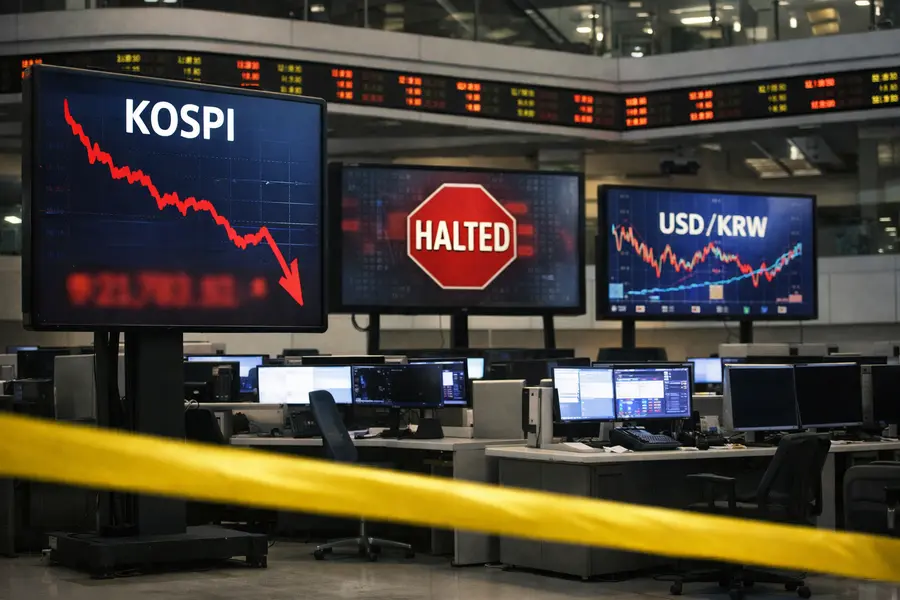
South Korea's benchmark index triggered back-to-back circuit breakers for the first time in history as a China chip-tool shock and record earnings disappointment wiped ₩250 trillion from Seoul's markets.
- KOSPI fell below 6,000, with the seoul exchange halted for 20 minutes on both July 28 and July 29 for the first time ever.
- SK Hynix shed as much as 14.7% in a single session; Samsung Electronics dropped up to 13%, sending the kospi board red across all major components.
- China's announcement of mass-produced homegrown DUV chipmaking tools ignited fears of a structural disruption to South Korean semiconductor dominance.
Lead
Seoul, July 29, 2026 — South Korea's KOSPI plunged more than 8% on Tuesday, triggering an exchange-wide circuit breaker for the second consecutive session in an unprecedented back-to-back halt, as panic selling in SK Hynix (000660.KS) and Samsung Electronics (005930.KS) deepened a rout that has now erased approximately ₩250 trillion in market capitalization in a single month. The Korea Exchange (KRX) suspended trading for 20 minutes as the benchmark index dropped below 6,000, its weakest level in more than a year.
What Happened
The immediate catalyst was a report, published late July 28, that China has begun mass production of domestically developed deep ultraviolet (DUV) chipmaking tools — equipment previously sourced almost exclusively from Dutch firm ASML and Japanese suppliers operating under Western export-control frameworks. The prospect of China achieving production-scale semiconductor lithography without foreign inputs sent a direct threat signal to the Korean memory industry, which depends on perpetual technology-cycle leadership to defend margin and market share.
The selloff accelerated after SK Hynix — the world's second-largest DRAM maker — reported record second-quarter revenue of ₩79.32 trillion and operating profit of ₩60.54 trillion, figures that nonetheless fell short of elevated analyst forecasts. Markets interpreted the guidance-miss as evidence that the AI-driven memory supercycle may be approaching a cyclical ceiling, even as infrastructure spending from hyperscalers remains robust. SK Hynix shares fell 14.7% on July 28 and extended losses on July 29, bringing the stock's cumulative July decline to more than 30% from its 2026 high. Samsung Electronics fell 13% in the worst sessions of the two-day rout, with Tuesday's session alone contributing a further 5% decline.
Market Reaction
The kospi board red condition spread beyond semiconductors. With the benchmark slipping past the 8% circuit-breaker threshold, the KRX halted all trading at 10:13 a.m. local time — the second such suspension in as many sessions, an event with no precedent in Korean market history. The KOSDAQ, which houses smaller technology and biotech names, triggered its own circuit breaker concurrently.
Foreign institutional investors accelerated net selling that has been running since early July, when South Korea was passed over for inclusion on MSCI's Developed Markets watchlist — a decision that removed a structural bid that portfolio managers had priced in for months. Leveraged equity ETFs tied to semiconductor sector indices amplified intraday moves, with forced liquidations at key technical levels compounding the directional pressure.
The Korean won weakened past the ₩1,400 per dollar mark, reflecting both capital outflows and elevated crude oil import costs linked to U.S.–Israeli military strikes on Iranian infrastructure, which have pushed energy prices sharply higher. South Korea imports virtually all of its petroleum, making energy-price shocks a secondary but meaningful drag on corporate earnings across the economy.
Strategic Context
The DUV tool announcement represents the most significant development in China's decade-long campaign to localize its semiconductor supply chain. Prior Western export controls had effectively denied Chinese chipmakers access to cutting-edge extreme ultraviolet (EUV) lithography, but DUV equipment — used in legacy-node and mature-process manufacturing — remained a vulnerable gap in the control architecture. If Chinese-made DUV tools achieve competitive yield rates at scale, the cost structure for commodity DRAM and NAND production shifts materially in Beijing's favor.
For SK Hynix and Samsung, the immediate business risk is margin compression in lower-end memory segments, where Chinese competitors such as CXMT and YMTC have been steadily closing the technology gap. Both Korean firms have hedged by pivoting toward high-bandwidth memory (HBM) products that power AI accelerators — a segment where China's domestic capabilities remain limited — but that pivot now faces fresh scrutiny about its long-term defensibility.
Samsung Electronics (005930.KS) carries additional exposure through its foundry and consumer electronics divisions, making its selloff disproportionate relative to pure-play memory peers. The stock had already been under pressure following a disappointing foundry yield report in the second quarter.Geopolitical Dimension
The dual shocks — Chinese chip-tool autonomy and elevated oil prices driven by Middle East conflict — illustrate the compound geopolitical risk now embedded in Korean equity valuations. South Korea sits at the intersection of three structural tensions: U.S.–China technology decoupling (which alternately benefits and constrains its chip exports), Middle East energy dynamics (which directly affect its import bill), and the unresolved North Korean security overhang that systematically depresses the "Korea discount" in global portfolio allocation.
The absence of an MSCI Developed Markets upgrade removes a near-term re-rating catalyst that had been widely anticipated as a valuation floor. With that floor gone and macro headwinds intensifying, international investors have had limited reason to hold through the volatility.
Outlook
The back-to-back circuit-breaker events mark a structural inflection point for Korean equities, not merely a bout of technical volatility. The KOSPI has shed roughly 23% in July alone — a monthly decline without modern precedent for the index. Near-term stabilization will likely require either a credible rebuttal of China's DUV tool capabilities, a policy response from the Bank of Korea, or a sharp reversal in oil prices.
The Korean government has convened an emergency financial stability meeting, and the KRX is reviewing whether additional market stabilization mechanisms are warranted. Until the competitive implications of Chinese chipmaking self-sufficiency are more precisely quantified, semiconductor-led pressure on the seoul exchange halted narrative is unlikely to fully resolve. Investors will watch SK Hynix's next earnings call and any official Korean government response to the DUV disclosure for the first signals of a floor.
Mentioned tickers: 000660.KS, 005930.KS, 035420.KS


