Pomegra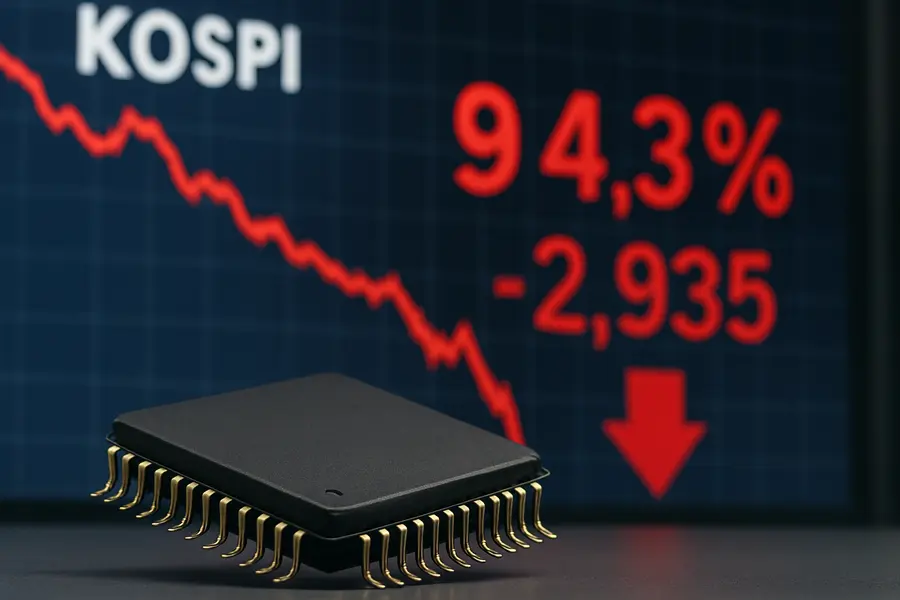
South Korea's benchmark Kospi index plunged nearly 9 percent on Friday, triggering the country's second circuit-breaker suspension this week as a fresh wave of chip selling erased billions in market value.
- The Kospi triggered a 20-minute trading halt on June 26 — its fifth circuit-breaker activation this year — after falling more than 8% intraday.
- Samsung Electronics and SK Hynix each fell more than 10% at session lows, accelerating the South Korea chip crash.
- Foreign investors offloaded a net 4.7 trillion won ($3.1 billion) in a single session, extending a weeks-long exodus.
Lead
Seoul, June 26, 2026 — The Korea Exchange suspended trading in the Kospi for 20 minutes beginning at 12:10 p.m. local time on Friday after the benchmark index plunged more than 8 percent below its previous close — the trigger threshold for the exchange's circuit-breaker mechanism. The Kospi stood at 8,198.33 when the halt was activated, down 731.97 points, or 8.19 percent. By early afternoon it had partially recovered to 8,282.85, still off 7.3 percent, before Bloomberg later confirmed the day's Kospi 9 percent drop as the index extended losses into the close. The junior Kosdaq fell 4.4 percent to 849.01.
What Happened
The Korean market selloff was the second circuit-breaker event of the week, following a similarly violent session three trading days earlier in which the Kospi lost 9.99 percent — its fifth-largest single-day decline on record. Friday's halt marked the eleventh circuit-breaker in the exchange's history.
Samsung Electronics and SK Hynix — which together represent roughly 48 percent of the Kospi's total market capitalization and contributed approximately 70 percent of its 2026 gains — fell more than 10 percent each at intraday lows. The outsized concentration of two chipmakers in a single national index transformed what would have been a sector pullback into a market-wide crisis.Drivers of the Selloff
The South Korea chip crash traces directly to a guidance miss by Broadcom Inc., which in its most recent quarterly report projected third-quarter AI chip revenue of $16 billion — well below analyst estimates of $17.2 billion — and left its fiscal-year 2027 revenue outlook at $100 billion unchanged. That disappointment ignited doubts about the sustainability of AI-driven semiconductor demand globally and hit Korea's chip-heavy market disproportionately.
Three compounding forces amplified the move. First, MSCI declined to add South Korea to its Developed Markets watchlist in its annual review, removing the passive-inflow catalyst that had drawn foreign capital into the Kospi throughout 2026. Second, a record 37.74 trillion won in retail margin debt — built up as domestic investors chased the AI-related chip rally — created a forced-liquidation dynamic as prices fell. Third, foreign institutional outflows accelerated: overseas investors have now sold a net $62 billion equivalent of Korean equities in recent months, with Friday's 4.7 trillion won in net selling among the largest single-session figures on record. Domestic institutions sold an additional net 698.8 billion won.
Market Reaction
Trading halt news drew immediate attention from global risk desks. The broader Asian technology complex weakened in sympathy, with the Nikkei shedding 4.2 percent and world shares broadly retreating. Concerns about overinvestment among U.S. mega-cap technology companies — already a theme following the Federal Reserve's hawkish June 17 policy meeting — reinforced selling pressure on Korean shares, which act as a high-beta proxy for global AI capital expenditure cycles.
Strategic Context
The episode underscores the structural vulnerability of an economy in which two companies effectively function as a sovereign risk barometer. South Korea's export-dependent model, with DRAM and NAND flash memory constituting the country's single largest export category, means that any repricing of AI infrastructure spend transmits directly and amplified into domestic equity markets. The MSCI non-inclusion decision compounds the problem: without the passive-flow anchor that developed-market classification would have provided, the Kospi remains exposed to discretionary foreign positioning — which has proven fickle in 2026.
Regulators had already flagged concerns about recently approved leveraged single-stock ETFs tied to Samsung and SK Hynix, which critics say added a further reflexive layer to the selloff dynamics.
Outlook
The Kospi's back-to-back circuit-breaker week signals that the AI chip trade — the dominant engine of the index's 2026 rally — has entered a phase of sharp sentiment recalibration. Near-term stabilization will depend on whether U.S. big-tech capex guidance improves and whether foreign outflows abate. The overhang of record retail margin debt means a sustained recovery requires orderly deleveraging rather than a sharp rebound that could reignite speculative buying. Policymakers and the Korea Exchange face growing pressure to reassess circuit-breaker thresholds and the regulatory framework around leveraged chip ETFs as the Korean market selloff narrative draws sustained international scrutiny.
Mentioned tickers: 005930 KS, 000660 KS, AVGO