Pomegra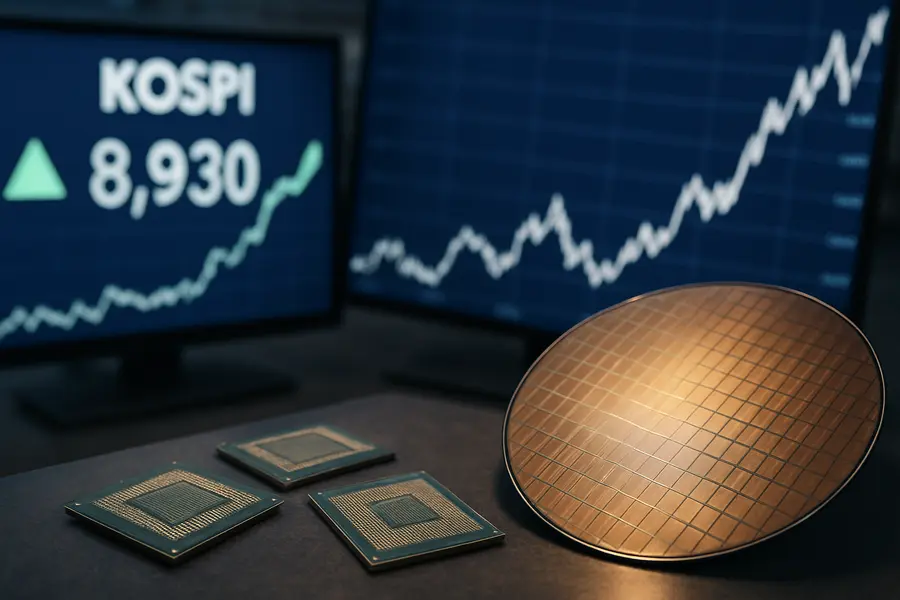
South Korea's Kospi surged 5.4% to 8,930.30 on June 25, 2026, as Samsung Electronics and SK Hynix led a chipmaker rebound triggered by Micron Technology's record quarterly earnings.
- The Kospi closed at 8,930.30 on June 25, gaining 459.28 points (+5.42%), two days after the index's largest single-day point decline on record.
- Micron Technology reported Q3 FY2026 revenue of $41.5 billion — up 345% year-on-year — easing fears of a slowdown in AI-driven memory demand.
- Samsung Electronics and SK Hynix, which together account for roughly 48% of Korea's benchmark market capitalisation, led Wednesday's advance.
Lead
Seoul, June 25, 2026 — South Korea's Kospi closed at 8,930.30, advancing 459.28 points or 5.42%, on Wednesday as an aggressive rebound in semiconductor shares erased a significant portion of Monday's historic 9.99% collapse. The catalyst was straightforward: Micron Technology delivered a record quarterly revenue print after Tuesday's close, signalling that artificial-intelligence infrastructure spending had not paused, and sending the world's most chip-concentrated major equity index sharply higher.
What Happened
The session opened with decisive institutional buying across the technology board. Samsung Electronics and SK Hynix — which together drove roughly 70% of the Kospi's 2026 year-to-date gains — climbed in tandem, with institutional players absorbing the foreign selling pressure that had defined the prior two sessions.
Wednesday's close of 8,930 represents a recovery of roughly 726 points from the June 23 trough of 8,203.84, though the index remains below the intraday highs of 9,114 reached on June 22, when SK Hynix briefly overtook Samsung in market capitalisation for the first time in over 25 years.
Volume was elevated throughout the session. Institutional net buying in Korean equities, which had been negative during Monday's rout when foreign investors offloaded an estimated 5.79 trillion won (approximately $3.8 billion) of shares, flipped sharply positive.
The Micron Catalyst
The immediate trigger for Wednesday's rally originated in the United States. Micron reported third-quarter fiscal 2026 revenue of $41.5 billion, a 345% year-on-year increase, with gross profit margins reaching approximately 85% — a level that underscored how AI-linked data-centre demand for high-bandwidth memory has transformed the economics of the chip industry.
Because Samsung Electronics and SK Hynix are Micron's direct competitors in DRAM and high-bandwidth memory, the results served as a proxy read-through for Korean chipmakers' own order books. The earnings effectively invalidated the demand-deceleration thesis that had driven Monday's sell-off.
The June 23 Context
Monday's crash — a 9.99% decline to 8,203.84 that triggered a market-wide circuit breaker and halted trading for 20 minutes — was the Kospi's steepest single-session point fall on record. Samsung shed approximately 12.3% and SK Hynix approximately 12.5% as foreign sellers moved en masse. The episode exposed the concentration risk embedded in the Korean benchmark: two companies representing nearly half the index's capitalisation meant that any rotation out of semiconductor names carried outsized systemic weight.
Tuesday's partial recovery had been tentative. Samsung surged more than 7% on reports of a substantial share buyback programme worth close to 90 trillion won, but those gains faded intraday as the broader market remained cautious. Wednesday's Micron earnings provided the firmer fundamental footing the market needed.
Strategic Context
The Kospi has been 2026's standout global equity story. From January to its June 22 peak, the index approximately doubled — a pace that surpassed even Korea's late-1980s industrial boom and its pre-dotcom run-up. The engine has been a single thesis: that AI infrastructure demand would create a sustained supercycle for advanced memory chips, particularly high-bandwidth memory used in AI accelerators.
SK Hynix's emergence as Korea's largest listed company by market capitalisation — a milestone that stood briefly on June 22 before the correction — encapsulates that shift. SK Hynix has captured the dominant share of high-bandwidth memory supply for leading AI accelerator programmes, a position that re-rates its earnings multiple relative to Samsung, which retains broader but more cyclically exposed product lines.
The concentration of Korea's benchmark in two names does, however, leave the index unusually sensitive to any revision in the AI capex narrative. Monday's correction illustrated how quickly sentiment can transmit global technology-sector anxiety directly into the Kospi's headline number.
Market Reaction
The Korean won strengthened modestly against the dollar during the session, recovering from the pressure exerted by foreign capital outflows earlier in the week. The iShares MSCI South Korea ETF also moved higher in after-hours trading in New York on Tuesday following the Micron report, telegraphing Wednesday's Seoul open.
Broader regional markets tracked the move positively, though Korea remained the standout performer in Asia. The Kosdaq composite, home to smaller technology and biotech names, also recovered ground.
What Comes Next
Attention now shifts to Samsung's and SK Hynix's own second-quarter earnings, where investors will look to confirm whether Micron's margin expansion is replicated across the industry. Any guidance on high-bandwidth memory capacity additions and customer commitments for 2026 through 2027 will be closely scrutinised.
The circuit-breaker event of June 23 has also prompted market structure discussions among Korean financial regulators, with questions raised about the adequacy of existing volatility safeguards for a benchmark that has become this concentrated.
The broader trajectory — a Kospi that has roughly doubled in six months on the back of one of the most aggressive AI-driven capex cycles in the history of the semiconductor industry — remains intact. But Monday's session established that the index is capable of sharp, violent mean reversions when the demand narrative is questioned.
Outlook
Korea's Kospi has reclaimed the 8,900 level on the back of a Micron earnings catalyst that restored confidence in AI memory demand. The structural story — high-bandwidth memory as the indispensable substrate for AI infrastructure — is unchanged, but the index's extreme concentration in Samsung Electronics and SK Hynix means that volatility remains a defining feature rather than an anomaly. Upcoming domestic earnings will determine whether the path to 9,000 and beyond resumes on a more durable footing.
Mentioned tickers: 005930.KS, 000660.KS, MU, EWY