Pomegra
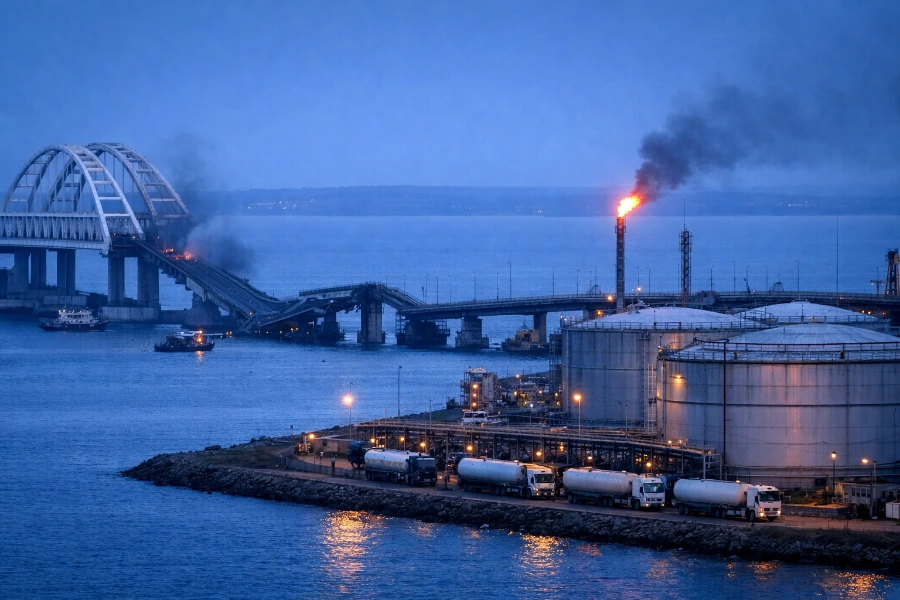
Ukraine's strikes collapsed a road span of the Kerch Strait bridge to Crimea and hit Russian oil sites, deepening fuel shortages across Russian regions.
- The central road arch of the 19 km Kerch Strait bridge fell into the sea after strikes on Nov. 16 and 17; rail traffic has partly resumed.
- Russia reports fuel shortages in at least six regions as Ukraine's refinery campaign cuts refining capacity by about 30%.
- Brent crude rose 1.14% to $93.49 a barrel; WTI gained 0.30% to $84.66.
Lead
Ukraine struck the Kerch Strait bridge for a second consecutive day on Nov. 17, collapsing the main arch of the road span and halting vehicle traffic between Russia and occupied Crimea. The Ukrainian Security Service (SBU) said its special forces used Palianytsia drones against the roadway and described a month-long operation conducted in seven stages. The railway section also took damage, though rail service across the bridge resumed later the same day.
The strikes coincided with attacks on Russian oil infrastructure. These included the Ilsky refinery and the Flash Energy oil depot on Nov. 15-16, and a refinery and petrochemical complex at Salavat in Bashkortostan. Russian officials and media report fuel shortages in at least six regions.
What Happened to the Kerch Strait Bridge?
The central road arch and the roadway beneath it fell into the strait, leaving a gap that vehicles cannot cross. Crimea's Russian-installed governor confirmed that road traffic was suspended. Two people were killed in the attack.
The railway span sustained damage to its arch but remained standing. Service between Crimea and Taman partly resumed on Nov. 17. The Kremlin said repair plans would be prepared and that the bridge would be rebuilt "even better than before."
Ukraine used a mix of domestically produced drones and missiles, including Neptune and FP-5 Flamingo systems. The attack came as Russia reported shooting down a record 1,441 Ukrainian drones across 22 regions, up from the previous day's record of 1,336. Around 800 of the drones targeted the Moscow region.
Why Does the Bridge Matter for Russia's War Effort?
The bridge is the main artery carrying fuel, ammunition, equipment and personnel to Crimea and onward to southern Ukraine. It opened in 2018 and has been hit before, most notably in October 2022 and again in later attacks. This week's damage to the road span is more severe than in earlier strikes.
Alternatives exist but are slower and more exposed. Ferries across the strait depend on the weather. Overland routes run through the land corridor along the Sea of Azov, which is already within range of Ukrainian fire. Crimea was already under strain: Russian-installed authorities declared a state of emergency over the summer because of power outages and fuel shortages on the peninsula.
How Deep Are Russia's Fuel Shortages?
Shortages now cover at least six regions: Buryatia, Zabaykalsky Krai, Nizhny Novgorod, Arkhangelsk, Penza and Krasnoyarsk. Filling stations have imposed purchase limits and some regions have banned fuel sales in containers. Karelia capped purchases at 30 litres of gasoline and 50 litres of diesel per customer. The queues are not as long as those seen at filling stations during the summer.
The pressure builds on a campaign Ukraine intensified after Oct. 30, when an energy truce announced by U.S. President Donald Trump failed to take effect. Eight major refineries were hit in roughly two weeks. Ukraine's president says more than half of Russian refining capacity has been knocked out. Industry estimates are lower, putting the reduction at about 30%. Even at the lower figure, the loss is large enough to strain domestic supply during the autumn harvest and the start of winter heating demand.
What Does This Mean for the Crude Oil Price?
The crude oil price moved modestly higher on Nov. 17, with Brent up 1.14% at $93.49 and WTI up 0.30% at $84.66. The reaction was contained because the refinery strikes reduce Russia's demand for crude and its output of refined products, rather than its crude production. Damaged refineries can leave more crude available for export, but only if ports and pipelines keep functioning. Diesel and gasoline are the more exposed markets, since Russia is a large exporter of refined products.
The bridge attack carries little direct commodity weight. Its significance is military and logistical, and it adds to a risk premium that rises with each strike on energy assets. Traders will watch whether Ukraine's strikes move from refineries to export terminals and Black Sea shipping routes, which would affect crude flows directly.
Geopolitical Dimension
The attacks show a shift in Ukraine's approach toward targeting the economic and logistical systems that sustain Russian forces, rather than front-line positions alone. Russia has responded in kind. It struck the North and South bridges in Kyiv in the same period, partly damaging metro infrastructure and causing localized power and water outages.
Both sides are now attacking bridges and energy networks at scale. The failed energy truce removed a diplomatic channel that might have limited strikes on energy assets, and no replacement has emerged. Russian officials have so far offered repair timelines rather than concessions.
What Comes Next?
In the next three to six months, the main questions are how quickly Russia can restore road traffic across the strait and whether it can reroute fuel to Crimea without the bridge. Rebuilding a collapsed arch under continued drone threat will be difficult. Temporary measures such as ferries and expanded rail use are the likely stopgaps, and each one is a target.
On fuel, domestic shortages should persist while refinery repairs lag the pace of new strikes. Government measures such as export curbs and purchase limits typically follow. A longer campaign would also pressure Russian budget revenue, since refined products make up a significant share of energy exports.
Outlook
Ukraine's two-day assault has cut the road link to Crimea and added to a refinery campaign that has left Russian regions short of fuel. Oil prices have so far absorbed the news with small gains. The structural effects are greater: tighter military logistics for Russia in the south, a heavier domestic fuel burden, and a conflict in which both sides target infrastructure. The pace of repairs and the next round of strikes will determine how long the disruption lasts.
Mentioned tickers: None