Pomegra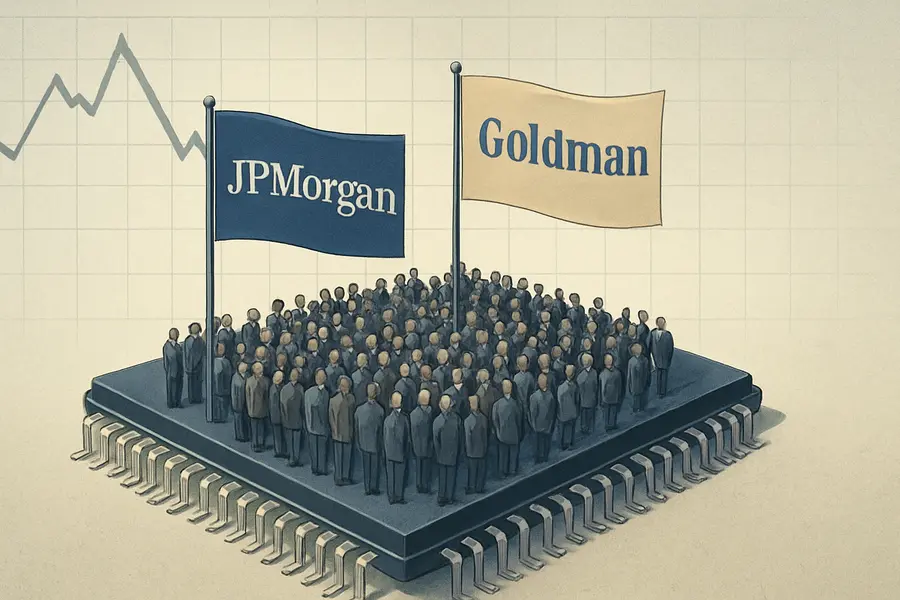
JPMorgan and Goldman Sachs warn the AI trade has reached a five-year positioning extreme as $770 billion in 2026 capex far outstrips revenues.
- Goldman Sachs reports AI momentum positioning hit the 100th percentile relative to the past five years — the ceiling of its recorded dataset.
- Hyperscalers are on track to spend $770 billion on AI capex in 2026, equivalent to 100% of their combined operating cash flows.
- JPMorgan flagged a flash-crash risk from crowded speculative-growth momentum trades as the Nasdaq-100 fell 4.8% in a single session in late June.
Lead
Two of Wall Street's most closely followed research desks issued concurrent warnings this month on the concentration of AI-related market exposure. JPMorgan flagged an acute flash-crash risk from overcrowded momentum positions, while Goldman Sachs identified the AI-fueled equity rally as the most crowded trade in five years. The concerns crystallized on June 23, 2026, when the Nasdaq-100 dropped 4.8% in a single session, a momentum-factor ETF shed 6%, and South Korea's KOSPI triggered a circuit breaker as $2.5 billion in foreign capital exited the market in one day.
What Happened
Goldman Sachs strategists flagged that momentum positioning in AI-linked equities had reached the 100th percentile relative to the prior five years — the absolute ceiling of the firm's recorded dataset. The finding encapsulates a market where long momentum bets stand at record highs and corresponding short positions remain subdued, producing a severely imbalanced long-short structure that amplifies downside risk disproportionately.
The JPMorgan AI warning echoed the concern in near-identical terms, describing the current setup as one where crowded momentum positioning — particularly in low-quality and speculative-growth segments — carries a high probability of a flash crash. Despite raising its year-end S&P 500 target to 7,800 from 7,600 on strong earnings estimates, JPMorgan downgraded its near-term outlook to cautious, citing sustained selling pressure in technology stocks.
The warnings arrived alongside fresh data on quantitative fund positioning. Commodity Trading Advisors (CTAs) and volatility-targeting strategies had lifted their equity allocations to the highest levels since February 2026. These strategies are highly sensitive to price moves; any sustained decline triggers mechanical, forced selling that can rapidly amplify drawdowns beyond what fundamental valuation would justify.
The Capex-Revenue Gap
The overcrowded trades 2026 environment is inseparable from a broader structural tension: the gap between what the AI industry is spending and what it is earning. The four largest hyperscalers — Amazon (AMZN), Microsoft (MSFT), Alphabet (GOOGL), and Meta Platforms (META) — are each projected to exceed $100 billion in capital expenditure in 2026, with Meta alone targeting $115–135 billion, nearly double its 2025 outlay.
Aggregate capex across AI hyperscalers is expected to reach $770 billion in 2026, equal to 100% of their combined operating cash flows. Against that backdrop, estimates of total AI industry revenue stand at roughly $50–60 billion annually, implying the sector is investing $8–10 for every $1 of current revenue generated. The Goldman Sachs Global Institute projects $7.6 trillion in cumulative AI capital expenditure between 2026 and 2031, with annual spending expected to more than double from $765 billion in 2026 to $1.6 trillion by 2031.
JPMorgan's credit desk separately estimated that the broader AI data-center build-out will require $1.5 trillion in investment-grade bonds over the next five years. AI-linked debt already represents approximately 15% of the entire corporate bond universe — a share with no historical precedent in the sector.
Market Reaction
The June 23 selloff underscored how quickly crowded positioning can unravel. The Nasdaq fell 2.2% that session, while the Philadelphia Semiconductor Index dropped 8%. The broader Nasdaq was tracking its worst weekly loss in more than a year as of late June 2026, with the S&P 500 recording a fifth consecutive daily decline.
Goldman Sachs strategists noted that CTA marginal buying is drying up, that pension fund rebalancing at month-end will add selling pressure, and that hedge fund deleveraging is already underway. The confluence suggests the initial selloff was unlikely to be a singular event. Barclays issued a parallel warning, with both firms noting that a cooling of the AI narrative or a further rise in realized volatility could trigger a chain reaction in systematically managed portfolios, accelerating selling beyond what fundamentals alone would warrant.
The Concentration Problem
Goldman Sachs described the equity market as effectively "one big trade" — a condition in which AI and momentum move in lockstep to drive the direction of the S&P 500, concentrating systemic risk in a narrow set of names. The firm's basket of AI infrastructure companies returned 44% year-to-date through mid-2026, against just a 9% rise in consensus two-year forward earnings-per-share for the same group.
The AI investment risk is amplified further by winner concentration: nearly all the capital flowing into the AI ecosystem has accrued to Nvidia (NVDA) as the dominant supplier of AI accelerators, while companies deploying AI at the application layer have captured little of those economics. Excluding AI infrastructure and energy companies, S&P 500 2027 EPS estimates have been flat year-to-date, indicating the earnings uplift from AI investment remains narrowly distributed and heavily reliant on continued capex expansion.
What Comes Next
The JPMorgan AI warning scenario envisions a non-linear path higher for markets, with near-term risk concentrated in the lead-up to second-quarter earnings. If hyperscaler results fail to validate the spending trajectory — or if management commentary introduces ambiguity on capex timelines — the mathematical pressure on crowded momentum positions could amplify moves sharply to the downside. CTA selling mechanics, once triggered, do not require a narrative shift; price alone is sufficient.
Goldman Sachs research identifies five parallels with the late-1990s dot-com cycle: market concentration, valuation expansion on forward assumptions, narrative extrapolation, debt-financed infrastructure build-out, and revenue circularity within the ecosystem. The firm stops short of calling a full Goldman Sachs AI bubble, but warns that markets are pricing outcomes far into the future that remain inherently difficult to verify in the present.
Outlook
The dual warnings from JPMorgan and Goldman Sachs reflect a market that has concentrated an unusual degree of systemic risk into a single thematic trade. With momentum positioning at a multi-year extreme, AI capex running at 100% of hyperscaler operating cash flows, and corporate bond markets absorbing a record share of AI-linked debt, the margin for error is narrow. Near-term volatility is likely to remain elevated through the second-quarter earnings cycle, with hyperscaler capex guidance functioning as the pivotal risk event for both bulls and bears in the AI investment risk debate.
---
Sources:
- [Goldman Sachs warns AI-fueled market rally is becoming 'one big trade' — Seeking Alpha](https://seekingalpha.com/news/4594206-goldman-sachs-warns-ai-fueled-market-rally-is-becoming-one-big-trade)
- [Just a Prelude? Goldman Sachs and Barclays Warn: AI Trade Is Overcrowded — BigGo Finance](https://finance.biggo.com/news/eYOqrJ4B2jrwCtgl4PkZ)
- [Goldman Sachs Called the AI Rally the Most Crowded Trade in Five Years — Medium / AMO Research](https://medium.com/the-investors-handbook/goldman-sachs-called-the-ai-rally-the-most-crowded-trade-in-five-years-and-kept-buying-anyway-fbd1256953a2)
- [AI: In a Bubble — Goldman Sachs Research](https://www.goldmansachs.com/pdfs/insights/goldman-sachs-research/ai-in-a-bubble/report.pdf)
- [Tracking Trillions: The Assumptions Shaping the Scale of the AI Build-Out — Goldman Sachs](https://www.goldmansachs.com/insights/articles/tracking-trillions-the-assumptions-shaping-scale-of-the-ai-build-out)
- [Is the momentum trade over? — J.P. Morgan Private Bank](https://privatebank.jpmorgan.com/nam/en/insights/markets-and-investing/tmt/is-the-momentum-trade-over)
- [AI Stock Selloff Hits Nasdaq 2.2%: KOSPI Circuit Breaker — TechTimes](https://www.techtimes.com/articles/319013/20260624/ai-stock-selloff-hits-nasdaq-22-kospi-circuit-breaker-signals-divided-market.htm)
- [AI boom may be on its last legs — Fortune / Yahoo Finance](https://finance.yahoo.com/markets/stocks/articles/ai-boom-may-last-legs-160910015.html)
- [Big Tech's AI bond binge shatters 'unspoken contract' with investors — CNBC](https://www.cnbc.com/2026/02/23/big-techs-ai-bond-binge-shatters-unspoken-contract-with-investors.html)
- [Goldman Sachs Partner Warns: AI Capex Has Become the Market's 'Achilles' Heel' — BigGo Finance](https://finance.biggo.com/news/4DTasZ4BrX5PFN7BYDFo) }}