Pomegra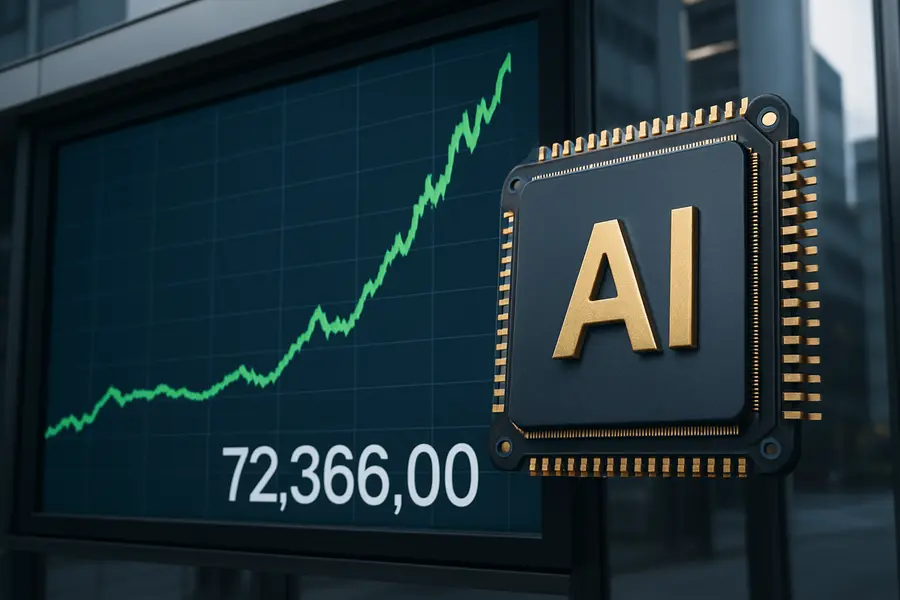
Japan's Nikkei 225 closed at 72,366 on June 25, up 4.6% and within 0.6% of its all-time peak, as SoftBank's 7.9% advance and broad semiconductor gains reversed the week's AI-driven selloff.
- Nikkei 225 added roughly 3,190 points to 72,366 on June 25, erasing the bulk of the week's losses in a single session as semiconductor names rebounded sharply.
- SoftBank Group rose 7.9%, Advantest surged 12.7%, and Tokyo Electron gained 7.3%, with Japan's AI-linked equities driving the recovery.
- Micron Technology reported fiscal third-quarter revenue of $41.5 billion—74% above the prior quarter—confirming that AI memory demand is structural, not cyclical.
Lead
TOKYO — Japan's Nikkei 225 closed at 72,366 on Wednesday, June 25, advancing 4.6% and recovering to within striking distance of its all-time record after Micron Technology reported fiscal third-quarter revenue of $41.46 billion—74% above the prior quarter and more than four times the year-ago figure—and net income of $28.24 billion, confirming that AI infrastructure investment is accelerating rather than stabilising. The session's gain of roughly 3,190 points reversed the damage inflicted during the week's rout, when concerns over hyperscaler capital discipline sent the benchmark down as much as 3.6% and briefly pulled it below 69,200.
What Happened
The rebound was concentrated in the AI and semiconductor names that had absorbed the sharpest selling over the preceding sessions.
SoftBank Group (9984.T) led the Nikkei with a 7.9% advance, reaching a market capitalisation of approximately $230 billion and reasserting its status as Japan's most prominent listed AI investment vehicle. Advantest (6857.T), which manufactures chip-testing equipment deployed at leading-edge memory fabs, surged 12.7%, lifting its valuation past $135 billion. Tokyo Electron (8035.T), the country's dominant semiconductor toolmaker, gained 7.3%, while Kioxia Holdings (285A.T), the world's second-largest NAND flash memory producer, climbed 7.6%, pushing its market capitalisation above ¥45 trillion ($282 billion) and consolidating its position as Japan's most valuable publicly listed company.The broader TOPIX also rebounded, though the Nikkei's price-weighted structure—heavily influenced by high-unit-price technology names—amplified the session's headline return relative to the cap-weighted gauge.
Market Reaction
Session turnover was elevated as investors unwound short positions and re-entered technology exposure built up during the selloff. SoftBank Group touched an intraday advance exceeding 9% before settling at 7.9%. Kioxia's intraday trajectory tracked memory optimism closely; the stock has now appreciated more than fiftyfold since its Tokyo Stock Exchange debut in late 2024, a move underpinned by insatiable AI-driven demand for NAND flash storage.
Across Asia-Pacific, the reversal was broadest in Japan. South Korea's Kospi, which had plunged nearly 10% at the depth of the week's rout as SK Hynix and Samsung Electronics each fell more than 4%, also recovered, though by a narrower margin. Korean semiconductor names had partially rebounded a session earlier, leaving less ground to retake.
The yen held near ¥160 to the dollar. At that level, Japan's exporters continue to report amplified yen-denominated earnings when dollar-priced chip contracts are translated back to domestic currency—a structural tailwind that has supported the Nikkei's 87% rise over the past twelve months.
Strategic Context
Micron's report was the decisive catalyst. The company's fiscal third-quarter figures—revenue of $41.46 billion against $23.8 billion in the second quarter and $9.3 billion in the same period a year earlier—provided a direct read-through for Japan's semiconductor supply chain. Management flagged that high-bandwidth memory for AI accelerators and enterprise NAND for inference-optimised storage were both running below procurement targets at major data-centre operators, keeping supply tight and margins expanding.
For SoftBank Group, the session's gain reflected more than sector sentiment. The conglomerate's deepening commitment to AI infrastructure—spanning its Vision Fund portfolio, domestic carrier AI buildout, and announced equity stakes in large-language model developers—has repositioned the stock as a leveraged bet on the broader AI capital cycle. That positioning, which drew scepticism when AI spending projections began to attract scrutiny in late May, was revalidated by Micron's numbers.
Separately, SK Hynix's announced plan to raise $30 billion through a US listing—proceeds targeted at South Korean capacity expansion—reinforced the market's conclusion that the memory industry is investing for a demand cycle measured in years, not quarters.
AI and Technology Angle
The week's rout had crystallised around a specific anxiety: whether hyperscaler AI capital expenditure, collectively projected above $350 billion in 2026, would translate into durable semiconductor volumes or face near-term rationalisation. Micron's quarterly figures resolve that question in favour of durable demand. Revenue nearly doubling sequentially is inconsistent with procurement caution; it reflects data-centre operators accelerating, not moderating, their AI infrastructure build.
For Japan's semiconductor equipment makers—Tokyo Electron and Advantest chief among them—sustained memory capex translates directly into tool orders. Both companies derive a significant share of revenue from memory fabs, and both carry elevated order backlogs. The quarter's selloff, viewed in that context, was a positioning correction rather than a fundamental deterioration.
What Comes Next
Japan's equity market now confronts a second variable: monetary policy. The Bank of Japan's June policy summary reaffirmed that underlying inflation is tracking its 2% target and that further interest-rate normalisation remains appropriate. Rate increases would strengthen the yen and compress the currency tailwind that has amplified Nikkei returns for foreign investors—a trade-off the BoJ appears prepared to accept as domestic demand firms.Geopolitical factors provided a secondary support. Progress toward a US-Iran peace framework, if formalised over the near term, would lower oil prices further, easing input costs for Japan's manufacturing base and reducing the import burden on an economy that sources virtually all of its energy from overseas.
The next set of confirming data arrives within four to six weeks, when TSMC, SK Hynix, and the major US hyperscalers report second-quarter earnings. Their demand signals will likely set the direction for Japan's equities heading into the third quarter.
Outlook
The Nikkei 225's 72,366 close re-establishes a high-water mark for Japan's AI-era equity rally and confirms that semiconductor demand fundamentals, as evidenced by Micron's blowout results, remain intact. SoftBank's 7.9% advance, Advantest's 12.7% surge, and Kioxia's continued ascent reflect Japan's deepening integration into the global AI infrastructure supply chain. The week's rout proved transient; the structural re-rating of Japan as an AI semiconductor hub has not.
Mentioned tickers: 9984.T, 6857.T, 8035.T, 285A.T, MU