Pomegra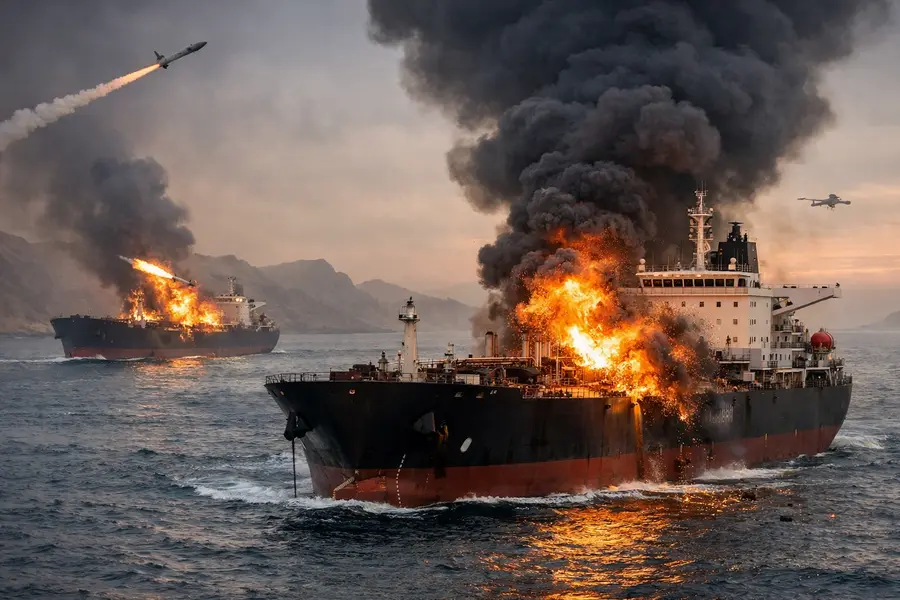
Iran's Revolutionary Guard struck two oil tankers crossing the Strait of Hormuz under U.S. air escort on July 31, forcing four additional vessels to reverse course and threatening to collapse a six-week-old ceasefire framework.
- The IRGC struck two oil tankers it said were traveling an "unauthorized route" under U.S. military air cover, turning back four more.
- The incident, on July 31, 2026, risks destroying the June 17 Islamabad Memorandum, which paused hostilities and pledged a 60-day toll-free Hormuz passage.
- Brent crude has surged as high as $126/barrel during the broader crisis; analysts warn a breakdown in negotiations could push prices toward new records.
Lead
Tehran, July 31, 2026 — Iran's Islamic Revolutionary Guard Corps announced on July 31 that its naval forces struck and halted two oil tankers attempting to transit the Strait of Hormuz while operating "under an air escort of the American military," and forced four additional vessels to change course and withdraw. The IRGC described the tankers as traveling an "unauthorized route" in defiance of Iran's claimed authority over the waterway, which carries roughly 25 percent of global seaborne oil trade and approximately 20 percent of the world's liquefied natural gas shipments.What Happened
The IRGC issued a statement characterizing the tankers as having been "encouraged by U.S. Central Command" to attempt passage through a corridor Tehran does not recognize as freely navigable. The names of the two struck vessels were not disclosed. Four other tankers altered course immediately after the strikes, the Guard said.
The Pentagon rejected Iran's framing, reiterating that it does not recognize Iranian authority over the Strait of Hormuz and that U.S. forces remain positioned in the region to uphold freedom of navigation. CENTCOM said its air presence was consistent with ongoing escort operations under Operation Project Freedom, the U.S.-led initiative launched in early May to accompany commercial traffic through the waterway.
The exchange occurred against a backdrop of resumed U.S. military strikes on Iranian targets. American forces restarted offensive operations on July 13 following a series of Iranian attacks on commercial shipping that began in early July—within 25 days of the June 17 ceasefire signing. Iran's foreign ministry had already accused Washington of violating "nearly all parts" of the memorandum before Thursday's tanker incident.
Strategic Context
The June 17 Islamabad Memorandum, signed remotely by U.S. President Donald Trump and Iranian President Masoud Pezeshkian, established a 60-day toll-free commercial passage arrangement through Hormuz, a halt to U.S. military strikes, and the termination of a U.S. naval blockade. In exchange, Washington secured a ceasefire and opened a pathway to negotiations on Iran's nuclear program, uranium stockpiles, ballistic missiles, and regional proxy networks—issues deferred to future talks.
The agreement was already under severe strain before Thursday. A Qatari LNG tanker, the Al Rekayyat, was struck by an Iranian drone on July 6, triggering fresh U.S. retaliatory strikes. Qatar, host of the U.S.-Iran negotiations, held Tehran "fully legally responsible" and demanded an immediate halt to attacks on regional shipping. It was the third IRGC strike on Qatari LNG assets during the broader 2026 crisis.
Iran's Foreign Minister Abbas Araghchi said Tehran would not resume negotiations until the U.S. complied with the memorandum's first clause. Trump countered with a stark ultimatum: "Make a deal, or we're going to finish the job."
Geopolitical Dimension
The Strait of Hormuz crisis, which erupted following U.S. and Israeli strikes on Iranian military targets in late February, has produced the largest energy supply disruption since the 1970s oil embargo. By early June, more than 1,000 ships carrying over 20,000 crew members were stranded outside the strait, with tanker traffic having declined as much as 70 percent at the crisis peak. Total documented maritime attacks have exceeded 56 incidents. Seventeen seafarers have been killed since hostilities began.
Thursday's strikes introduce a qualitatively new element: direct confrontation between IRGC naval assets and tankers moving under U.S. military protection. Prior incidents targeted vessels traveling independently or without explicit American air cover. The IRGC's willingness to engage escorted shipping signals an escalation in Iran's enforcement posture and complicates Washington's ability to credibly guarantee passage for commercial operators.
Ship owners and marine insurers had already questioned the operational parameters of Operation Project Freedom after the initiative was paused just one day after its May 4 launch. The July 31 strikes are expected to further dampen industry confidence in the escort framework.
Market Reaction
Brent crude has oscillated sharply throughout the crisis, rising from approximately $71 per barrel in late February to a peak of $126 per barrel—the largest recorded monthly oil price increase. News of Thursday's tanker strikes extended gains in early trading, with markets pricing in a higher probability that the Islamabad Memorandum collapses before its 60-day window closes in mid-August. Energy equities tied to Middle East production exposure and tanker operators with Hormuz exposure moved sharply on the news. War risk insurance premiums for Gulf transits, already at crisis-era highs, ticked higher following IRGC's announcement.What Comes Next
The immediate diplomatic test is whether the Islamabad framework survives the July 31 incident. Negotiators face a narrowing window: the 60-day ceasefire expires in mid-August, and no second-stage agreement on Iran's nuclear or missile programs has been reached. A full breakdown would likely trigger renewed U.S. strikes, Iranian counter-operations across the strait, and an oil price spike that analysts project could test the $130-per-barrel threshold.
The IRGC's decision to strike oil tankers moving under American air cover also tests the operational limits of U.S. deterrence in a confined waterway where geography favors Iranian fast-attack doctrine over open-ocean power projection.
Outlook
Thursday's strikes by the Revolutionary Guard on escorted tankers in the Strait of Hormuz represent the most direct challenge yet to U.S. naval authority in the region and place the June ceasefire in acute jeopardy. With negotiations stalled, oil markets elevated, and both sides signaling a willingness to escalate, the path to a durable agreement has narrowed considerably. The next 72 hours of diplomatic and military signaling will likely determine whether the Islamabad Memorandum holds or gives way to a new and more intense phase of the conflict.
Mentioned tickers: USO, BNO, TTE, XOM, CVX, FRO, STNG, DHT, NAT