Pomegra
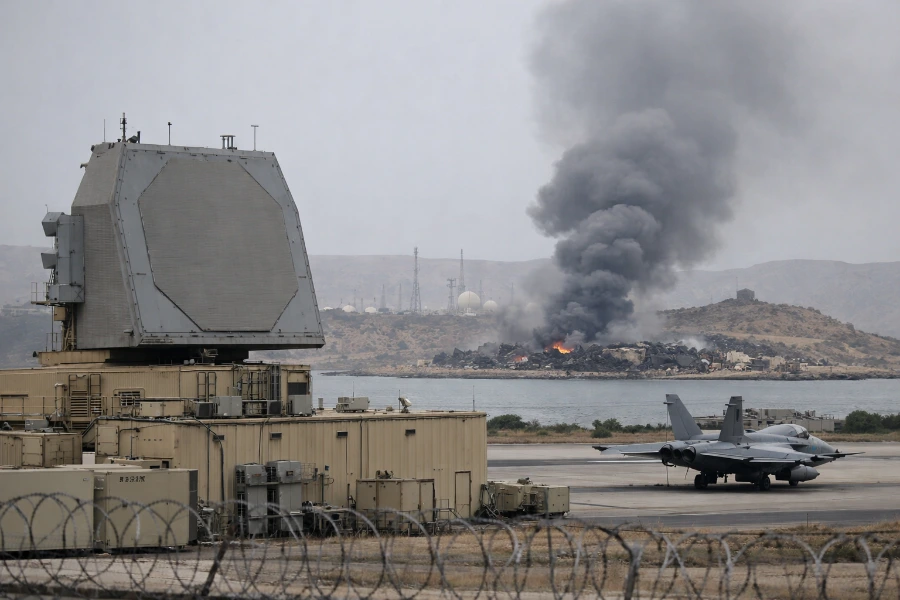
Iran's Revolutionary Guard hit a US radar at Bahrain's Isa Air Base and US jets struck a Qeshm Island missile site, the third Bahrain attack in under a week.
- The Guards said drones hit a US radar at Isa Air Base; US jets answered with precision strikes on Qeshm Island on Tuesday.
- It was the third reported Iranian attack on Bahrain in less than a week; no casualties were reported.
- Brent crude held near $93 a barrel, about 22% below its late-October peak.
Lead
Iran's Islamic Revolutionary Guard Corps (IRGC) said its combat drones carried out a "precision operation" early on Tuesday, November 17, against a radar system operated by US forces at Isa Air Base in Bahrain. Hours later, US fighter jets used precision munitions to destroy an IRGC missile launch site on Qeshm Island in the Strait of Hormuz. A US military official described the strike as self-defense against IRGC aggression targeting American personnel and assets. The exchange is the latest in a conflict that has run since late February 2026.
What Happened at Isa Air Base and on Qeshm Island?
The IRGC attacked a US radar at Isa Air Base, and the US hit a Guard missile site on Qeshm Island in return. The Guards said the drone strike answered repeated violations of Iranian airspace by US military drones. Bahrain's Defence Force said it intercepted and destroyed several Iranian munitions launched toward the kingdom.
Iranian media reported that the US strike hit an air-defense launcher in the Nariman area of Qeshm. A provincial official said civilian infrastructure was undamaged. No casualties were reported on either side. The Guards also said they struck Patriot air-defense systems and drone and missile launch platforms at Kuwait's Ali Al-Salem Air Base. Kuwait said its air defenses countered hostile drones.
Why Is Iran Targeting Bahrain?
Bahrain hosts a large US military presence, so it is the closest Gulf target for Iranian retaliation against American forces. On Sunday, Bahrain said its air defenses intercepted several Iranian attacks. Tehran said it had launched six drones at a US air-defense radar at the Riffa helicopter base. Tuesday's strike was the third such attack in under a week.
The pattern is consistent. Iran frames each strike as a response to US drone flights, and it targets radar and air-defense assets rather than inhabited facilities. Washington frames its replies as proportionate self-defense. Earlier in November, the US carried out limited strikes on Qeshm as well, so the island was already part of the escalation ladder.
Strategic Context
The exchange is part of a war between the US-Israeli coalition and Iran that began on February 28, 2026, now in its ninth month. The US maintains a naval blockade. Qatar and Oman are mediating over possible ceasefire terms, and no agreement has been announced.
Qeshm is the largest island in the Strait of Hormuz, a waterway that carried roughly one-fifth of global oil and liquefied natural gas before the conflict. Missile sites there put commercial shipping lanes within reach, which is why strikes on the island carry weight beyond their immediate military effect. Tanker attacks around Hormuz have reached an unprecedented level, and crews have been reported missing.
What Does the Escalation Mean for the Crude Oil Price?
Brent crude held near $93 a barrel on Tuesday, with the January contract settling at $93.14, up about 0.8%. That is roughly 22% below the late-October peak. On November 12, Brent stood at $94.58, down 11% from a month earlier.
Two forces are offsetting each other. Tanker attacks and renewed strikes add a risk premium. Against that, oil flows through Hormuz rose 78% in the third quarter, and the International Energy Agency expects a surplus of about 2 million barrels a day this quarter as Gulf exports recover. The result has been directionless trading in the low $90s. Markets are pricing the exchanges as contained, not as the start of a new supply shock.
Economic and Aviation Spillovers
Regional air travel continues to absorb the risk. flydubai has canceled flights to Riyadh and Abha through November 27, and Etihad has extended Saudi cancellations through November 30. Gulf insurers and shipowners remain exposed to any rise in attacks near Hormuz. They account for much of the cost of the conflict outside the energy price itself.
What Comes Next?
Three paths are open over the next three to twelve months. In the first, tit-for-tat exchanges continue at the current scale: drone strikes on Gulf bases, limited US responses on Iranian coastal sites. Oil would stay range-bound while supply recovers. In the second, Qatari and Omani mediation produces a ceasefire framework, which would pull the risk premium out of crude and ease shipping and insurance costs. In the third, an attack that causes casualties or hits a tanker or energy facility forces a larger US response. That would lift prices quickly, given how close the Hormuz lanes are to the launch sites involved.
Outlook
The Revolutionary Guard's strike on the Isa Air Base radar and the US response on Qeshm Island show a conflict that is escalating in small, calibrated steps. For now, falling prices and recovering Gulf exports have limited the economic fallout, but a single casualty-causing strike or a hit on Hormuz shipping could change that. Mediation by Qatar and Oman remains the main route to a ceasefire.
Mentioned tickers: None