Pomegra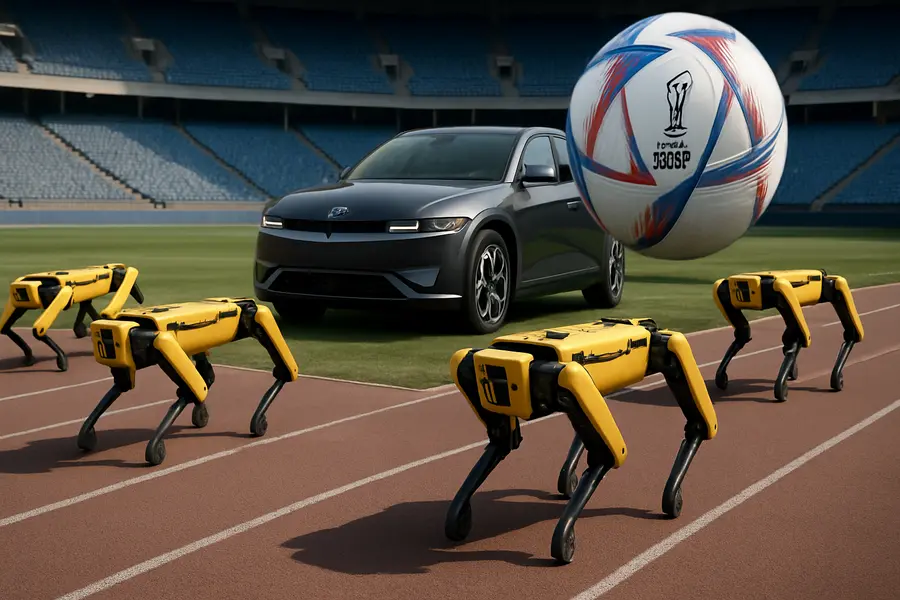
Hyundai Motor's 1,500-vehicle fleet and four Boston Dynamics Spot robots mark its largest-ever FIFA World Cup deployment and debut as official robotics partner.
- Hyundai deploys 994 passenger vehicles and 506 buses across 16 FIFA World Cup 2026 host cities in the U.S., Canada, and Mexico.
- Four Boston Dynamics Spot robots will conduct autonomous perimeter security at the Dallas Broadcast Center and New York–New Jersey Stadium.
- The 2026 tournament marks Hyundai's first major activation as FIFA's Official Robotics Partner, a role secured through a 2023 partnership renewal.
Lead
Hyundai Motor Company is fielding its largest-ever mobilization at a FIFA World Cup, dispatching a 1,500-vehicle transportation fleet and, for the first time in tournament history, a complement of autonomous Boston Dynamics Spot robots to support security operations across the United States, Canada, and Mexico. The June 5, 2026 announcement confirms Hyundai's expanded role as FIFA's Official Robotics Partner alongside its long-standing position as Official Mobility Partner — capping a 27-year institutional relationship with the world's most-watched sporting event.What Happened
The ground transportation deployment spans 16 host cities across three nations: 994 passenger vehicles — spanning the Palisade, Santa Fe, Tucson, Santa Cruz, Sonata, Elantra, Kona, and Genesis GV80 — and 506 buses will move national teams, match officials, tournament staff, and media throughout the six-week event. The fleet is the single largest vehicle mobilization in Hyundai's history at a FIFA tournament.
On the Hyundai robotics side, four customized Spot quadruped robots, equipped with Boston Dynamics' Enterprise Asset Management kit and industrial inspection applications, will be deployed at the International Broadcast Center in Dallas and New York–New Jersey Stadium. The machines will execute autonomous patrol operations and real-time site monitoring, assisting security personnel in investigating suspicious packages and potentially hazardous materials. The units carry no facial recognition capability.
Atlas, Boston Dynamics' bipedal humanoid platform, will also appear at designated venues in a fan-engagement capacity, reinforcing Hyundai's global "Next Starts Now" campaign. South Korean captain Son Heung-min serves as the campaign's global brand ambassador.Strategic Context
Hyundai's robotics ambition extends well beyond stadium perimeters. At CES 2026 in January, Hyundai Motor Group unveiled a sweeping AI robotics strategy anchored by a $26 billion U.S. investment commitment, with Atlas production targets set at 9.8 million units by 2030. Hyundai Mobis, the group's parts arm, supplies actuators for Atlas, tightening vertical integration across what the group calls its "End-to-End AI Robotics value chain."
The FIFA World Cup deployment, while modest in robot count, functions as a high-visibility proof of concept. Placing Spot robots inside a broadcast center and a marquee stadium — environments defined by crowds, sensitive infrastructure, and compressed operational timelines — demonstrates real-world dependability in exactly the conditions enterprise and government customers scrutinize most carefully before committing to autonomous security contracts.
Hyundai acquired Boston Dynamics from SoftBank in 2021 for approximately $1.1 billion. Since then, the group has systematically embedded the Cambridge, Massachusetts–based firm into its industrial and commercial strategy, supplementing its platforms with a Google DeepMind AI partnership revealed at CES 2026.
AI and Technology Angle
Tech in sports is graduating from concept to operational standard. Spot's Enterprise Asset Management configuration allows the robot to follow pre-programmed patrol routes, flag anomalies, and relay live data feeds to security command centers without requiring continuous human supervision — a meaningful operational improvement over manual inspection rounds in high-footfall environments.The selection of the International Broadcast Center as one of the two primary deployment sites carries specific weight. Broadcast infrastructure represents the highest-consequence security asset at any international tournament; disruption or intrusion can sever global transmission to billions of viewers. Deploying autonomous inspection robots at this node validates the platform's reliability under conditions that few enterprise settings can replicate.
Hyundai is the first and only official partner in FIFA's history to provide robotics as part of tournament operations.
Market Reaction
What Comes Next
Spot's operational performance data — anomaly detection rates, uptime, and operator feedback — gathered across the tournament will sharpen Hyundai's sales case to stadiums, airports, and large-venue operators evaluating autonomous security solutions. The group has indicated parallel plans to expand Atlas deployments into manufacturing sites and logistics facilities during the same period.
FIFA World Cup 2026 is the first edition to expand to 48 national teams and 16 host cities, making it operationally the most complex edition in the tournament's history. Hyundai's mobilization scale mirrors that complexity, positioning the company to argue that only a partner combining large-scale ground transportation with autonomous robotics can meet the logistics demands of modern mega-events.
Outlook
Hyundai Motor's FIFA World Cup 2026 presence marks a structural shift in how the automaker defines its core business — from vehicle manufacturer to integrated mobility and robotics provider. The 1,500-vehicle fleet anchors logistical credibility, while the Spot deployment at high-stakes security nodes stress-tests autonomous inspection at the scale and visibility needed to accelerate enterprise adoption. With a $26 billion U.S. robotics investment underway and Atlas production targets reaching into the millions, the tournament serves as both a showcase and a commercial inflection point for a strategy designed to redefine Hyundai's market position through the end of the decade.
Mentioned tickers: 005380.KSTechnology