Pomegra
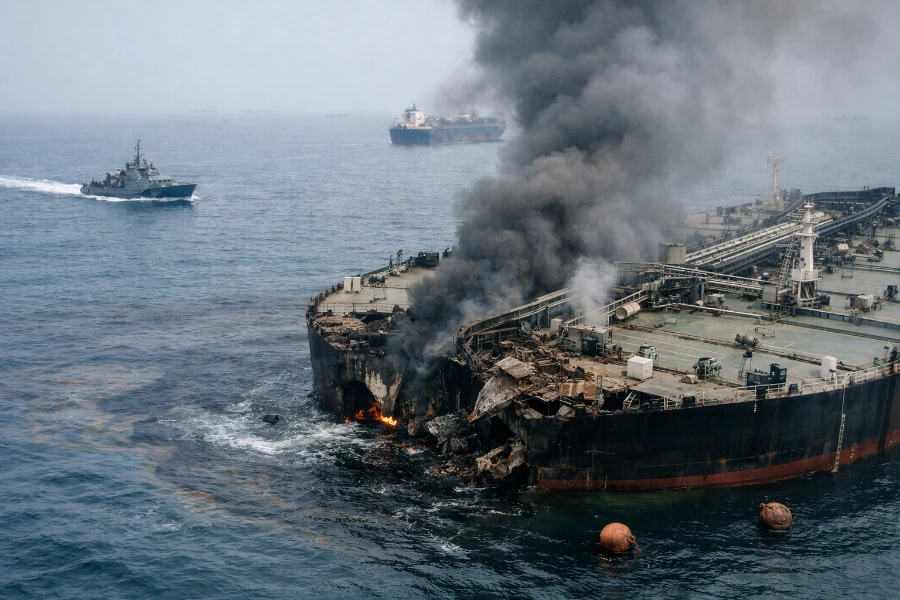
Iran's IRGC says two tankers hit mines in the Strait of Hormuz as Tehran enforces its closure at sea, keeping Brent crude oil near $90 on supply fears.
- The IRGC said two oil tankers hit naval mines and caught fire in the Strait of Hormuz.
- Tehran has moved from declaring the strait closed to enforcing the closure at sea.
- Brent is holding near $90 a barrel on supply-disruption fears.
Lead
Iran's Islamic Revolutionary Guard Corps (IRGC) said two oil tankers struck naval mines and caught fire in the Strait of Hormuz this week. The claim marks a shift from a declared closure to one enforced on the water. The waterway carried roughly 20 million barrels a day of crude and petroleum products before the conflict began in February 2026. Commercial transits have fallen from about 85 a day to a handful. Brent crude is trading around $90 a barrel.
What Happened in the Strait of Hormuz?
The IRGC Navy said the two tankers hit mines while attempting transits that did not follow its navigation rules, and both caught fire after explosions. The statement framed the incidents as consequences of violating Tehran's traffic-control regime. It also warned that further mines would greet vessels that ignore the rules.
The latest episode follows a run of near-daily incidents through November, after record attack frequency in October. Iran attributes the strikes to mines. Other parties have pointed to projectile attacks. Earlier incidents this week involved three vessels, which continued their journeys with all crew accounted for. The IRGC has also claimed it downed two U.S. drones over the strait.
How Is Iran Enforcing the Closure?
Iran is enforcing the closure through a permission-based passage regime backed by mines and naval patrols. Ships are told to coordinate transit with Iranian authorities. Vessels that do not are treated as violators, and the IRGC has pointed to the fires as the result.
The approach changes the risk calculation for shipowners and insurers. A declaration alone can be tested. Mines make the cost of an unauthorized transit physical and immediate. One commercial transit was recorded on November 22 against a pre-crisis baseline of about 85 a day, a drop of nearly 99%.
Why Is the Crude Oil Price Holding Near $90?
The crude oil price is holding near $90 because supply-disruption fears are offset by expectations of ample supply elsewhere. Brent is well below the highs above $100 reached in October and near three-month lows at points this week. Traders have largely discounted each new mine claim. They are weighing returning supply and oversupply forecasts against a strait that is functionally shut.
That gap shows how much of the world's spare capacity, stock draws and rerouted flows have absorbed the loss of Gulf export routes. It also leaves prices exposed. Any incident that damages a large vessel, produces a spill or draws in a third navy could reprice the market quickly. WTI trades at a discount to Brent in the low-to-mid $80s.
Geopolitical Dimension
Washington has not accepted Tehran's terms for reopening the strait. Indirect talks continue through Qatari and Omani mediators. President Donald Trump has said Iran is more aggressive than before the U.S. election and has suggested attacks on Iranian targets could restart after the end of the year.
The strait is the only seaward exit for most Gulf producers. Saudi Arabia, the United Arab Emirates, Kuwait, Iraq and Qatar all depend on it for the bulk of their exports. Pipeline bypasses exist but cover only a fraction of normal volumes. Asian importers, led by China, India, Japan and South Korea, take most of the crude that moves through the strait and face the largest exposure.
What Comes Next for Hormuz Shipping?
Hormuz shipping is likely to stay constrained in the near term, because neither a negotiated reopening nor a military escort operation has yet produced safe passage. Three paths shape the next three to twelve months:
- Negotiated reopening. A deal brokered through Qatar and Oman would let transits resume gradually, subject to demining and insurance repricing.
- Prolonged enforcement. Tehran keeps its permission regime in place, and flows stay at a fraction of normal levels. Prices stay range-bound while stock draws and rerouting absorb the shortfall.
- Renewed military action. Resumed strikes on Iranian targets would raise the risk of further mining and attacks on shipping, and would likely send Brent back above $100.
Even if the strait reopens, mine clearance, war-risk premiums and shipowner caution would slow any return to pre-crisis volumes.
Outlook
The IRGC's mine claims show Tehran treating the closure as an operational reality rather than a declaration. Brent near $90 reflects a market that has priced in disruption but still counts on supply from elsewhere to cushion it. Diplomacy through Qatar and Oman, the U.S. posture after year-end and the frequency of mine incidents will determine whether that balance holds.
Mentioned tickers: None