Pomegra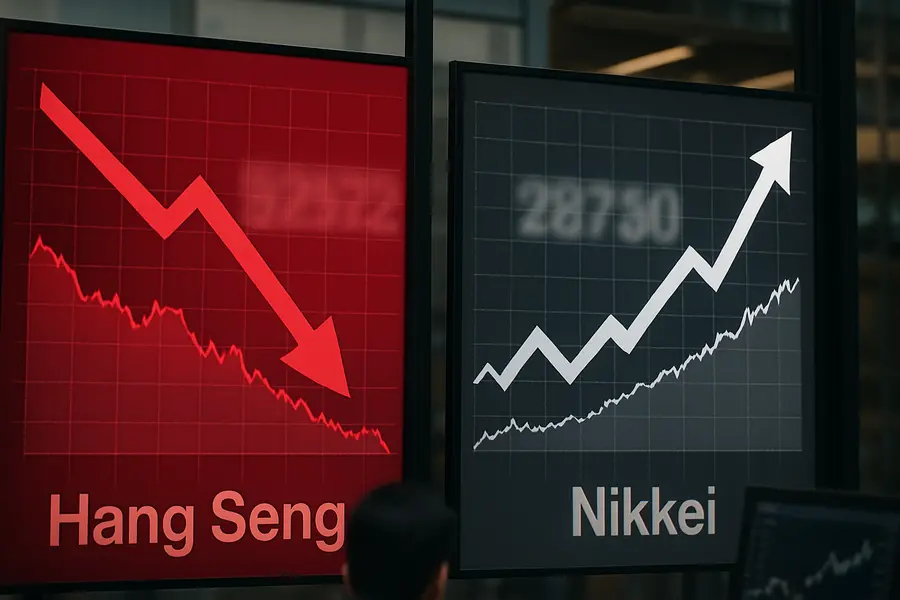
Hong Kong's HangSeng dropped 1.4% to a 14-month low as Alibaba slid on AI extraction claims, while Japan's Nikkei surged to a record 72,000.
- The HangSeng Index fell 1.4% to 23,076.91 on June 25, its lowest close since May 2025, driven by a 4.4% slide in Alibaba.
- Anthropic accused Alibaba of running a distillation campaign across roughly 25,000 fraudulent accounts to extract Claude AI model capabilities.
- Japan's Nikkei 225, up 33% in 2026, extended gains near record 72,000 on AI semiconductor tailwinds, sharpening the divide across Asia's major markets.
Lead
Hong Kong — The Hang Seng Index fell approximately 330 points, or 1.4%, to close at 23,076.91 on Wednesday, June 25, marking its lowest level since May 2025 as a technology sell-off centered on Alibaba Group Holding erased more than HK$88 billion in market capitalization within a single session. The decline put Hong Kong sharply at odds with Japan's Nikkei 225, which extended record-high territory near 72,000 — a 33% year-to-date advance — underscoring a deepening structural split between Asia's two largest equity benchmarks.What Happened
The Hang Seng Tech Index led the retreat, sinking 1.6% as investors reacted to allegations that Alibaba had systematically extracted proprietary artificial intelligence capabilities from US AI firm Anthropic. Alibaba shares dropped 4.43% to HK$95.00, the stock's lowest close since February 2025. At its intraday trough, the HangSeng briefly dipped below 23,000 — a level not touched in over a year — before recovering to close just above that threshold.
Xiaomi Corp. and Baidu Inc. fell more than 3% each, as the controversy extended across China's broader large-language-model sector.The Anthropic Accusation
The catalyst was a letter Anthropic sent to U.S. senators on June 24, alleging that operators linked to Alibaba and its Qwen AI division conducted what the company described as the largest known "distillation attack" in its history. The campaign ran from April 22 to June 5, 2026, and involved more than 28.8 million exchanges with Anthropic's Claude model, conducted through approximately 25,000 fraudulent accounts. The goal, Anthropic alleged, was to extract advanced model capabilities for use in training competing AI systems.
The incident placed renewed scrutiny on AI model distillation — the practice of training one system to replicate the outputs of another — and its legal exposure under intellectual property frameworks. For Alibaba, whose Qwen AI series has positioned the company as a leading developer of open-source Chinese large language models, the reputational and regulatory fallout was immediate and severe.
Mainland-Hong Kong Split
The HangSeng sell-off was notably absent from mainland China's markets. The CSI 300 Index closed 1.6% higher on June 25, while the technology-heavy Star Market surged nearly 4% to a record close. The divergence between Hong Kong and the mainland reflects structurally different investor bases: the HangSeng draws substantially more international capital and proved far more sensitive to the reputational risk embedded in the Anthropic dispute, while mainland investors directed attention toward domestic fiscal and monetary policy signals.
Japan's Divergent Path
While HangSeng stocks retreated to multi-month lows, Japan's equity market continued its historic run. The Nikkei 225 climbed above 72,000 for the first time on June 22 — a level the index had never previously reached in its 76-year history — powered by a combination of AI-driven capital flows and a yen trading near 160 per dollar that amplifies revenues for exporters. Approximately 16 trillion yen, equivalent to roughly $100 billion, has flowed into Japanese equities since April 2025.
The structural logic differs fundamentally from China's technology sector. Japan's market has embedded itself in the global AI hardware supply chain. Tokyo Electron, which accounts for roughly 10% of the Nikkei 225 by index weighting, holds a 90% global market share in coater/developer systems — machinery essential to manufacturing advanced semiconductors. As AI infrastructure investment accelerates across the United States and Europe, demand for Japanese semiconductor equipment has risen in lockstep, providing the Nikkei with a durable earnings tailwind insulated from the geopolitical frictions that weigh on Chinese technology names.
Strategic Context
The divergence between the HangSeng and the Nikkei is not a single-session anomaly. It reflects deepening structural differences in how each market is positioned within the global AI cycle. Japan benefits from hardware — chip-making equipment, precision materials, and components — that faces minimal export restriction exposure and commands rising demand. China's technology champions, by contrast, operate under tightened US semiconductor export controls, face a slowing domestic economy, and now confront growing allegations around intellectual property practices that carry regulatory risks across multiple jurisdictions.
The Anthropic episode arrives as China's AI industry has been attempting to establish itself as a credible global competitor. The distillation allegations complicate that narrative and increase the probability of additional scrutiny from Western governments already monitoring Chinese AI development closely.
Outlook
The HangSeng faces near-term pressure from the Alibaba-Anthropic fallout, with the index at its weakest in 14 months and the Hang Seng Tech gauge showing no clear technical base above 22,000. Stabilization will likely depend on a combination of Beijing policy support, a resolution or de-escalation of the AI intellectual property dispute, and improvement in China's underlying economic data. Japan's Nikkei, meanwhile, appears positioned to hold elevated levels as long as global AI capital expenditure remains robust and yen weakness persists. The gap between Asia's two benchmark indices now reflects increasingly separate trajectories — one anchored in AI hardware integration, the other navigating the regulatory and geopolitical headwinds facing China's technology sector.