Pomegra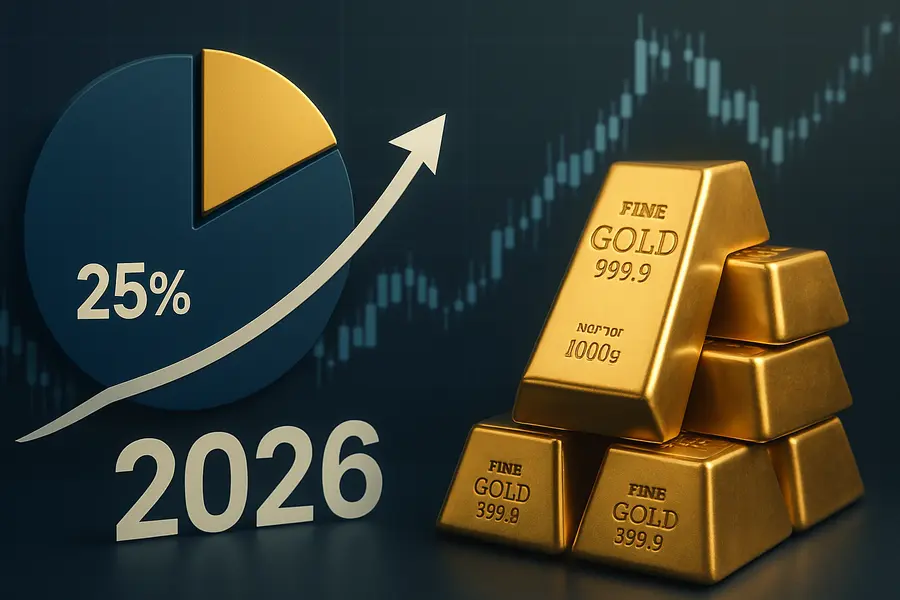
DoubleLine Capital's Jeffrey Gundlach says a 25% portfolio allocation to gold is not excessive, citing dollar weakness and structural demand from central banks as the primary drivers of the precious metals rally.
- Gundlach told CNBC a 25% gold weighting functions as an "insurance policy" for investors in the current macro climate.
- Dollar weakness, central bank accumulation, and inflation pressures underpin his case for elevated gold exposure.
- Major institutions forecast gold reaching $5,400–$6,000 per ounce by year-end 2026, reflecting a structural shift in the metal's global role.
Lead
DoubleLine Capital CEO and Chief Investment Officer Jeffrey Gundlach told CNBC that a 25% portfolio weighting in gold is not excessive, framing the precious metal as insurance against a structurally weakening U.S. dollar. Gundlach, one of the most closely followed fixed-income managers in the world, described gold investment 2026 dynamics as fundamentally different from prior cycles — driven not by speculative demand, but by sovereign and institutional buying that has changed the metal's supply-demand balance on a durable basis.What Gundlach Said
Speaking on CNBC's "Closing Bell," Gundlach said the gold position advice is straightforward: gold is "in a winning mode because of the weaker dollar," and he believes that condition will continue. He described a 25% weighting in precious metals as an insurance-style allocation, not a speculative bet — language that carries weight given DoubleLine's standing as one of the largest fixed-income managers in the United States.
Gundlach has refined his portfolio framework multiple times in recent months. Earlier in 2026 he proposed allocating 20% to real assets overall, with gold as the primary vehicle within that sleeve alongside a smaller commodity basket. The 25% figure he is now defending represents an increase from that prior framework, reflecting his conviction that macroeconomic conditions have deteriorated in ways that justify a larger defensive position in hard assets.
Market Context
Gold has staged one of its strongest sustained rallies in decades, driven by three reinforcing forces: dollar depreciation, persistent inflation across major economies, and a 16th consecutive year of net purchases by global central banks. Official sector demand exceeded 860 tonnes in 2025, a level that analysts describe as structurally price-inelastic — meaning sovereign buyers are not sensitive to short-term price moves in the way speculative investors are.The U.S. dollar index has declined materially over the past 18 months as Federal Reserve rate policy, elevated fiscal deficits, and rising term premiums on long-dated Treasuries all weighed on the currency. Because gold is priced globally in dollars, a softer greenback directly enhances the metal's purchasing power appeal for international buyers, amplifying demand further.
Gold trading near record highs has not deterred Gundlach. He has previously called pullback zones around $3,500 a "very good opportunity" to add to precious metals positions, a level that would represent a significant retracement from current prices. That willingness to add on dips signals that his bullish view is not contingent on price momentum alone.
The Broader Investment Thesis
Gundlach's Jeffrey Gundlach gold thesis rests on dollar structural decline rather than a specific event trigger. He has argued that U.S. fiscal trajectories, shifting Fed leadership expectations, and the gradual diversification of global reserve portfolios away from dollar-denominated assets all point to continued currency weakness over the medium term. Under those conditions, real assets — particularly gold — serve a function that cash and nominal bonds cannot replicate: they preserve purchasing power when the unit of account itself is depreciating.
His framework places gold alongside non-U.S. equities and high-quality bonds as the three pillars of a portfolio resilient to that environment. The implicit message to institutional investors is that traditional 60/40 portfolios, built around dollar-denominated assets, carry concentration risk that has historically been underappreciated until a dollar cycle turns.
Major financial institutions share a structurally bullish backdrop for gold investment 2026. Goldman Sachs forecasts the metal reaching $5,400 per ounce by year-end, while J.P. Morgan projects an average of $6,000 per ounce in the fourth quarter of 2026, rising toward $6,300 by end-2027. Both institutions cite central bank demand and dollar dynamics as the primary engines.
Strategic Context
The endorsement of a 25% gold position from a manager of Gundlach's profile carries strategic significance beyond individual portfolio allocation. It signals that a significant allocation to precious metals is no longer a fringe view or the preserve of inflation hawks — it is increasingly positioned as mainstream risk management for institutional and high-net-worth investors navigating a macro regime defined by dollar vulnerability and geopolitical fragmentation.
Central bank buying by emerging-market sovereigns seeking to reduce dollar dependency has been a consistent trend since the 2008 financial crisis, but accelerated sharply after Western sanctions on Russian reserves in 2022 demonstrated the risk of holding foreign exchange in dollar form. That structural shift in official-sector demand creates a persistent bid beneath the gold market that supports price floors regardless of near-term speculative positioning.
Outlook
Gundlach's call for gold position advice centered on a 25% weighting represents the clearest articulation yet of his conviction that the current macroeconomic cycle rewards hard assets over paper. With dollar weakness, central bank accumulation, and institutional reallocation all working in the same direction, the near-term conditions that drove gold investment 2026 to record levels show no sign of reversing. Whether prices advance toward the $5,400–$6,000 range forecast by major banks will depend on the pace of Fed easing, the trajectory of the dollar, and the resilience of sovereign buying — but the structural argument Gundlach is making does not depend on any single catalyst to hold.
Mentioned tickers: GLD, IAU, GDX