Pomegra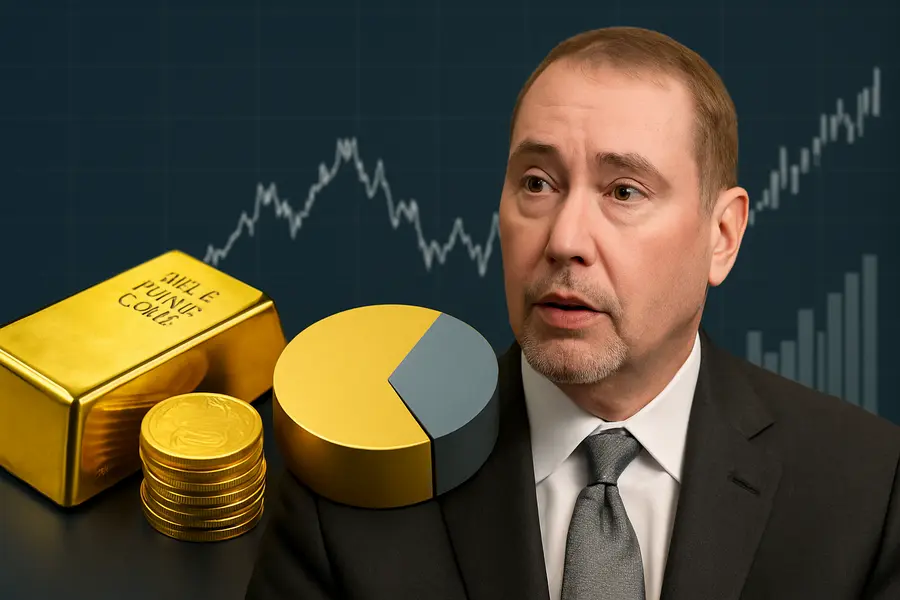
Jeffrey Gundlach says a 25% gold portfolio weighting is not excessive as dollar weakness and central bank demand keep precious metals elevated near $4,000.
- Gundlach describes a 25% gold portfolio weighting as "not excessive," framing the metal as an insurance policy against dollar debasement.
- Gold surged to an all-time high above $5,500 in January 2026 before retracing to approximately $4,089 per ounce in late June.
- Central bank accumulation, U.S. dollar weakness, and persistent fiscal deficits underpin Gundlach's long-term bullish thesis on precious metals.
Lead
Jeffrey Gundlach, chief executive and chief investment officer of DoubleLine Capital, has reinforced his bullish stance on gold, stating that a portfolio weighting as high as 25% in the metal is "not excessive" given the current macroeconomic environment. With gold trading near $4,089 per ounce as of late June 2026—substantially above the $2,600 range that prevailed at the start of 2025—Gundlach's endorsement of a substantial gold investment 2026 allocation carries added weight as the metal consolidates following a record-breaking run.What Happened
Gundlach, widely known as the "New Bond King," declared that a 25% gold position in a portfolio represents sound risk management rather than an extreme bet. He characterized the metal as an "insurance policy"—a hedge against structural forces he views as steadily eroding the U.S. dollar's purchasing power.
The stance aligns with a broader rethinking of portfolio construction that Gundlach has championed throughout the current cycle. His proposed framework allocates approximately 30% to non-U.S. equities, 30% to high-quality bonds, 20% to cash, and 20% to real assets. Gold comprises the core of that real-asset sleeve—roughly 10 percentage points allocated to the metal outright, with a further 5 percentage points directed toward a diversified commodity basket such as the Bloomberg Commodity Index.
Gold's 2026 Run
Precious metals staged one of their most dramatic price runs in modern history through early 2026. Gold set an all-time high of approximately $5,595 per ounce in late January, up more than 25% from early 2025 levels and roughly 115% above its 2022 lows. The surge was fueled by persistent inflation, escalating U.S. fiscal deficits, dollar softness, and geopolitical uncertainty that amplified safe-haven flows.By late June 2026, the metal had retraced to approximately $4,089 per ounce as easing geopolitical tensions reduced near-term haven demand. Even so, prices remain elevated by any historical standard. Separate institutional research has maintained year-end 2026 price targets near $6,000 per ounce, citing the same structural themes Gundlach has articulated.
The Investment Thesis
Gundlach's case for a large gold portfolio share rests on three interlocking structural arguments.
First, currency debasement. Years of quantitative easing and fiscal expansion have expanded global money supplies beyond historical norms. The U.S. national debt has crossed $37 trillion, and annual deficit projections remain above $1.5 trillion. In environments where fiat currency supply grows faster than real economic output, tangible assets with finite supply—gold primary among them—historically retain purchasing power.
Second, U.S. dollar vulnerability. The dollar's trade-weighted index has come under pressure as foreign governments and central banks diversify reserve holdings away from Treasuries. Dollar weakness directly amplifies gold prices, which are dollar-denominated, making the relationship self-reinforcing during periods of confidence erosion in U.S. fiscal management.
Third, central bank accumulation. Emerging-market central banks—particularly those in China, India, Poland, and Turkey—have been purchasing gold at near-record rates since 2022, adding structural demand that operates independently of speculative flows. This institutional buying has provided a price floor during correction periods, distinguishing the current cycle from prior bull markets in the metal.
Strategic Context
Gundlach's endorsement of a high gold investment 2026 weighting stands against a backdrop of unusual uncertainty in traditional fixed-income markets. As DoubleLine's flagship product is bond management, his pivot toward real assets as a portfolio anchor marks a notable evolution. He has acknowledged the tension explicitly: bonds have historically served the diversification and capital preservation role that gold is now sharing in his recommended framework.
The gold portfolio share of 25% that Gundlach describes as acceptable is roughly five times the weighting that conventional asset allocation models typically assign to commodities. Traditional 60/40 portfolios carry gold at 0–5%. Endowments and sovereign wealth funds, with broader mandates, typically hold 5–10%. A 25% allocation represents a substantial overweight by institutional standards, signaling deep conviction in gold's role as a macro anchor rather than a peripheral hedge.
Market Reaction
Gold exchange-traded products have seen sustained inflows consistent with the allocation thesis Gundlach outlines. GLD (SPDR Gold Shares) and IAU (iShares Gold Trust) both registered elevated average daily volumes through 2026. Mining equities, meanwhile, have lagged the spot metal's advance, as cost inflation and operational risk have weighed on margins despite higher realized prices.
Outlook
Gold has retraced meaningfully from its January 2026 all-time high near $5,595, but the structural forces Gundlach identifies—dollar weakness, central bank buying, and fiscal imbalances—remain intact. His 25% allocation threshold functions less as a precise target than as a statement that conventional commodity weightings significantly underestimate gold's portfolio role in the current macroeconomic regime. With the Federal Reserve facing constrained room to ease without reigniting inflation, and U.S. fiscal consolidation appearing politically difficult near-term, the conditions underpinning Jeffrey Gundlach gold conviction show no sign of reversing.