Pomegra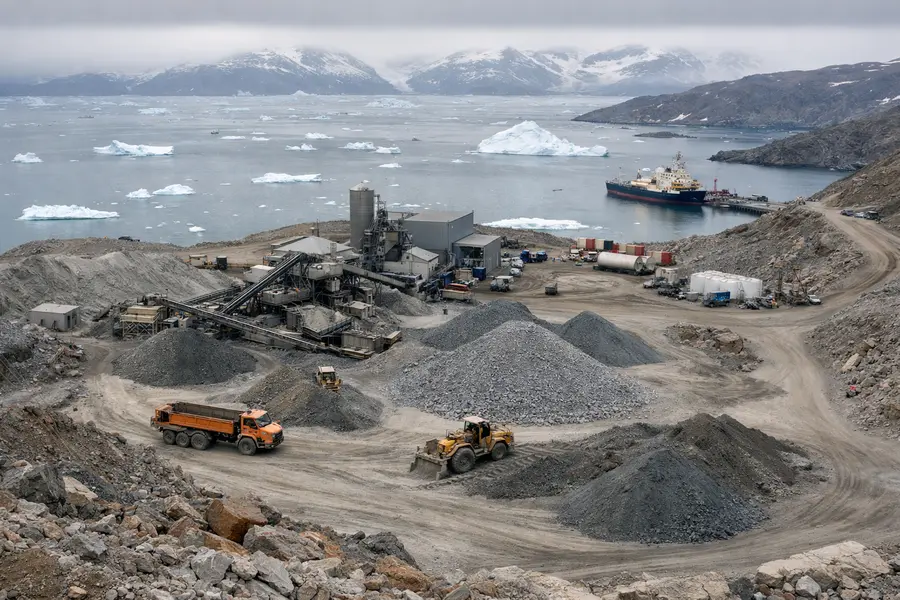
A Trump-brokered Arctic security and military-expansion deal at the UN General Assembly sent Greenland-linked mining stocks surging, with GRML up 245%, GLND up 150%, and CRML up 34%.
- GRML surged 245% and GLND jumped 150% on volume more than 15 times their 30-day averages after Trump signed the Arctic accord at the UNGA.
- The agreement extends a US military-security umbrella over Greenland and establishes a joint task force to fast-track critical minerals extraction with American financing access.
- Greenland holds an estimated $1 trillion in untapped mineral wealth, including rare earths, lithium, uranium, and zinc central to defense and clean-energy supply chains.
Lead
President Donald Trump signed a landmark Arctic security and military-expansion agreement with Denmark and Greenland on the sidelines of the United Nations General Assembly in New York on Wednesday, September 24, 2026, triggering an immediate speculative surge in Greenland-linked mining and energy stocks. GRML surged 245%, GLND jumped 150%, and CRML advanced 34% in heavy trading as investors priced in a US-backed critical minerals pipeline connecting Greenland's vast untapped deposits to Western supply chains.
What Did Trump's Arctic Deal Include?
The agreement covers expanded American military access to facilities in Greenland, joint Arctic patrol operations, and a bilateral framework for accelerating critical minerals extraction projects with US government financing. Under the terms, Washington commits to infrastructure funding and security guarantees for mining operations, providing a formal diplomatic architecture previously absent. Denmark, which retains formal sovereignty over Greenland under a relationship of autonomous home rule, co-signed the pact following months of negotiations that intensified after Trump's renewed public interest in acquiring Greenland earlier in 2026. Nuuk's government welcomed the economic development provisions while affirming home-rule governance over mineral rights.
Why Did Greenland Mining Stocks Enter a Speculative Frenzy?
Markets interpreted the deal as the concrete trigger for monetizing Greenland's estimated $1 trillion in mineral wealth, which includes rare earth elements, lithium, uranium, and zinc - all flagged in US policy reviews as critical to defense manufacturing and the clean-energy transition. Prior regulatory uncertainty and the absence of a US security guarantee had kept institutional capital sidelined. With the American military-security umbrella now formally extended and Export-Import Bank financing in scope, permitting timelines are expected to compress materially. GRML and GLND, both micro-cap operators with Greenlandic exploration licenses, saw volume spikes exceeding 15 times their 30-day averages. CRML, a larger operator with producing regional assets, posted a more measured 34% advance, reflecting its comparatively lower development-stage risk.
Strategic Context
The Arctic has re-emerged as a central theater of great-power competition. Russia and China have both invested heavily in northern sea routes, undersea surveillance infrastructure, and military positioning above the Arctic Circle, while the United States lacks a permanent warm-water Arctic port. Greenland's geography - straddling the North Atlantic and offering proximity to transpolar shipping lanes - has made it a recurring object of American strategic interest since 1946. The new agreement narrows that strategic gap while simultaneously addressing Washington's critical minerals dependence, a structural vulnerability documented in recent Defense Department supply-chain assessments. Broader equity markets saw limited spillover on the session, with the S&P 500 and Nasdaq drifting marginally lower as investors weighed rising US-Russia Arctic frictions against the deal's long-term economic upside.
What Comes Next for Arctic Mineral Investment?
Near-term attention will concentrate on whether the framework translates into funded projects. The deal text establishes a joint US-Greenland minerals task force with an 18-month mandate to identify priority extraction sites and matching infrastructure investment. The Export-Import Bank and the US International Development Finance Corporation are positioned as primary financing vehicles. Greenland's existing regulatory process requires parliamentary approval from the Inatsisartut for major concessions - a step that adds procedural time but confers legal certainty once cleared. Institutional capital, including sovereign wealth funds and defense-oriented private equity, is expected to evaluate entry points as the framework matures.
Outlook
The Trump-Denmark-Greenland accord represents the most substantive shift in Arctic minerals diplomacy in a generation. GRML, GLND, and CRML each carry development-stage risk, and the gap between signed frameworks and producing mines typically spans years. Nevertheless, the US security guarantee and access to government-backed financing alter the sector's risk calculus materially. Congressional ratification, Greenlandic parliamentary approval, and the pace of task-force recommendations will define the next catalysts for Greenland-linked mining equities.