Pomegra
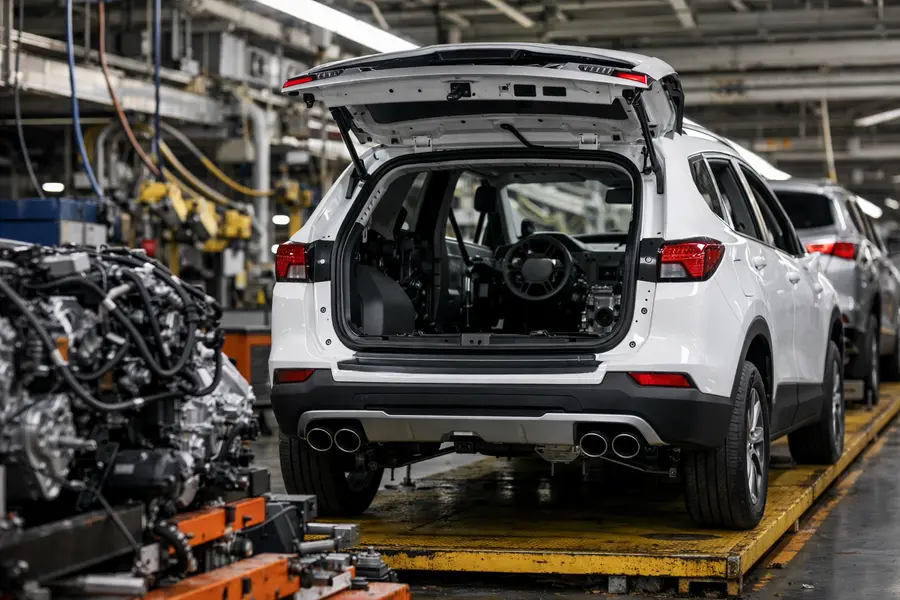
General Motors (GM) fell 6.8% after Q3 2026 results as narrowed profit guidance missed estimates, overshadowing a $20 billion buyback and higher cash flow.
- GM shares closed at $77.09, down 6.8%, the steepest one-day fall since July 2025, as the 2026 EPS midpoint missed consensus.
- Q3 adjusted EPS rose 32% to $3.70 on $50.0B revenue, but guidance narrowed instead of rising for a third time.
- A new $20B buyback and a higher free cash flow range failed to offset about $2B in expected commodity inflation.
Lead
General Motors (NYSE: GM) shares dropped 6.8% to $77.09 on Tuesday, October 20, 2026, on volume of about 24.7 million shares. It was the stock's worst session in 15 months. The automaker had beaten third-quarter expectations and announced a new $20 billion share repurchase authorization. Investors focused on a narrowed 2026 earnings outlook whose midpoint fell short of Wall Street forecasts, along with a warning about rising costs.What Did GM Report for the Third Quarter?
GM reported third-quarter revenue of $50.0 billion, up 2.9% from a year earlier and about $1.2 billion above consensus. Net income attributable to stockholders reached $3.3 billion, compared with $1.3 billion in the prior-year period. EBIT-adjusted, the company's core operating profit measure, rose 21.6% to $4.1 billion, and adjusted diluted EPS climbed 32.2% to $3.70.
North America drove the result. Adjusted EBIT in the region was $3.6 billion, an 8.7% margin, up from $2.5 billion and 6.2% a year earlier. Weakness came from elsewhere. GM International earned just $28 million, down from $226 million. Equity income from China fell to $32 million from $80 million. GM Financial adjusted earnings declined 16.9%.Why Did GM Shares Fall Despite the Beat?
GM shares fell because the revised full-year outlook sat below what the market had priced in. The company narrowed 2026 EBIT-adjusted guidance to $14.5 billion-$15.5 billion from $14.0 billion-$16.0 billion. It narrowed adjusted EPS guidance to $12.75-$13.75 from $12.00-$14.00. The new EPS midpoint of $13.25 compares with a consensus of about $13.41.
Having raised its range twice earlier in the year, GM left investors expecting a third increase and delivered a narrower band instead. The implied fourth quarter sharpened the concern. The guidance points to adjusted EBIT of roughly $2.7 billion at the midpoint, against $2.8 billion a year earlier, and adjusted EPS near $2.28, about 9% below the prior-year quarter's $2.51. The company said the fourth quarter would decline sequentially from the third.
What Cost Pressures Is GM Flagging?
GM expects about $2 billion in commodity inflation this year, including memory chips, at the high end of its previous range. Management also pointed to logistics and other recent cost pressures. A pickup truck changeover is expected to reduce roughly 35,000 deliveries in the fourth quarter, weighing on the most profitable part of the North American lineup.
Electric vehicle volumes declined as GM compared against a third quarter of 2025 that was lifted by the expiring federal consumer purchase incentive. The company has aligned EV production with current demand. Management said 2027 should be another strong year if demand holds and cost pressures stabilize, and that free cash flow next year could be consistent with or slightly above 2026 levels.
How Large Is the New Buyback?
The $20 billion multi-year authorization has no expiration date and represents roughly 30% of GM's current market capitalization. It follows a $6.0 billion program announced in January 2026 that has now been completed. Share count has fallen to 849 million from 904 million at the end of 2025, a reduction of about 6%.
GM also raised its 2026 adjusted automotive free cash flow guidance to $11.5 billion-$12.5 billion from $9.5 billion-$11.5 billion. Capital expenditure guidance is unchanged at $10.0 billion-$12.0 billion. The quarterly dividend remains $0.18 per share, payable December 17, 2026.
Market Reaction
The sell-off wiped out a substantial share of the stock's recent gains. GM closed Monday at $82.75, so the decline took $5.66 off the share price in a single session. An intraday move of as much as 8% was recorded, and the drop marked the stock's largest one-day loss since July 2025. Premarket trading had already pointed to a decline of nearly 7% after the release.
The reaction shows how far expectations had risen. A beat of roughly $0.07 on adjusted EPS and a larger buyback were not enough against a guidance midpoint that missed and a cost outlook that worsened. The consensus 12-month price target remains well above the current share price.
Outlook
GM enters the final quarter with strong North American margins, a lower share count and a higher cash flow range, but with a weaker implied fourth quarter and about $2 billion in commodity inflation to absorb. The pickup changeover and soft International and China contributions will shape how the year closes. The next test is the fourth-quarter report, which will show whether the narrowed range proves conservative or a ceiling.