Pomegra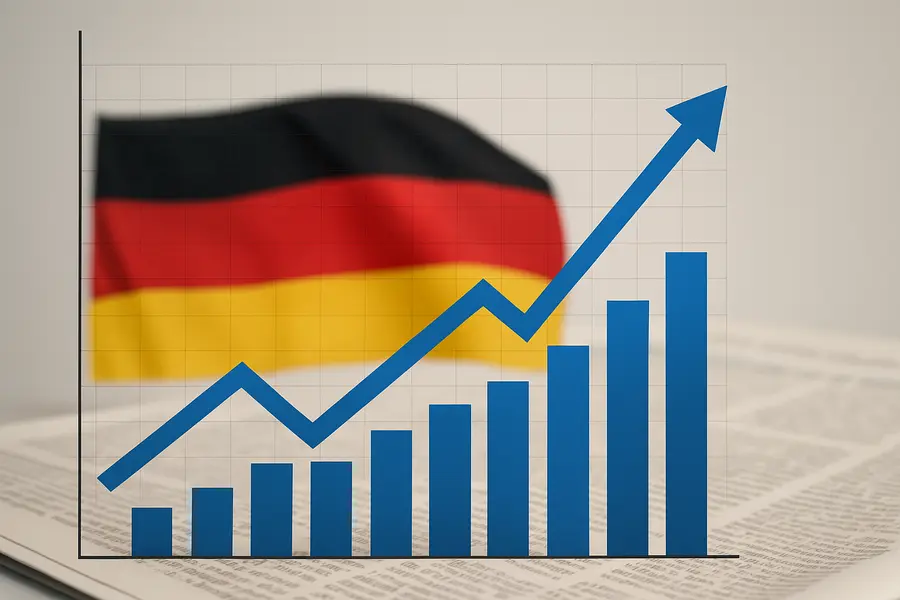
Germany's Ifo Business Climate Index climbed to 85.6 in June 2026, signaling a fourth consecutive monthly gain as manufacturing expectations improve and industrial demand shows the earliest signs of stabilization.
- Germany's Ifo Business Climate Index rose to 85.6 in June 2026, beating estimates and up from 85.0 in May.
- The Current Assessment sub-index climbed to 87.0, exceeding the 86.4 consensus forecast.
- Manufacturing led the improvement in expectations; services reported stronger current-period satisfaction.
Lead
Germany's Ifo Business Climate Index advanced to 85.6 points in June 2026, the Ifo Institute confirmed on June 24, edging higher from May's revised 85.0 reading and matching market expectations. The Current Assessment component, which gauges conditions at the time of survey, came in at 87.0 — above the consensus estimate of 86.4 and the prior month's 86.0 — pointing to a broadening of the confidence recovery beyond the expectations component alone. The reading reinforces a cautious narrative of stabilization after the index struck a six-year trough of 84.5 in April.
What Happened
The June survey showed Germany business confidence improving across several dimensions simultaneously for the first time in months. Companies described their current business situation more positively, while forward-looking expectations, though still cautious, became less pessimistic. Executives surveyed cited easing geopolitical tensions as a key factor behind the shift in sentiment — a notable departure from the deep uncertainty that had depressed readings throughout the first quarter of 2026.
The Ifo Current Assessment Index reaching 87.0 is particularly significant because it measures conditions as companies experience them, not as they project them. A gap between assessment and expectations — where companies feel somewhat better about the present than the future — has been a recurring feature of German survey data this year. June's data suggests that gap is beginning to close.
Sector Breakdown
Manufacturing drove the headline gain through markedly improved expectations, as order-book assessments grew incrementally less negative. Germany's industrial sector has delivered mixed signals for most of 2026: new manufacturing orders fell 3.8% month-on-month in April after a sharp 4.5% rebound in March, and January's 11.1% slump set the tone for a volatile year. Yet the underlying stock of orders in manufacturing stood 8.4% higher year-on-year in April after calendar adjustment — a figure that gives credence to the view that the European industrial news picture is slowly, if unevenly, turning. Services posted a genuine improvement, with providers reporting stronger satisfaction with current business conditions. The transport and logistics sector extended its recovery, benefiting from stabilizing freight demand. Tourism remained the outlier, with conditions described as still difficult despite the broader upturn.Market Reaction and DAX Trends
DAX trends on the week of the Ifo release reflected a market weighing positive domestic survey data against external headwinds. The DAX 40 closed at approximately 24,671 on June 27, down 1.29% on the day and roughly 1.3% for the week, as a global tech-driven selloff overshadowed the encouraging Ifo print. Infineon Technologies fell nearly 5%; Siemens Energy slid 5.6%; Volkswagen dropped 3.7% after reports of deeper-than-expected workforce restructuring. The divergence between improving survey-based confidence and equity weakness illustrates the degree to which global sentiment — particularly around AI infrastructure costs and US tariff exposure — continues to dictate near-term price action in German equities.Strategic Context
The German Ifo index 2026 trajectory sits within a broader macro framework that remains constrained. Berlin revised its full-year GDP growth forecast to 0.5% — half of January's initial 1.0% estimate — as US tariff policy, Middle East conflict-related energy volatility, and persistent domestic demand weakness compress the recovery path. The Ifo Institute's own modeling places the tariff drag on German GDP at 0.6 percentage points for 2026, largely through suppressed business investment in export-oriented sectors.
Industrial output rose 0.4% month-on-month in April, led by construction, chemicals, and fabricated metals — a pattern consistent with selective demand rather than broad-based expansion. Foreign demand has consistently outperformed domestic orders this year, with international new orders rising 4.7% in February while domestic orders fell 4.4%, underscoring Germany's continued dependence on global trade flows.
The European industrial news backdrop is supportive at the margin: the European Commission's Spring Forecast projects the euro area expanding by 0.9% in 2026, and European Central Bank rate cuts delivered earlier in the year have reduced financing costs for capex-dependent manufacturers.
Outlook
Germany's Ifo Business Climate reading of 85.6 represents meaningful progress from April's cycle low, but the absolute level remains historically subdued. Recovery, where it exists, is concentrated in manufacturing expectations and services satisfaction rather than in hard industrial output or domestic order volumes. The Ifo survey's own language — "less skeptical" rather than optimistic — appropriately frames the inflection point Germany appears to be approaching. For the second half of 2026, the central variables are the trajectory of US trade policy, energy price stability, and whether improved business confidence translates into tangible capital spending decisions. The conditions for a durable recovery are forming; the confirmation is yet to arrive.