Pomegra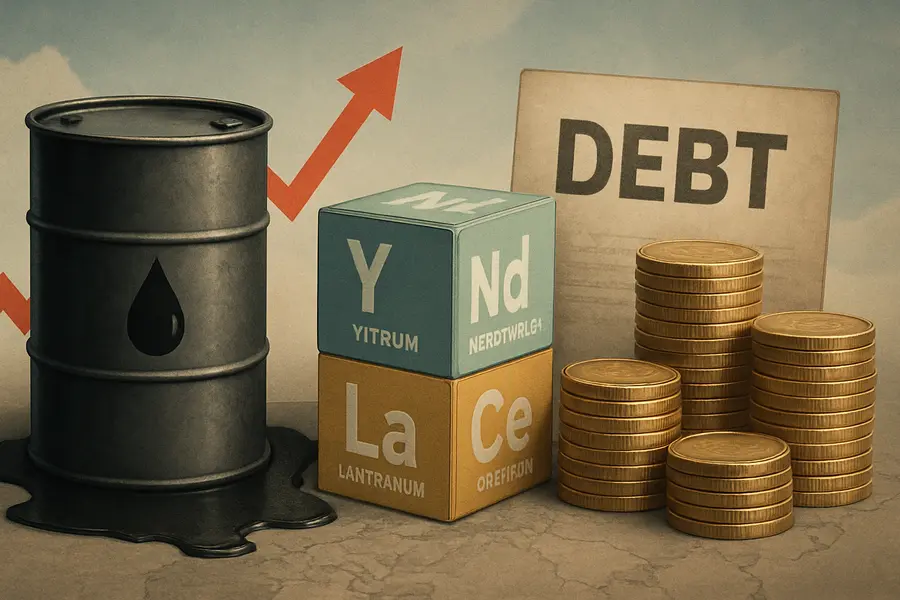
G7 leaders at Évian set a 60% rare earth dependency ceiling and $74 billion in minerals investment while oil markets recovered from the historic Hormuz supply crisis.
- G7 committed to cutting reliance on any single non-G7 rare earth supplier below 60% by 2030, backed by $74 billion in announced critical minerals investment.
- Brent crude fell from above $100/barrel to roughly $72 after a U.S.-Iran ceasefire restored Strait of Hormuz flows past 10 million barrels per day.
- Macron warned macroeconomic imbalances had reached 2007–2008 crisis levels, driving leaders to adopt a joint declaration on coordinated fiscal action.
Lead
G7 leaders concluded their three-day summit in Évian-les-Bains, France on June 17, 2026, adopting nine declarations covering energy security, critical minerals, debt sustainability, and global conflict. Hosted by French President Emmanuel Macron under France's 2026 G7 presidency, the gathering convened as an oil supply crisis triggered by Iran's blockade of the Strait of Hormuz drove Brent crude above $100 per barrel for the first time since 2022, while China's export controls on rare earth permanent magnets had already deepened a structural vulnerability across Western industrial supply chains.
What Happened
The G7 Summit 2026 opened June 15 against a backdrop of acute energy market stress. Iran's Hormuz blockade — through which approximately 20% of global petroleum consumption flows — triggered what energy agencies characterized as the largest oil supply disruption in history. G7 energy ministers, convening virtually in March, had already signaled readiness to coordinate a strategic reserve release in concert with the International Energy Agency, declaring themselves "ready to take all necessary measures."
By the time leaders gathered at Évian, a U.S.-Iran ceasefire framework had begun to stabilize flows. The United Arab Emirates restored crude exports to more than 3.9 million barrels per day, pushing total Strait of Hormuz volumes past 10 million barrels daily and creating a market surplus. Brent retreated to approximately $72 per barrel in late June and early July as the ceasefire held — though peace talks in Qatar face delays following the death of former Iranian Supreme Leader Ali Khamenei, and Tehran's demand for maritime control over the strait preserves near-term geopolitical risk.
Rare Earth Shortage: The Supply Chain Declaration
The rare earth shortage emerged as the summit's most structurally consequential agenda item. China controls more than 90% of global rare earth refining capacity. Its 2025 export controls on rare earth permanent magnets — components critical to electric vehicle motors, wind turbine generators, jet engine components, and consumer electronics — exposed the depth of G7 industrial dependence on a single source for materials now rated as strategically vital as crude oil.
G7 leaders issued a formal declaration on securing supply chains for critical minerals, committing to reduce reliance on any single non-G7 supplier of rare earths and permanent magnets below 60% by 2030, with an ambition to reach 50% "as soon as possible." Member governments reported 195 critical minerals projects already announced in 2026, totalling €64 billion ($74 billion) in aggregate investment. Leaders agreed to establish a new coordination platform led by the IEA and endorsed pilot stockpiling mechanisms for lithium and nickel, with additional metals to be added as the framework matures. Price support mechanisms, joint procurement arrangements, and sector-specific quotas remain under active consideration, though the U.S. administration failed to secure European backing for a Pentagon-drafted floor-price proposal for strategic minerals.
G7 Debt: Macroeconomic Imbalances Declaration
On G7 debt and fiscal sustainability, Macron framed the challenge in unusually stark terms, warning that macroeconomic imbalances — spanning excessive sovereign indebtedness, industrial overcapacity, and chronic underinvestment — had reached levels not seen since the 2007–2008 global financial crisis, and risked fueling protectionism and broader economic instability. Leaders adopted a joint declaration on global economic imbalances, committing to cooperative, coordinated reduction of excessive imbalances while guarding against competitive devaluations and trade-distorting industrial subsidies.
The declaration acknowledged the particular burden facing emerging market and developing economies, where elevated debt service costs crowd out investment in energy transition and resilience infrastructure. France advocated a multilateral approach to debt restructuring as preferable to fragmented bilateral arrangements.
Geopolitical Dimension
The summit produced separate joint statements on Ukraine and the Middle East. Leaders reaffirmed support for Ukraine's sovereignty while acknowledging that energy market stabilization — directly linked to the Hormuz crisis — remains a prerequisite for any durable European fiscal recovery. The Strait reopening, if sustained, would materially redraw global energy trade patterns: Iran's return to export markets and the restoration of full Gulf throughput remove the structural supply premium embedded in global oil prices since early 2026.
No joint summit communiqué was issued, marking the second consecutive G7 gathering to forgo the traditional consensus document amid persistent U.S.-European divergences on trade, industrial policy, and multilateral institutional reform.
What Comes Next
The IEA critical minerals coordination platform is targeted for operationalization before year-end 2026. Lithium and nickel stockpile pilots will serve as the testing ground for a broader strategic reserves regime the G7 hopes to extend to cobalt, dysprosium, and other high-criticality materials. Oil market stability hinges on the durability of the U.S.-Iran framework, with formal talks scheduled in Switzerland pending the resolution of Iranian state funeral proceedings.
Outlook
The Évian summit produced actionable commitments on three of the defining supply-side vulnerabilities of the mid-2020s: oil supply crisis containment, rare earth access, and G7 debt coordination. Implementation timelines — a 60% rare earth dependency ceiling by 2030, IEA platform operationalization before 2027, and synchronized fiscal frameworks across seven sovereign governments — are ambitious. Whether the political alignment forged at Évian survives structural tensions between U.S. unilateralism and European multilateralism will determine whether the summit's nine declarations translate into durable industrial and energy policy shifts.