Pomegra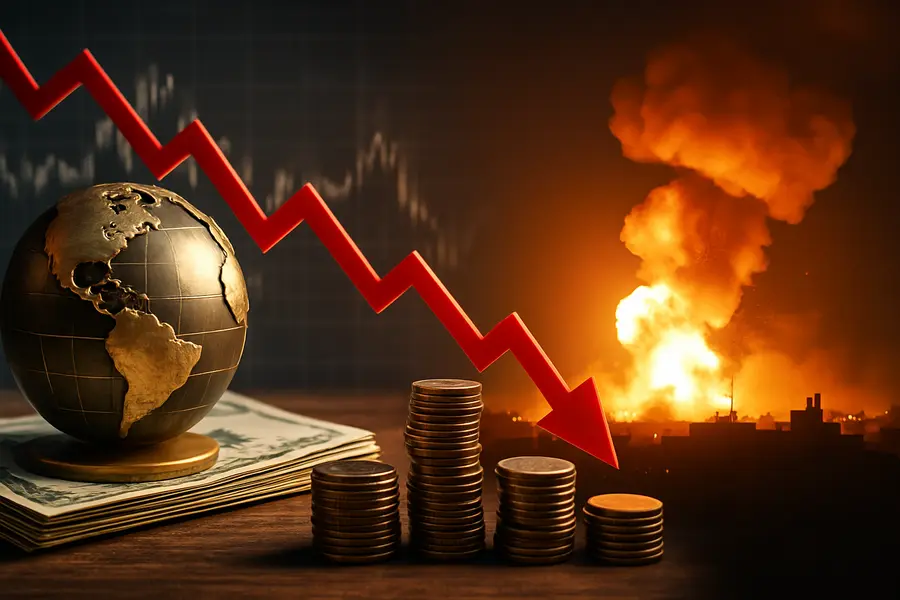
Fitch Ratings slashed its global growth forecast 2026 to 2.4%, as the Iran conflict impact on Strait of Hormuz oil flows sends Brent crude to $87 a barrel and drags advanced economy growth to near-stagnation.
- Fitch cut its 2026 global GDP forecast to 2.4%, down 0.2 percentage points from its March estimate of 2.6% and below 2025's 2.7% outturn.
- The Strait of Hormuz has been shuttered for 14 consecutive weeks; Fitch does not expect a partial reopening before July, sustaining the $87/barrel Brent crude outlook.
- The Federal Reserve and Bank of England are now projected to hold rates through end-2026, deferring cuts to 2027 as oil-driven inflation resurges.
Lead
Fitch Ratings reduced its 2026 global GDP growth forecast to 2.4% in its June 2026 Global Economic Outlook, a downward revision of 0.2 percentage points from its March estimate and below the 2.7% expansion recorded in 2025. The agency cited the sustained economic downgrade pressure from the US-Iran conflict, which has blocked oil transit through the Strait of Hormuz for 14 consecutive weeks — delivering what the International Energy Agency has characterized as the largest supply disruption in the history of global oil markets.What Happened
Fitch lifted its average Brent crude price forecast for the full year to $87 per barrel, up sharply from the $70 projection held in March. The revision reflects the protracted closure of the Strait of Hormuz, through which approximately 20% of global oil supply and significant volumes of liquefied natural gas normally flow. Fitch's baseline now assumes the waterway will not begin reopening until July; any further delay shifts forecast risk meaningfully to the downside.
The Iran conflict impact transmits rapidly through energy price channels. US headline inflation by year-end 2026 has been revised up 0.7 percentage points to 3.7%; eurozone consumer price inflation has been lifted 1.3 percentage points to 3.1%; and UK inflation rises 1.1 percentage points to 3.7%. Elevated energy costs compress household purchasing power, raise corporate input costs, and dampen consumption — the primary mechanism behind the broad-based growth downgrades.
Regional Breakdown
For the United States, Fitch trimmed its 2026 growth estimate by 0.3 percentage points to 1.9%. The revision reflects both the direct energy cost burden and the policy bind now facing the Federal Reserve, which Fitch projects will hold rates steady through year-end before resuming cuts in 2027. Markets that had priced in Fed easing in the second half of 2026 must reassess.
The eurozone faces the sharpest relative deterioration among major blocs, with its forecast cut 0.4 percentage points to 0.9% — leaving the bloc's largest economies with minimal buffer before contraction territory. The European Central Bank confronts stagflationary conditions as energy import bills escalate, compressing the space for monetary accommodation. Eurozone growth stood at 1.4% in 2025.
Geopolitical Dimension
The Iran conflict has weaponized geography. The Strait of Hormuz, an 18-nautical-mile chokepoint at the Persian Gulf's mouth, is irreplaceable as a transit route — there is no equivalent alternative for most Gulf producers. Its effective closure has rippled into European gas markets, Asian factory input costs, and global freight insurance premiums. Supply disruptions from Kuwait, Iraq, Saudi Arabia, and the UAE reportedly totaled upwards of 10 million barrels per day at the conflict's most acute phase.
Emerging economies most exposed to sustained disruption include Pakistan, Bangladesh, and Vietnam, where energy import dependency is high and foreign-currency reserves are limited. The IMF, in its April 2026 World Economic Outlook, projected a base-case global growth rate of 3.1% contingent on rapid conflict resolution, but warned a prolonged-disruption scenario could push global growth toward 2% — close to global recession territory. Fitch's June update confirms that the optimistic scenario has not materialized.
Monetary Policy Constraint
The energy shock creates a central bank dilemma Fitch addresses directly: conventional tightening cannot relieve a supply-side disruption, yet policymakers must guard against second-round effects — the risk that elevated oil and gas costs feed into wage demands and persistent broader inflation. The Bank of England, facing the same calculus as the Fed, is also projected to hold through 2026 before easing in 2027.
AI Investment as Partial Offset
The principal cushion in Fitch's analysis is accelerating investment in artificial intelligence infrastructure. Capital spending on AI compute and data centers is generating measurable productivity gains and supporting business investment, particularly in the United States and parts of Asia. Fitch acknowledges this structural tailwind but concludes that the inflationary drag from the oil shock currently outweighs AI's positive contribution to the global growth outlook.
Outlook
The trajectory for the 2026 global growth forecast hinges almost entirely on how quickly the Strait of Hormuz reopens. Fitch's baseline — partial reopening in July — would relieve crude prices and create conditions for a modest second-half recovery in growth and a gradual easing of central bank caution. A delayed resolution would compress the forecast further, bringing the IMF's adverse scenario of near-2% global growth from theoretical risk to baseline projection. The economic downgrade embedded in Fitch's June report reflects not pessimism about underlying economic fundamentals, but a straightforward accounting of what happens when a single waterway — and the geopolitical standoff around it — determines the price of energy for the entire global economy.
Mentioned tickers: N/A