Pomegra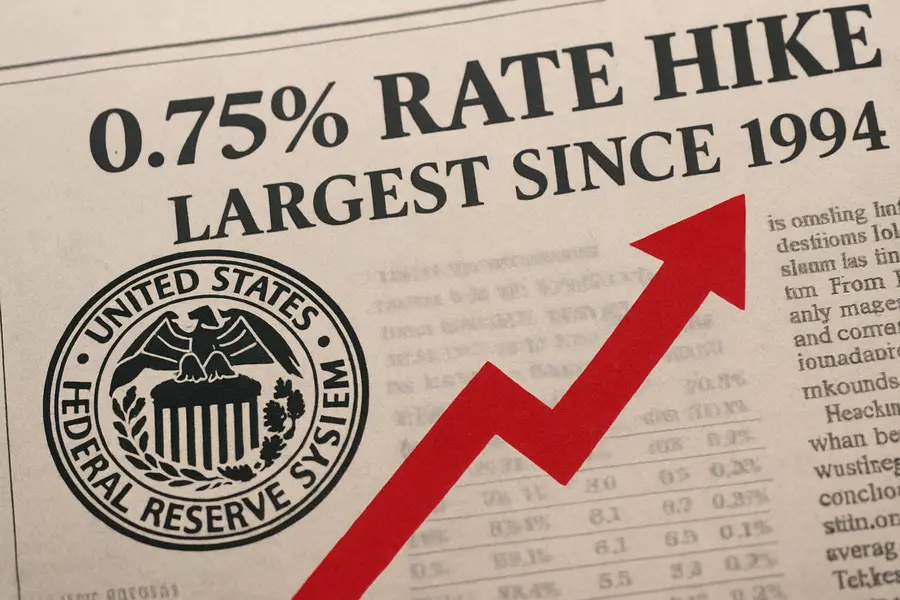
The Federal Reserve's June 2026 dot plot flagged a potential 75-basis-point tightening cycle as Fed Chair Kevin Warsh signals a decisive break from the prior easing bias, with Bank of America forecasting three consecutive hikes through year-end.
- The June 17 FOMC held rates at 3.5%–3.75% but revised the median dot to 3.8%, signaling at least one imminent hike.
- Bank of America projects 75bp of cumulative rate increases — September, October, December — lifting rates to 4.25%–4.5%.
- PCE inflation was revised sharply higher to 3.6% for year-end 2026, up from 2.7% in the March projection.
---
Lead
The Federal Open Market Committee held its benchmark rate steady at 3.5%–3.75% on June 17, 2026, but delivered a hawkish jolt: nine of 18 officials now project at least one rate hike before year-end, with the most aggressive dot penciling in a cumulative 75 basis points of tightening — a scope of tightening not seriously in play since the Fed's landmark 1994 rate-hike cycle. Chair Kevin Warsh, presiding over his first FOMC meeting, called persistently high prices "a burden" while overhauling the committee's communications to a spartan 130 words, down from 341 in April, and removing all language signaling a bias toward future cuts.
---
What Happened
The June decision was unanimous, but the accompanying Summary of Economic Projections marked a sharp break from the committee's recent posture. The median fed funds rate forecast for year-end 2026 climbed from 3.4% to 3.8% — the largest single-meeting upward revision in the current cycle. Among the 18 officials submitting projections, eight saw rates unchanged through December, five projected 50 basis points of cumulative hikes, three penciled in 25bp, and one lone hawkish dot landed at 75bp. Warsh himself did not submit a rate projection, citing ongoing operational reviews and the formation of internal task forces to overhaul major Fed operations.
The statement was stripped of forward-guidance language that had anchored markets to an easing trajectory. In its place: a terse acknowledgment that inflation remains "well above" the 2% goal.
---
Inflation and Projections
The committee's revised economic projections tell a stark story. Core PCE inflation — the Fed's preferred gauge — was revised to 3.3% for year-end 2026, up from 2.7% in March, and is now seen reaching only 2.5% by 2027. Headline PCE is projected at 3.6%, a 0.9-percentage-point upward revision driven heavily by energy prices. Real GDP growth was trimmed to 2.2% from 2.4%, and the unemployment rate forecast edged slightly lower to 4.3%, reflecting a labor market that has absorbed prior tightening without significant deterioration.
April CPI data, released ahead of the meeting, showed consumer prices rising 3.8% year-over-year — the largest annual increase since May 2023 — with energy prices surging 17.9% on the year.
---
The Iran War Factor
The inflation resurgence is materially tied to the 2026 Iran war, which erupted in late February and immediately disrupted oil and refined-product flows from the Persian Gulf. The average U.S. gasoline price reached $4.50 per gallon as of mid-May, and energy costs accounted for more than 40% of the overall CPI increase in April. Economists at the Dallas Fed have documented persistent upward pressure on prices that is unlikely to fully reverse even if crude oil markets stabilize, given supply-chain lags and elevated transportation costs throughout the economy. Consumer spending — roughly 70% of U.S. GDP — faces mounting headwinds as household fuel and utility costs absorb a larger share of income.
---
Wall Street and Market Reaction
Bank of America delivered the sharpest revision among major dealers, projecting three consecutive 25-basis-point hikes in September, October, and December — a cumulative 75bp of Fed rate hike 2026 tightening that would lift the target range to 4.25%–4.5%. The bank described the inflation outlook as "unambiguously worse" and does not see rate cuts resuming until 2028. CME FedWatch data placed the probability of a September hike at 72.8%, rising to 80.6% for October and 87.9% for December. Treasury markets registered the hawkish shift across the curve. Two-year yields have risen 64 basis points since September 2024, ten-year yields are up 86bp, and twenty-year yields have climbed 94bp. The ten-year is now expected to hold in a 4.0%–4.5% range through year-end, reflecting both the repricing of rate expectations and persistent term-premium expansion.---
Historical Context
The interest rate forecast now circulating on Wall Street draws explicit comparisons to the 1994 tightening cycle, when the Fed under Alan Greenspan raised the funds rate from 3% to 6% in twelve months — including a single-meeting 75-basis-point move in November 1994 — catching bond markets off guard and triggering the worst U.S. Treasury rout in decades. The 2022 episode revisited that speed when the Fed delivered 75bp at a single meeting, the largest rate hike since 1994. A cumulative 75bp across three consecutive FOMC June 2026 and subsequent meetings would parallel that cadence, underscoring how dramatically the committee's outlook has rotated within a single quarter.
---
Outlook
The Fed's June 2026 pivot — holding rates while signaling aggressive tightening ahead — establishes a policy framework that will be tested against incoming inflation and labor market data through the third quarter. If energy prices stabilize and core PCE begins to decelerate, the committee retains flexibility to pause after one or two hikes. If inflation proves stickier than the revised projections suggest, the hawkish tail — a single 75bp move or an extended three-hike sequence — moves from outlier to base case. Either path marks a decisive end to the easing cycle that defined 2024 and 2025, with rates potentially finishing 2026 at levels not seen since before the pandemic.
---
Mentioned tickers: UUP, TLT, IEF, SHY, SPY, QQQ, XLE, USO