Pomegra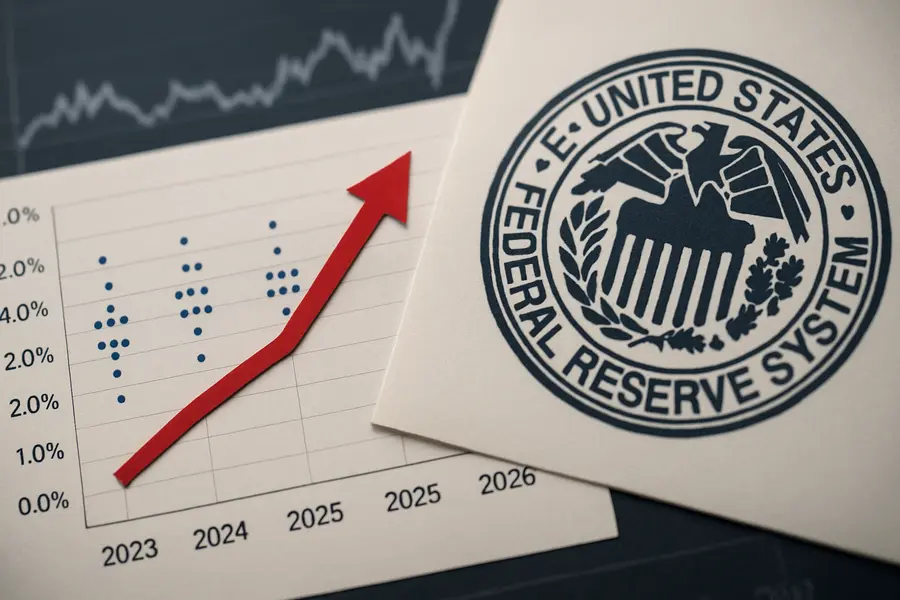
Nine of 18 Federal Reserve officials now project at least one 2026 rate hike as new Chair Kevin Warsh scraps forward guidance and markets price roughly 50 basis points of tightening ahead.
- Nine of 18 FOMC officials project at least one ratehike in 2026, a sharp reversal from March when the median dot pointed to a cut.
- Markets now embed approximately 50 basis points of Fed tightening over 12 months, with October flagged as a live meeting.
- Chair Kevin Warsh cut the policy statement to 130 words and eliminated explicit forward guidance at his first press conference.
Lead
The Federal Reserve held its benchmark rate at 3.50%–3.75% on June 17, 2026 — a fourth consecutive pause — but a stark shift in the quarterly dot plot delivered the substantive news: nine of 18 officials now pencil in at least one ratehike before year-end, splitting the committee evenly between holders and hikers for the first time in the current cycle, as persistent inflation and an unrelenting labor market push the policy calculus toward tightening.
What Happened
The June FOMC vote to hold was unanimous at 12-0. The headline belonged to the Summary of Economic Projections. Of the 18 officials who submitted forecasts, nine placed their year-end 2026 dot above the current policy range — three projecting a single 25-basis-point move, five projecting 50 basis points of tightening. Eight expect no change. Only one still pencils in a cut.
The median year-end 2026 Fed funds rate projection rose to 3.8%, up 30 basis points from the midpoint of the current target range, with the full distribution running from 3.4% to 4.4%. Officials simultaneously marked up their inflation outlook: median 2026 PCE projections moved to 3.6% headline and 3.3% core, from 2.7% and 2.5% in March. Seventeen of 18 participants assessed inflation risks as skewed to the upside.
New Chair, New Posture
June 17 was Chair Kevin Warsh's first FOMC decision since taking office on May 15, 2026. He reshaped the policy statement to match. The document was condensed to roughly 130 words, down from more than 300, and stripped of any explicit rate guidance — a deliberate break from the communication framework that defined recent years.
"The Fed will deliver price stability," Warsh said at his post-meeting press conference. "The commitment to deliver is strong, unanimous, and unambiguous." He declined to submit his own dot, saying he preferred colleagues to register their views independently, a stance that itself signals a preference for data dependence over committee consensus signaling.
Market Reaction
Fed funds futures repriced promptly. Markets now embed approximately 50 basis points of tightening over the next 12 months, with meaningful probability assigned to a first ratehike as early as October 2026. The two-year Treasury note — the instrument most sensitive to near-term policy expectations — extended its climb as traders recalibrated.
Equity markets reflected the shifting rate trajectory. Rate-sensitive sectors diverged: bank stocks found support in the steeper policy path while longer-duration assets, including real estate investment trusts and utilities, faced pressure. The CME Group's FedWatch tool showed the probability distribution for year-end 2026 tilting decisively toward at least one 25-basis-point move.
Inflation and Labor Market Context
The hawkish pivot rests on durable data. Core PCE has run above the Fed's 2% target for five consecutive years. May's consumer price index printed at a 4.2% annual rate, with energy supply dynamics continuing to sustain upward pressure on headline measures.
The labor market provides no disinflationary cover. Nonfarm payrolls added 172,000 jobs in May, above consensus, while the unemployment rate held steady at 4.3% — consistent with full employment. Wage growth remains elevated. The softening in labor demand that the Fed projected in late 2025 has not materialized at the pace required to validate a continued pause.
Strategic Context
The dot-plot reversal follows a pattern from prior tightening cycles: an extended hold, sticky inflation, and a gradual committee tilt toward action. What distinguishes the current episode is speed. In March 2026, the median official expected the next move to be a cut; by June, half the committee had shifted to ratehikes.
Warsh's decision to abandon forward guidance accelerates that dynamic. With no explicit central bank anchor on the rate path, each incoming inflation print, payroll report, and consumer demand reading becomes a potential market-moving catalyst. The late-July FOMC meeting is now a live event for the first formal tightening debate.
Outlook
The June dot plot marks a decisive turn for the Fed after four consecutive pauses. With nine officials projecting ratehikes, a median year-end target of 3.8%, and markets pricing roughly 50 basis points of tightening over 12 months, the policy conversation has shifted from when the Fed will cut to whether — and how far — it will hike. Chair Warsh's removal of forward guidance puts the data in the driver's seat, ensuring that inflation and employment releases carry maximum weight through year-end.