Pomegra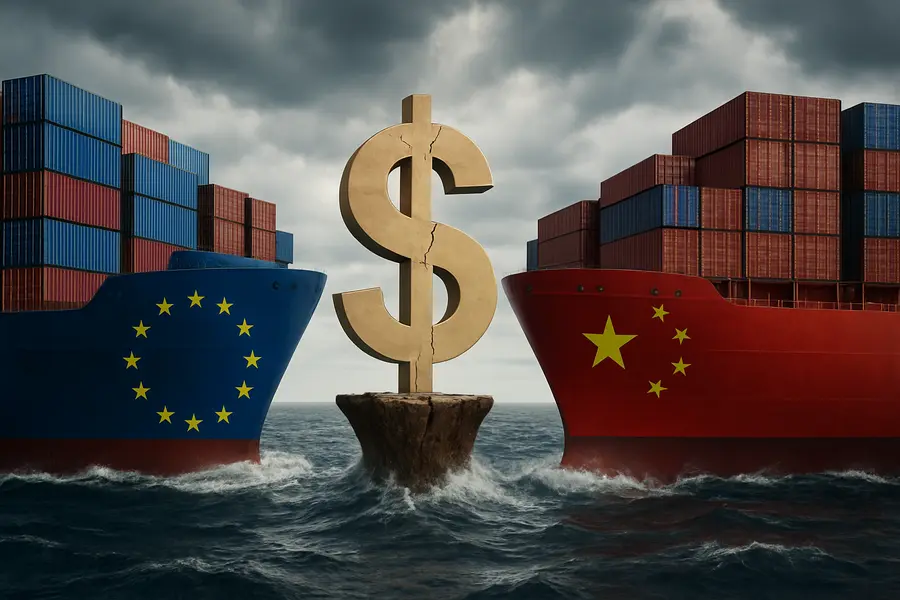
Fresh analysis shows a full EU-China trade war hits Europe harder than Beijing, with GDP losses potentially exceeding 1% amid deep supply-chain exposure.
- The EU's goods trade deficit with China reached €359.9 billion in 2025 and widened a further 10% in the first four months of 2026.
- A full-scale trade confrontation could cut EU GDP by more than 1%, with Germany facing a potential $134 billion four-year loss alone.
- European retaliation tariffs risk functioning as a supply-chain tax on domestic manufacturers given the bloc's structural dependence on Chinese inputs.
Lead
Brussels is confronting an uncomfortable arithmetic: the harder it pushes against Chinese exports, the more it risks damaging its own industrial base. Multiple independent economic assessments published through mid-2026 conclude that in a full-scale EU-China trade war, it is Europe — not China — that absorbs the steeper economic cost, a structural asymmetry now at the centre of the bloc's cautious and internally divided response.
Growing Trade Imbalance
The numbers that precipitated the debate are stark. The EU vs China trade deficit in goods reached €359.9 billion ($414 billion) in 2025, a 15% increase from the prior year. The gap has not stabilized in 2026: in the first four months alone, Beijing accumulated a surplus of $113 billion with the EU-27, up from $91 billion in the same period a year earlier. The EU's Q1 2026 trade deficit with China of €98 billion was the widest since Q3 2022.
Since 2021, Chinese exports to the EU have expanded at a compound annual rate of 6%, while EU exports to China have contracted by 2.5% per year, falling to just under €200 billion in 2025. Displacement has been sharpest in the automotive, steel, chemicals, batteries, and solar sectors. Chinese chemical imports into the EU alone have surged 81% over five years, according to European Commission data.
The Cost Asymmetry
The central finding from Allianz Trade and broader economic modelling is that the EU occupies a uniquely exposed position in any tit-for-tat escalation. The bloc simultaneously consumes large volumes of Chinese intermediate goods — components, materials, and modules embedded in European manufacturing — and exports the premium final goods that Beijing can most plausibly restrict.
Allianz Trade estimates that a full EU trade war cost scenario could strip 1% or more from EU GDP, with Germany — the bloc's largest economy — potentially losing 1.4% of GDP by 2028, amounting to more than $134 billion over four years. Some $67 billion in EU exports face direct threat in 2025 and 2026, concentrated in automotive, transport equipment, and metals. The ECB has separately calculated that the surge in Chinese industrial capacity is already contributing a 0.2-percentage-point drag on euro area GDP growth in 2026, prior to any formal trade war.
The self-harm mechanism is structural. When European tariffs are applied across machinery, chemicals, cars, and batteries — as the political logic of a trade confrontation demands — they simultaneously raise input costs for European manufacturers who depend on Chinese-sourced components. The punitive measure and the supply-chain tax become, at that point, the same instrument. Allianz Trade analysts have concluded that by broadly aligning its trade posture with Washington, Europe is currently absorbing damage exceeding that felt by the US economy itself.
Europe's Strategic Vulnerabilities
China retains meaningful leverage across several dimensions. A state-affiliated Chinese broadcaster identified EU luxury goods, alcohol, meat, and cosmetics as plausible retaliation targets — sectors directly relevant to France, Spain, and Italy. Beijing can also redirect its manufacturing surplus toward Asian and emerging-market export channels, a flexibility less available to European industrial producers already competing with Chinese imports at home.
The PIIE noted in a June 2026 assessment that Europe lacks a coherent strategy toward China, leaving it exposed to bilateral pressure from both Washington and Beijing simultaneously. Allianz Trade framed the dilemma in similarly direct terms: the EU risks falling between two stools through half-measures and internal divisions, gradually becoming reactive rather than strategic in its trade posture.
Brussels Moves Toward Action
Political pressure for a tougher European response has intensified regardless. French President Emmanuel Macron formally called for a "European equivalent of Section 301" — the US statute enabling broad tariff authority over unfair trade practices — drawing reported backing from Germany, Poland, the Netherlands, and Belgium in June 2026. The framing marks a shift: where Brussels once positioned itself as a rules-based counterweight to Washington's unilateralism, it is now adopting the vocabulary of industrial protection.
The European Commission signalled on May 29 that its economic and security interests require "a more robust and coherent response" to the Chinese export surge and outlined plans to present additional trade-defense tools in September 2026. The EU has already pushed through new quotas and doubled tariffs on steel imports dominated by Chinese overcapacity, approved by EU member states and the European Parliament in April.
The Anti-Coercion Instrument — sometimes called the bloc's "trade bazooka" — remains available as a last resort for cases of deliberate economic pressure, though activation requires a qualified majority of member states, a threshold that persistent internal divisions make uncertain.
Member State Divisions
One central obstacle to coordinated action is the asymmetric exposure of member states. Countries with significant automotive, chemicals, and machinery manufacturing face Chinese retaliation risks that differ sharply from those facing southern European economies more exposed through luxury and food-and-beverage sectors. The European Commission has indicated that bundling trade-defense action across multiple sectors could help distribute costs and benefits more evenly, reducing the risk of Beijing exploiting bilateral divisions.
Outlook
The trade war impact 2026 picture from the latest analysis is one of asymmetric vulnerability. Europe's broad-based industrial structure, deep integration with Chinese supply chains, and dependence on export revenues create conditions in which escalation imposes proportionally larger losses on the EU than on Beijing. Whether the September 2026 trade-defense package addresses the underlying structural exposure — or merely concentrates the cost on sectors least equipped to absorb it — will determine whether Brussels has found a sustainable posture or has simply redirected the damage from Chinese producers to European ones.