Pomegra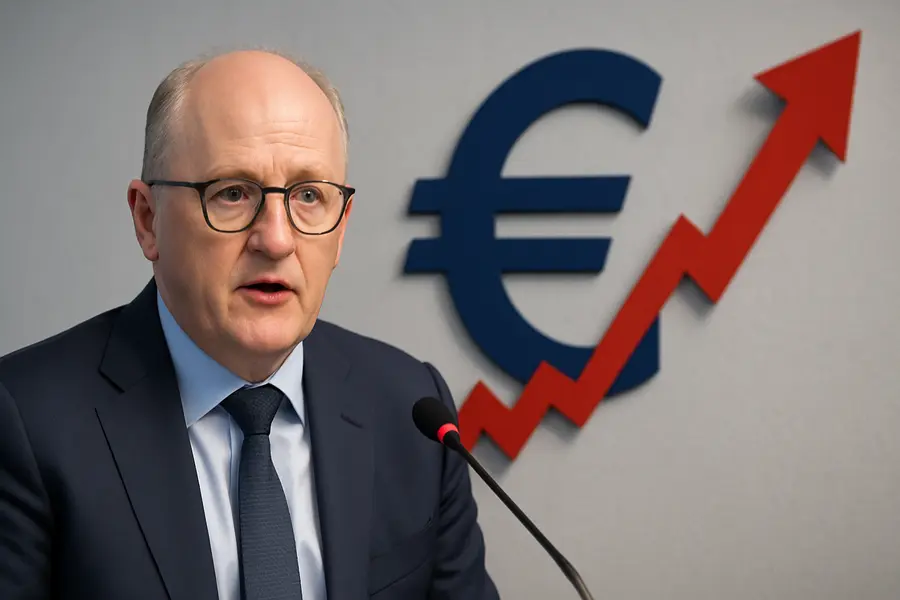
Philip Lane, the ECB's Chief Economist, signals the bank will remain proactive on eurozone inflation, keeping additional rate hikes firmly on the table after June's 25-basis-point move.
- The ECB raised its deposit facility rate to 2.25% on June 11, 2026 — its first hike since 2023 — effective June 17
- Eurozone headline inflation hit 3.2% in May; the ECB now forecasts 3.0% for full-year 2026, up from 2.6%
- Philip Lane cites wage growth and corporate price expectations as the key variables that could trigger further tightening
Lead
Philip Lane, the European Central Bank's Chief Economist, issued a clear signal on June 16, 2026 that the ECB stands ready to raise interest rates again if eurozone inflation fails to retreat, one week after the bank delivered its first rate increase in nearly three years. Speaking one day before the ECB's June 11 decision took effect, Lane stressed the institution would remain "proactive" in its fight against persistent price pressures, even as energy markets have begun to stabilize following a United States-Iran ceasefire agreement. The remarks underscore that European monetary policy has entered a new tightening phase with no predetermined ceiling.What Happened
The ECB's Governing Council voted on June 11 to raise all three of its key interest rates by 25 basis points, bringing the deposit facility rate to 2.25%, the main refinancing rate to 2.40%, and the marginal lending facility rate to 2.65%. The decision, effective June 17, marks the first ECB rate hike since 2023 and ends a prolonged period of easing that had taken the deposit rate to 1.75% earlier in 2026.
Alongside the rate decision, the ECB published materially revised macroeconomic projections. The bank lifted its headline inflation forecast for 2026 to 3.0%, from 2.6% previously, and raised its 2027 projection to 2.3%, above the prior estimate of 2.0%. Core inflation — stripping out energy and food — was revised upward to 2.5% for both 2026 and 2027, compared to earlier estimates of 2.3% and 2.2%. Eurozone headline inflation had already reached 3.2% in May, the latest available reading, well above the ECB's 2% target.
On the growth side, the ECB trimmed its eurozone GDP outlook to 0.8% for 2026, down from 0.9%, and to 1.2% for 2027, down from 1.3%, reflecting the drag from higher energy costs and tighter financial conditions.
Lane's Forward Guidance
Philip Lane ECB communications have been notably hawkish since the March meeting. In his June 16 remarks, Lane underlined that oil prices remain elevated compared to pre-conflict levels, even after the partial easing that followed the Iran ceasefire, and that the ECB's commitment to returning inflation to its 2% target remains unconditional.Lane identified two sets of indicators as central to any decision on further tightening: corporate price-setting behavior — whether companies continue to embed elevated price expectations in forward contracts — and wage dynamics for new hires, which offer the most forward-looking signal on labor cost pressures. Should either metric fail to moderate, Lane made clear the Governing Council retains full latitude to move again.
At the same time, Lane confirmed the ECB will proceed "meeting by meeting" without pre-commitment, maintaining a data-dependent posture across a range of scenarios for how the Middle East energy shock continues to evolve. The approach mirrors language used by the U.S. Federal Reserve during its own tightening cycles, placing maximum optionality in the hands of policymakers.
Strategic Context
The June hike represents a significant pivot for the ECB, which had spent much of the previous two years cutting rates as it sought to balance softening growth against an inflation rate that had been slowly converging toward target. The Iran conflict reshaped that calculus sharply: energy price spikes in late 2025 and early 2026 reignited inflationary dynamics across the eurozone's four largest economies — Germany, France, Italy, and Spain — all of which reported stubbornly elevated readings through May.
Lane has consistently argued internally that the risk of falling "behind the curve" — of allowing elevated inflation to become entrenched in wage and price-setting behavior — outweighs the near-term cost to economic growth of moving rates higher. That framing effectively set the policy direction and gave the June 11 decision its analytical foundation.
ECB President Christine Lagarde reinforced this posture in March, when she signaled the bank was prepared to hike even if any inflation surge proved short-lived, prioritizing institutional credibility over fine-tuning the economic cycle.
Market Reaction
European financial markets absorbed the June decision with limited disruption, as pricing in overnight-indexed swaps had fully reflected a 25-basis-point move ahead of the announcement. Attention shifted immediately to whether the ECB would follow with a second consecutive hike at its July meeting. Market-implied rates suggest a roughly even probability of an additional 25-basis-point increase by September 2026, contingent on incoming inflation and wage data.The euro strengthened modestly against the U.S. dollar in the days following the decision, supported by the hawkish tilt in Lane's subsequent communications.
Outlook
The ECB has moved decisively back into tightening mode, with the June ECB rate hike marking a policy inflection that Lane's June 16 remarks suggest is not yet complete. With eurozone inflation at 3.2% and ECB projections placing price growth above 2% through 2027, the threshold for pausing — let alone reversing — remains high. Corporate pricing behavior and new-hire wage data over the next six to eight weeks will be the primary determinants of whether the Governing Council moves again at its July meeting, or opts to hold while assessing the lagged effects of June's tightening on credit conditions and aggregate demand.
Mentioned tickers: N/A