Pomegra
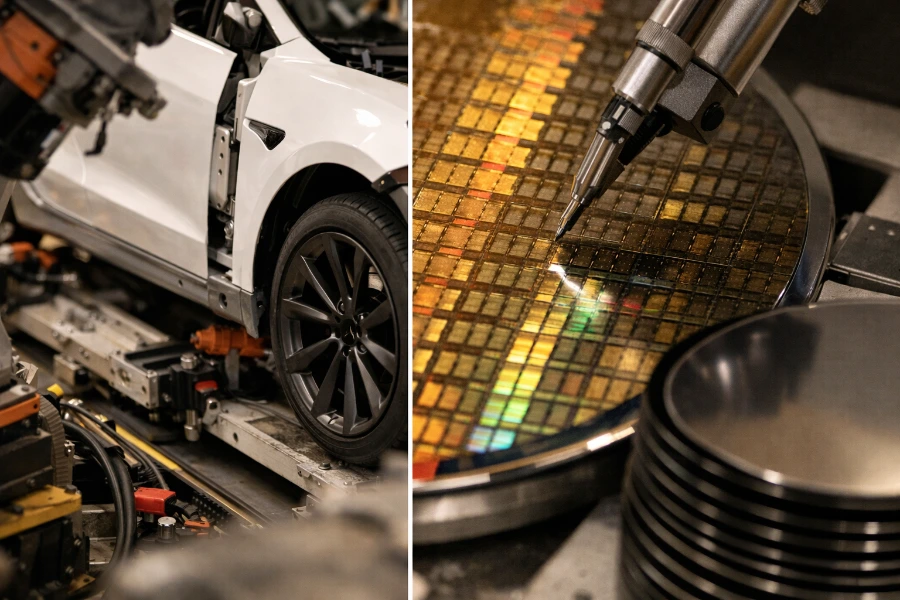
Democrats' midterm sweep revived fears of tougher AI data center rules, driving a selloff in Tesla, SpaceX, Palantir and chip stocks and a Nasdaq correction.
- The S&P 500 fell 4.3% and the Nasdaq Composite 5.5% on Nov. 5, the first full session after Democrats won both chambers.
- The Philadelphia Semiconductor Index lost 12%; Tesla and SpaceX shares each fell more than 9%.
- Stocks steadied Nov. 6 after a stronger-than-expected jobs report, but data center regulation remains unresolved.
Lead
Stock market today reflects a repricing of political risk. Democrats won control of the House and the Senate in the Nov. 3 midterms, flipping seven Senate seats and at least two dozen House districts. On Nov. 5, Wall Street sold the stocks most exposed to the AI infrastructure build-out. The Dow Jones Industrial Average dropped more than 1,800 points, or 3.4%. The S&P 500 fell 4.3% and the Nasdaq-100 6.3%, erasing about $2.3 trillion in market value. The Nasdaq Composite slid 5.5% and moved into correction territory, more than 10% below its record. The Cboe Volatility Index jumped more than 65% in a day, touching 27.45, its largest one-day rise since 2024.
Why Did AI Stocks Fall After the Midterms?
AI stocks fell because the election raised the odds that new rules will slow the construction of data centers, the power-hungry facilities that underpin demand for advanced chips and cloud software. Many winning Democratic candidates ran against data center expansion, citing electricity prices, water use and local tax breaks. Dozens of local ballot measures in states including Ohio, Maine, Illinois and Kansas restricted new projects or rejected measures that would have eased approvals. A majority of the incoming Democratic governors back stronger oversight, and a sizeable minority support moratoriums.
The result put a political ceiling on assumptions that had supported the AI trade for two years. Spending commitments by large technology companies are the main source of revenue for chipmakers. Any delay in permitting, grid connections or tax treatment feeds directly into those forecasts. Weak results from Qualcomm (QCOM) and Arm Holdings (ARM) added to the pressure that day.
Market Reaction
The damage concentrated in semiconductors. Nvidia (NVDA) fell 9.3% to about $181.60. Advanced Micro Devices (AMD) dropped roughly 15% to 17%, depending on the measure, and Micron Technology (MU) lost more than 12%. The Philadelphia Semiconductor Index declined 12%, one of its worst sessions on record. Chip stocks shed roughly $1.5 trillion in value in a single day.
Software names tied to AI deployment also sold off. Palantir Technologies (PLTR) lost more than 10%, shedding about $40 billion in market value, and closed Nov. 6 at $160.38, down nearly 10% for 2026.
For the week of Nov. 2 to Nov. 6, the Nasdaq Composite lost 3.4%, the S&P 500 lost 2.7% and the Dow lost 0.9%.
Why Are Tesla and SpaceX Falling?
Tesla and SpaceX are falling because the Democratic victory raises regulatory and oversight risk across Elon Musk's businesses at the same time as the AI selloff. Tesla (TSLA) fell 10.8% on Nov. 5, and SpaceX (SPCX) fell 9.05% to $123.62, well below its 52-week high of $225.64. Together the two companies lost about $456 billion in market value over two sessions, which investors dubbed the "Musk selloff." Musk's net worth fell about 9% to roughly $789.5 billion.
Several channels explain the move:
- Autonomy approvals. Tesla's robotaxi and driver-assistance ambitions depend on federal and state sign-offs that a Democratic Congress can scrutinize through hearings and oversight.
- Government contracts. SpaceX is a major supplier of defense launches, Starlink connectivity and military communications, which makes its awards a likely target for congressional review.
- Data center exposure. Stricter state rules on AI facilities would affect Musk's compute plans.
- Merger path. A possible combination of Tesla and SpaceX now faces a harder regulatory route in 2027.
Tesla rebounded 4.2% on Nov. 6 to $358.22, though it remains down about 20% for the year.
What Happened on Nov. 6?
Stocks stabilized on Nov. 6, with mixed results across the major indexes. The Nasdaq Composite rose 1.09% to 24,579.42 and the S&P 500 gained 0.31% to 7,376.86. The Dow slipped 0.46% to 51,285.73.
The October jobs report supported sentiment. Employers added 165,000 positions, against expectations of roughly 59,000, and the unemployment rate held at 4.1%. Growth is running near 3.4% and corporate earnings are up more than 25% from a year earlier, which gave buyers a fundamental argument that the selloff overshot. Futures pointed to further gains in Asia-Pacific trading ahead of Monday.
What Comes Next for Data Center Regulation?
The next phase will be set in state capitols and in Congress, and it will unfold over months rather than days. The Democratic House majority takes office in January and will gain subpoena power. State measures are likely to arrive first. Proposals on the table include disclosure of water and energy use, community consent requirements before approval, and repeal of sales tax exemptions for data center operators.
A patchwork of state rules is the most likely outcome, with some jurisdictions open to new capacity and others closed. That would raise costs and lengthen timelines for hyperscale builders without necessarily halting demand for chips. A federal framework is less likely in the near term, because Republicans retain influence over the Senate calendar through procedural tools and the White House holds a veto.
The bear case is that permitting delays push out chip orders and force a reset in 2027 capital spending guidance. The bull case is that large buyers shift capacity to friendlier states, and that power constraints already limited the pace of construction before the election. Quarterly earnings from chipmakers and cloud providers will show which view prevails.
Outlook
The midterm result converted a diffuse concern about AI spending into a concrete political risk. The first test is whether the Nov. 5 lows hold, with volatility still elevated and the Nasdaq in correction territory. The second is whether chipmakers and cloud operators hold their capital spending plans when they next report. For Tesla and SpaceX, the question is how quickly a Democratic Congress turns its attention to autonomy approvals and federal contracts.
Mentioned tickers: TSLA, SPCX, PLTR, NVDA, AMD, MU, QCOM, ARM