Pomegra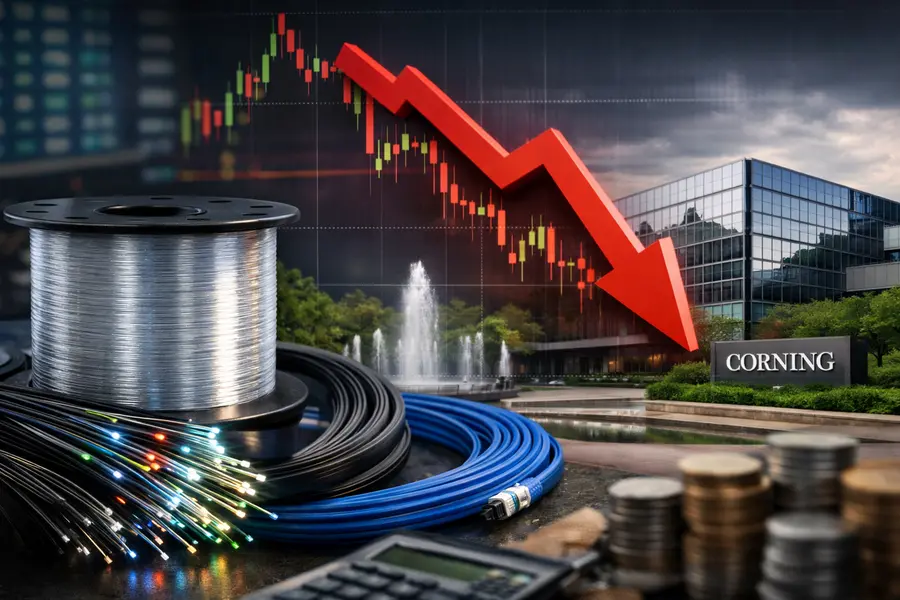
Corning's optical fiber cable segment delivered 32% revenue growth in Q2 2026, a marked deceleration from the 81% surge recorded a year earlier, sending shares sharply lower after guidance missed estimates.
- Optical Communications revenue rose 32% YoY to $2.07B in Q2 2026, down from 81% growth in Q2 2025 and 36% in Q1 2026
- GLW shed roughly 16% on July 28 after Q3 revenue guidance of $4.9B–$5.0B came in slightly below consensus
- Amazon and NVIDIA supply agreements underpin a $2B 2026 capex plan, though new fiber lines take months to qualify
Lead
Corning Incorporated (NYSE: GLW) dropped approximately 16% on July 28, 2026 — one of its steepest single-session declines in recent years — after the specialty Corning glass and fiber optic cable manufacturer reported second-quarter core sales of $4.74 billion, up 17% year over year, alongside a third-quarter outlook that landed modestly short of Wall Street expectations. Shares fell from a prior close near $143 to a premarket trough around $119, shedding more than $24 per share, before settling in the mid-$130s on heavy volume.
What Happened
The company's Optical Communications segment generated $2.07 billion in Q2 2026 revenue, a 32% year-over-year gain that in absolute terms signals robust demand. The comparison set, however, unsettled investors: the same unit had grown 81% in Q2 2025 and 36% in Q1 2026, making the sequential deceleration unmistakable. Enterprise Networks within the optical division rose 65%, and segment net income climbed 77% to $438 million, confirming that margins are expanding — but the headline growth rate drew the market's attention.
Consolidated core earnings per share reached $0.78 in the quarter, a 30% year-over-year increase. Management guided Q3 core EPS to $0.85–$0.89, implying roughly 28% growth, and revenue to $4.9 billion–$5.0 billion, representing approximately 16% expansion. The revenue midpoint at $4.95 billion came in slightly below the consensus figure, triggering a broad reassessment of a valuation that had been anchored to hypergrowth assumptions in fiber optic cable infrastructure.
Market Reaction
GLW's selloff unfolded in premarket trading immediately after the earnings release, with the stock touching an intraday range of $136.31 to $148.69 during the session as buyers stepped in to narrow the gap. Volume ran well above average, reflecting institutional repositioning rather than isolated retail activity.
Strategic Context
Management emphasized that the growth deceleration does not reflect softening customer demand — orders continue to outpace current shipping capacity. The constraint is physical: expanding Corning glass fiber fabrication requires months to commission, qualify, and ramp new production lines before they contribute revenue. The company has allocated approximately $2 billion in capital expenditure for 2026 to accelerate that buildout.
Two landmark supply agreements announced alongside the results illustrate the structural demand backdrop. Amazon signed a multiyear, multibillion-dollar contract to source Corning's fiber optic cable, optical connectivity hardware, and related solutions for its expanding U.S. data center footprint. NVIDIA entered a long-term partnership under which Corning will scale its U.S. optical connectivity manufacturing tenfold and expand domestic fiber production capacity by more than 50% to support the accelerating pace of AI factory construction.
Outside of optical, soft global smartphone demand continued to weigh on Corning's display and specialty glass divisions, providing a secondary drag on consolidated guidance and compounding the market's reaction to the deceleration in the core optical franchise.
AI and Technology Angle
The optical unit's deceleration arrives at a moment when generative-AI infrastructure spending is accelerating across hyperscale operators. Demand for high-density fiber optic cable in data centers — driven by the shift from copper to optical interconnects inside AI clusters — has outrun the industry's ability to add capacity quickly enough. The Amazon and NVIDIA agreements provide multi-year revenue visibility and validate Corning's position as a critical link in the AI buildout supply chain, but the pace of capacity additions will govern whether optical growth reaccelerates.
Outlook
The gap between the 81% optical growth investors priced into GLW over the past year and the 32% rate now in evidence is the central tension. Core profitability is expanding — 30% EPS growth, 77% optical segment income growth — and two of the largest AI infrastructure spenders have committed to multiyear supply arrangements with Corning. The near-term trajectory hinges on how quickly the $2 billion capex program brings new fiber optic cable and Corning glass manufacturing lines to full qualification, a process management has not accelerated beyond physical limits. Structural demand for optical infrastructure tied to AI remains intact; the question is one of delivery timing, not destination.