 Pomegra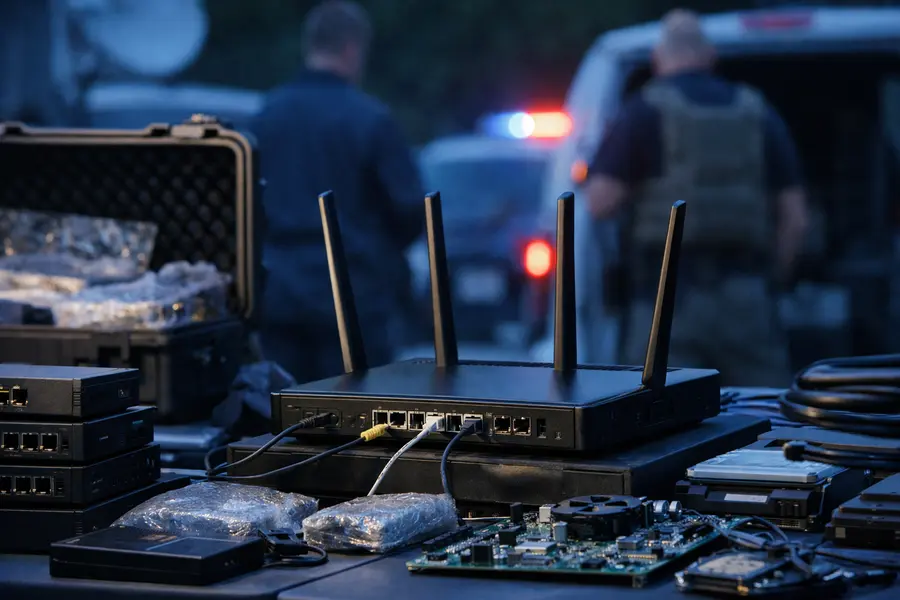
The Justice Department and FBI shut down two Chinese state-sponsored cyber-espionage platforms Wednesday, revealing an eight-year infiltration of the Federal Reserve, NASA, the DOJ, the U.S. Senate, and three additional federal agencies.
- QTFY, contracted by China's Ministry of State Security and People's Liberation Army, compromised seven U.S. federal agencies since at least 2018.
- The DOJ seized three domains - qtproxy.xyz, qt-proxy.org, and qt-team.com - rendering QScan and QTRouter inoperable.
- Nanjing Xinjiuwei Network Technology, a 17-person firm founded in 2018, operated the platforms as a state-contracted front company.
Lead
Federal prosecutors unsealed court documents Wednesday authorizing the seizure of three internet domains tied to QScan and QTRouter, two complementary Chinese state-sponsored hacking platforms that enabled a persistent espionage campaign against the Federal Reserve, the National Aeronautics and Space Administration, the Department of Justice, the U.S. Senate, the National Institutes of Health, the Department of Energy, and the Department of Health and Human Services. The action represents one of the most expansive documented penetrations of American federal institutions on record and marks a significant escalation in Washington's active posture against PRC-linked cyber operators.
What Are QScan and QTRouter?
QScan is automated malware that systematically scans and infects thousands of internet-of-things devices worldwide, conscripting consumer routers, cameras, and connected hardware into a controlled botnet. Those compromised devices, combined with commercial proxy servers and leased virtual private servers, form the QTRouter obfuscation network - a global relay system designed to mask the PRC origin of intrusion traffic by routing attacks through innocent third-party devices across multiple jurisdictions. Together, the platforms gave QTFY and its government clients in Beijing a scalable, deniable capability to penetrate sensitive networks and exfiltrate data without a traceable fingerprint pointing back to China.
The seized domains - qtproxy.xyz, qt-proxy.org, and qt-team.com - were hard-coded into both malware packages. Their removal rendered the entire infrastructure inoperable.
Who Is Behind the QTFY Hacking Campaign?
QTFY is a PRC-linked contractor run by Nanjing Xinjiuwei Network Technology Company, a Jiangsu province-based firm established in 2018 with 17 employees as of last year. Court documents confirm the company contracted directly with the Ministry of State Security and the People's Liberation Army, offering bespoke cyber-intrusion services including access to QScan and QTRouter. The arrangement is consistent with China's established model of outsourcing offensive cyber operations to nominally private firms, providing the state with political deniability while maintaining persistent operational capability. The group's infrastructure was active since at least 2018, meaning QTFY's access to U.S. federal networks may have persisted for up to eight years.Why Did Beijing Target the Federal Reserve and DOJ?
The victim list reflects deliberate strategic targeting. The Federal Reserve governs U.S. monetary policy and holds sensitive financial and regulatory data; the Department of Energy oversees nuclear assets and critical infrastructure; the Department of Justice manages prosecutorial strategy across national security investigations; the U.S. Senate holds classified legislative intelligence across defense and appropriations committees. Access to any one of those networks carries substantial intelligence value - combined, the penetration offered Beijing a comprehensive window into U.S. legal, financial, scientific, and legislative decision-making.
The campaign fits a documented pattern of Chinese cyber espionage in which state actors pre-position within critical networks aligned to economic leverage points and potential Taiwan contingency planning. The public unsealing came as U.S.-China tensions remain structurally elevated following the April 2025 tariff escalations, confirming that cyber operations and economic confrontation are running as parallel and mutually reinforcing tracks.
Geopolitical Dimension
The QTFY disruption is the latest in Washington's shift from passive attribution toward active counter-offensive operations - seizing infrastructure, unsealing indictments, and coordinating with allied intelligence services. That posture has hardened following earlier campaigns by Salt Typhoon, which penetrated U.S. telecom carriers, and Volt Typhoon, which pre-positioned inside U.S. power grids. The public naming of Nanjing Xinjiuwei adds a private Chinese firm to the growing roster of indicted or sanctioned entities and raises the diplomatic and reputational cost of future contractor-model operations.
For Microsoft (MSFT), CrowdStrike (CRWD), and Palo Alto Networks (PANW) - whose threat intelligence divisions have documented successive Chinese APT campaigns - the DOJ's action validates the sector's core investment thesis: state-sponsored cyber threats against government and critical infrastructure are an enduring, not cyclical, demand driver. Shares of CRWD, PANW, and adjacent ai stocks in the security intelligence space have historically reacted positively to high-profile state-attribution events that accelerate federal procurement cycles.
Outlook
Seven federal agencies confirmed as QTFY victims face immediate damage assessment and remediation requirements, with particular scrutiny on the Federal Reserve given any potential exposure of monetary policy deliberations or internal financial data. Congressional oversight bodies are expected to accelerate cybersecurity mandate proposals for critical infrastructure operators. The DOJ's action confirms that the U.S.-China confrontation is operating simultaneously across trade, export controls, capital markets, and now documented cyber seizures - a multi-front engagement with no near-term off-ramp. Further counter-operations targeting PRC-linked contractor networks remain probable as Washington's counter-cyber posture continues to shift from defense to active disruption.