Pomegra
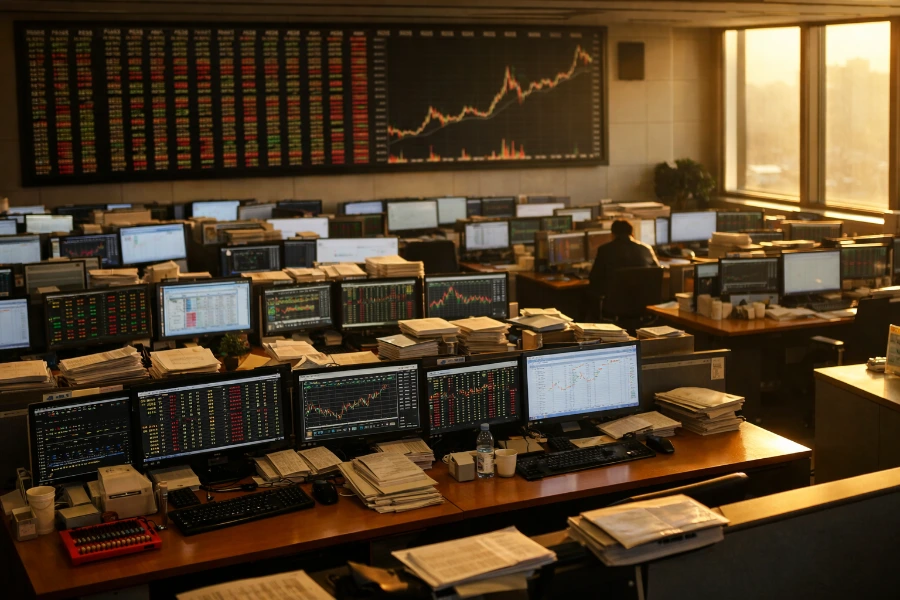
China's Shanghai Composite jumped 4.2%, its best day in two years, after the State Council pledged a bigger role for national team investors to steady stocks.
- Shanghai Composite closed up 4.2% and the CSI 300 gained 3.7%, both the biggest daily gains since October 2024.
- The State Council named Central Huijin as a quasi-stabilization fund and promised liquidity and long-term capital for equities.
- The STAR 50 index rose 15% in a day, and semiconductor indices gained more than 17%.
Lead
Chinese equities posted their strongest session in two years on Friday, November 27, after Premier Li Qiang chaired a State Council executive meeting. The meeting called for a larger role for state-backed "national team" investors to stabilize a falling market. The Shanghai Composite Index ended 4.2% higher and the blue-chip CSI 300 closed up 3.7%. The Shenzhen Component rose 7.2%, the Hang Seng Index gained 2.1%, and the yuan strengthened.
What Did the State Council Announce?
The State Council said the "national team" will play a greater role in the market, and Xinhua noted it was the first time the term had appeared in a State Council executive meeting release. The statement was issued during the midday trading break, a timing that amplified its effect on the afternoon session.
Central Huijin Investment, the sovereign wealth fund's domestic arm, will optimize its function as a quasi-stabilization fund. It is to provide sufficient liquidity in times of turmoil. The cabinet also pledged to improve policies that guide long-term funds into equities and to crack down on financial fraud. It encouraged listed companies to raise dividend payouts and share buybacks. The statement gave no funding figures and referred to "incremental" additional measures.Why Did China's Stocks Jump So Sharply?
Stocks jumped because the statement was the most direct signal of state backing since the stimulus rollout of October 2024, and it landed on a deeply oversold market. The CSI 300 had fallen more than 20% from its June 2026 peak and entered bear-market territory in October. It was caught in a decline of about ten weeks. The ChiNext Index had touched its lowest level since July 2025.
The pressure came from excess industrial capacity, weak consumer demand and a prolonged property slowdown. Retail investors account for roughly 90% of daily trading volume, so shifts in confidence move prices quickly. The downturn has been described as a crisis of confidence rather than a fundamental economic crisis, and a credible backstop addresses that directly.
The gains were concentrated in technology. The tech-focused STAR 50 Index surged 15%, its biggest one-day jump in two years. The CSI Semiconductor Industry Index and the STAR Chip Index each rose more than 17%. Indices tracking artificial intelligence, cloud computing and consumer electronics gained more than 10%.
Where Does China's Stock Market Today Stand After the Rally?
China's stock market today remains below its June peak despite the surge, and a single session has not reversed a ten-week slide. The CSI 300's 3.7% gain recovers only part of a decline of more than 20%.
The national team is a group of state-linked funds led by Central Huijin that buy equities to counter sharp selloffs. Its interventions are typically aimed at limiting volatility rather than setting a price floor. The absence of a stated funding amount leaves the scale of future buying uncertain.
Can Beijing's Support Sustain the Rally?
Support from the national team alone is unlikely to produce a lasting advance, according to the prevailing market view. Earlier rallies tied to policy announcements have often faded when they were not followed by fiscal or earnings support. The October 2024 surge is the closest precedent. It was driven by a wider stimulus package, not by market-support language alone.
Three factors will shape the next phase:
- Follow-through on funding. Disclosure of Central Huijin purchases or new liquidity facilities would show how large the backstop is.
- Dividend and buyback uptake. Higher payouts from listed companies would support valuations in a market dominated by retail traders.
- Economic data. Consumer demand and property activity will determine whether earnings can support prices without state purchases.
Outlook
The State Council's formal endorsement of the national team produced the biggest one-day gain in Chinese equities since October 2024. It also lifted the yuan. The rally rests on a policy signal, not on new fiscal spending or a change in economic data. Whether it extends depends on the size of the follow-up measures and on evidence that domestic demand is stabilizing.