Pomegra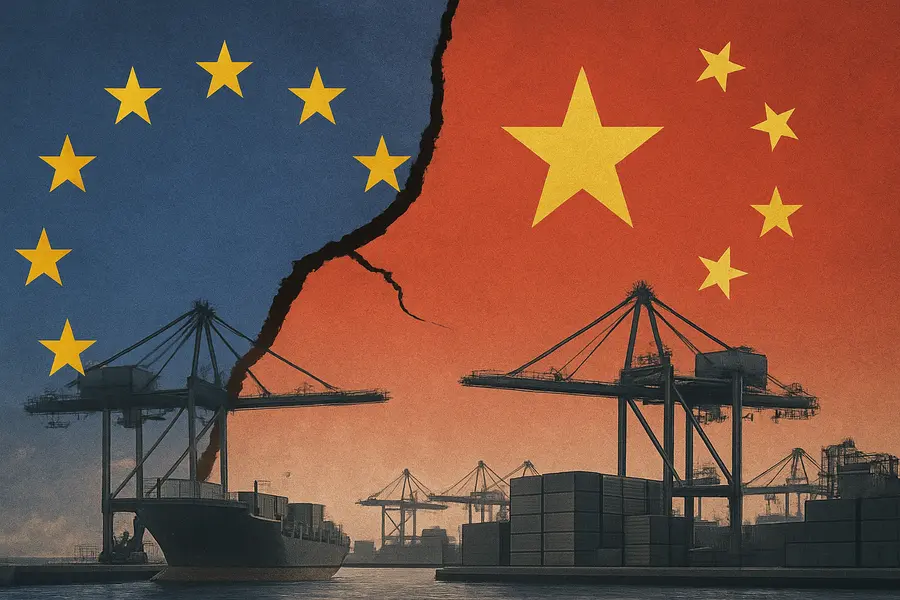
Beijing signals it can absorb a complete halt in EU-China economic ties as Brussels expands tariff measures and warns the trade relationship is unsustainable.
- China's CCTV-affiliated Yuyuantantian declared June 28 that Beijing can endure a full freeze in EU-China economic and trade ties.
- The EU's goods deficit with China reached €360.6 billion in 2025, growing a further 10% in early 2026 to roughly €1 billion per day.
- Brussels has escalated tariffs on Chinese EVs, ceramics, and steel as it prepares a broader trade defense overhaul.
Lead
China can endure a complete breakdown in economic and trade ties with the European Union, Beijing's state-linked media declared on June 28, 2026 — a pointed signal as the EU-China trade war threat intensifies and the bloc's goods deficit with China approaches €1 billion per day.
What Happened
Yuyuantantian, a social-media account affiliated with China Central Television, stated that Beijing trade resilience is sufficient to absorb even a freeze in bilateral economic ties should European negotiations collapse into formality. The account accused the EU of transforming from a rule-setter into a "rule-breaker," charging that Brussels increasingly uses probe mechanisms and market-access conditions as negotiating leverage. The 2024 electric-vehicle subsidy investigation was cited as the inflection point at which European trade strategy shifted from regulatory process to economic coercion.
The statement follows a June 26 state-media warning that China-EU ties risk dropping to a "freezing point," marking an escalation in rhetoric that mirrors rising friction across trade, technology, and industrial policy fronts.
The Trade Imbalance at the Core
The structural driver of the dispute is stark. China's goods trade surplus with the EU climbed to €360.6 billion ($413.4 billion) in 2025, a 15% year-on-year increase, and expanded a further 10% in the opening four months of 2026 as Chinese exports rose while EU shipments to China fell. The deficit has reached roughly €1 billion per day — a figure EU heads of state placed on the agenda at their June summit.
In the first quarter of 2026 alone, EU imports from China reached €145 billion, with the bilateral deficit widening from €65 billion in Q1 2024 to €98 billion. Germany, historically the EU's most trade-exposed economy to China, recorded a record bilateral deficit of €90 billion in 2025. China accounts for roughly 30% of global manufacturing output while representing only 13% of global consumption — a structural imbalance that drives export pressure across sectors.
EU's Defensive Escalation
Brussels has moved with increasing conviction. In 2024, the European Commission imposed additional tariffs on Chinese electric vehicles: 17% on BYD, 18.8% on Geely, and more than 35% on SAIC, atop the existing 10% levy. Despite an initial dip in imports, Chinese producers pivoted toward hybrid vehicles and have since recovered European market penetration.
On February 7, 2026, the Commission raised anti-dumping tariffs on ceramic and porcelain imports from 18–36% to a consolidated 79%. Beginning in July 2026, the EU will cut tariff-free steel import quotas by 47% — from roughly 33 million tonnes to 18.3 million — and double out-of-quota duties from 25% to 50% through 2031, targeting Chinese overcapacity that the European Parliament projects could reach 721 million tonnes by 2027, nearly five times total EU steel consumption. Tariffs on hybrid vehicles are in active preparation.
The European Commission declared in May 2026 that its trade relationship with China is "not sustainable," committing to a "more robust and coherent response" while privately acknowledging high probability of Chinese retaliation.
Beijing Trade Resilience: The Countercase
Beijing trade resilience rests on a shift in export geography and a surge in overall trade volumes. China's total goods imports and exports rose 16.9% year-on-year to 4.45 trillion yuan (approximately $653 billion) in May 2026 alone, underscoring the depth of the structural buffer Beijing is drawing on. In 2025, China's trade sector achieved what authorities described as "counter-trend growth" amid global economic softness and elevated geopolitical friction.Beijing has deepened trade ties with Southeast Asia, the Middle East, Latin America, and Africa, reducing structural dependence on European demand. Within the broader context of global trade 2026, world merchandise trade growth is projected to slow to between 1.5% and 2.5%, down from 4.7% in 2025 — conditions in which geographic diversification carries lower near-term cost for China than in previous cycles.
Strategic Context
The EU-China trade war risk reflects a deeper structural tension. The EU lacks a unified strategy toward China — member states diverge sharply on how aggressively to confront Beijing, given varied export exposures to the Chinese market. France has pressed for assertive trade defense; Germany and several eastern European states have urged caution, fearing reciprocal measures against automotive and manufacturing sectors.
Beijing has banned Chinese companies from engaging with the European Commission over EU foreign subsidy investigations and threatened retaliatory measures against European brands with significant China revenue, creating asymmetric leverage Brussels has yet to fully counter. The China trade freeze scenario, while not a base case, now carries sufficient credibility to shape the negotiating calculus on both sides.
Outlook
The declaration from Beijing's state-linked media that China can withstand a China trade freeze marks a hardening of posture that constrains Brussels' leverage even as European trade defenses expand. The EU's €360.6 billion goods deficit, widening steel and EV exposure, and internal strategic divisions give Beijing structural confidence heading into the second half of 2026. With steel quotas tightening from July, hybrid-car tariffs in preparation, and diplomatic talks under pressure, the bilateral relationship faces its most acute test of the decade. Both sides retain strong economic incentives to avoid a full rupture, but the gap between stated positions narrowed sharply in late June 2026, and the trajectory of global trade 2026 will be shaped in part by whether either side blinks first.