Pomegra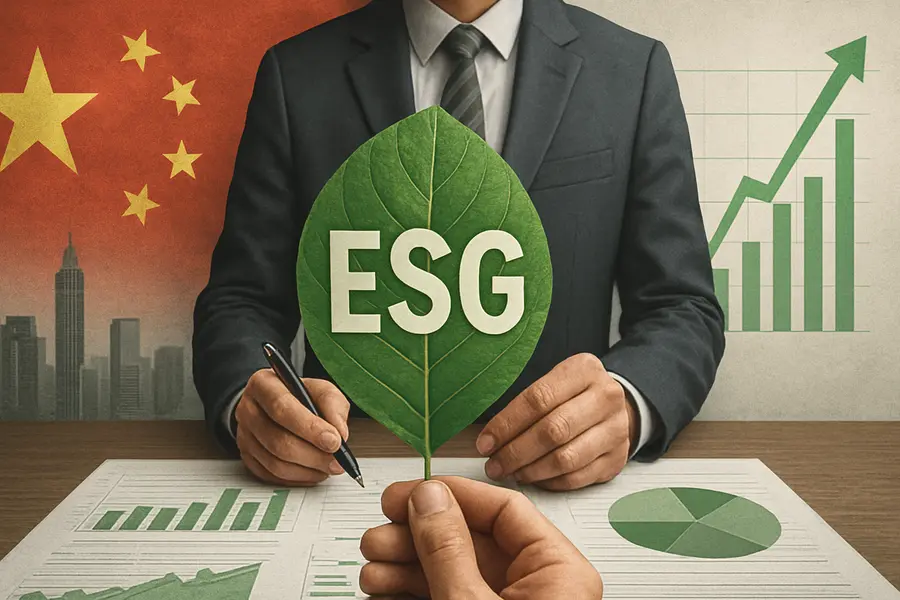
China's AMAC issued binding ESG fund rules effective June 12, 2026, setting an 80% portfolio alignment threshold for all sustainability-labeled funds.
- ESG, green, sustainable, and climate-labeled funds must hold at least 80% ESG-aligned non-cash assets under AMAC rules effective June 12.
- A two-tier fund structure echoes SFDR's Article 8/9 logic, giving managers a one-year transition period to comply by June 2027.
- The rules extend China sustainability disclosure reform from corporate filings to the asset management industry for the first time.
What Happened
The Asset Management Association of China (AMAC), the self-regulatory body overseeing the country's fund industry, published trial sustainability guidelines for ESG-labeled public funds on June 12, 2026 — the first time China has applied a binding, quantitative portfolio requirement to funds bearing sustainability labels. Funds using names containing "ESG," "sustainable," "green," or "climate" must ensure at least 80% of non-cash assets reflect the stated investment strategy. Managers have a one-year transition period, placing the compliance deadline at approximately June 2027.
Sustainable finance practitioners have drawn direct comparisons to the European Union's Sustainable Finance Disclosure Regulation (SFDR), with a leading Chinese sustainable finance consultant calling the guidelines "China's version of SFDR." The rules represent the most operationally consequential step to date in China's evolving ESG reporting framework, extending mandatory disclosure obligations from listed companies into the asset management sector for the first time.
How the Framework Works
AMAC's guidelines create two fund categories. Products meeting the 80% threshold qualify as "main strategy" funds — the higher-commitment tier — where ESG considerations must shape portfolio construction at the point of investment decision rather than serve as a post-selection overlay. To qualify, managers must apply either negative screening, excluding issuers that fail ESG criteria, or positive selection, favoring issuers with superior ESG profiles. These products must also adopt performance benchmarks aligned with the stated sustainability strategy, removing the ability to use broad market indices as primary benchmarks.
Funds carrying sustainability labels but falling below the 80% threshold drop into an "included strategy" tier with lighter requirements. This two-tier architecture mirrors the logic of the EU SFDR's Article 8 ("light green") and Article 9 ("dark green") distinction, though China's mechanism is more prescriptive: the 80% figure functions as a binary pass-fail compliance test rather than a disclosure-based categorization. The probable near-term outcome is a contraction in the number of products carrying premium ESG labels, accompanied by significantly stronger alignment between stated objectives and actual holdings.
Strategic Context: A Year of Green Finance Rulemaking
The AMAC guidelines land within a dense regulatory calendar that has made green finance news 2026 central to China's policy agenda. The country's stock exchanges — Shanghai and Shenzhen — made mandatory ESG reporting effective April 30, 2026, for large listed companies, covering fiscal year 2025 data and requiring Scope 3 supply-chain emissions disclosure for the first time. Companies on the SSE 180, STAR 50, SZSE 100, and ChiNext indices are directly in scope.
In January 2026, Beijing released the Corporate Sustainable Disclosure Standard No. 1 – Climate (Trial), broadly aligned with International Sustainability Standards Board (ISSB) rules but incorporating double materiality — obligating companies to disclose not only how climate risks affect financial performance but also how their operations affect the climate itself. Experts have described the standard as going "beyond many global standards in terms of rigour." A unified Green Finance Endorsed Project Catalogue, jointly issued by the People's Bank of China, the National Financial Regulatory Administration, and the China Securities Regulatory Commission, came into force in October 2025, consolidating fragmented classification standards into a single national green taxonomy.
China's 15th Five-Year Plan (2026–2030) targets a 17% reduction in carbon dioxide emissions per unit of GDP by 2030 and introduces a structural shift from controlling energy consumption to managing carbon emission intensity and total volume — a trajectory that requires mobilizing private capital at scale.
Addressing Greenwashing
China's ESG fund sector expanded rapidly after 2020 but without enforceable product standards. AMAC's 2018 Green Investment Guidelines were voluntary and qualitative, leaving fund naming and classification to individual managers. The resulting mismatch between sustainability branding and actual portfolio composition was well-documented. Analysts flagged systematic greenwashing risks, noting that the absence of classification standards complicated investor due diligence and undermined market credibility.
By tying fund names to asset composition and enforcing a quantitative threshold, regulators are moving ESG from narrative to constraint. For institutional investors — including foreign asset managers operating in China — the rules provide cleaner product comparisons and a clearer basis for assessing ESG reporting China data across the fund universe.
Geopolitical Dimension
The timing places Beijing in a contrasting regulatory posture to Washington. The U.S. Securities and Exchange Commission initiated a review of ESG fund naming rules in March 2026 against a backdrop of federal policy withdrawal from sustainability mandates. China and the European Union are moving in the opposite direction. China's SFDR-style fund rules signal a strategic intention to shape global sustainable investment standards at a moment when U.S. regulatory momentum has reversed, putting Beijing and Brussels in direct competition for influence over how international capital markets define sustainability.
The EU is simultaneously reforming its own SFDR style rules, with the European Parliament circulating a draft proposal in early 2026 to tighten categorization and disclosure obligations. The parallel evolution of the two frameworks reflects a broader global contest over sustainable finance architecture.
Outlook
With a June 2027 compliance deadline, the next twelve months will test how many of China's currently labeled ESG funds can credibly demonstrate 80% portfolio alignment. Sector-specific application guidelines for industries including electricity, steel, cement, and automobiles are expected from the Ministry of Finance before year-end, extending China sustainability disclosure requirements further down the corporate value chain. China's binding ESG fund rules mark the transition from aspirational sustainability policy to enforceable market standard — a shift that will define the credibility of Chinese sustainable products for both domestic and international investors.
Mentioned tickers: None