Pomegra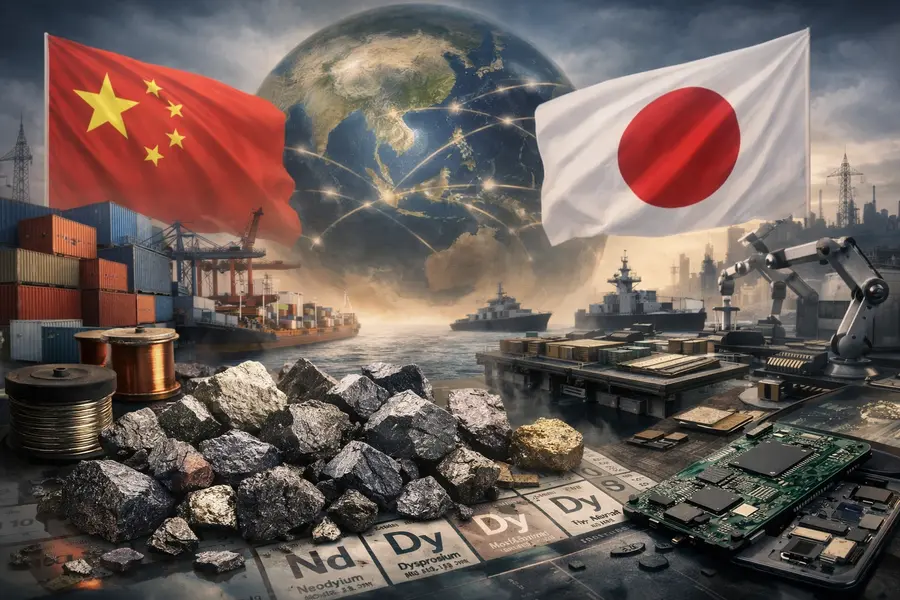
Beijing's rare earth export restrictions against Tokyo have deepened since January 2026, threatening up to $6.5 trillion in annual global economic activity and accelerating G7 efforts to reduce dependence on Chinese mineral supplies.
- China has effectively halted heavy rare earth shipments to Japan since December 2025, targeting dysprosium, terbium, yttrium oxide, and gallium.
- Japanese corporate filings have logged an unprecedented surge in critical mineral risk disclosures, with economists estimating a full-year cutoff could trim Japan's GDP by 1.3%, or ¥7 trillion (~$43.3 billion).
- The G7 pledged at its June 2026 Evian Summit to cut dependence on any single rare earth supplier below 60% by 2030.
Lead
China's Ministry of Commerce imposed sweeping export controls on dual-use materials destined for Japan on January 6, 2026, formalizing what had already become a near-total halt to heavy rare earth shipments that began in December 2025. The measures — covering dysprosium, terbium, yttrium oxide, and gallium — represent Beijing's sharpest use of mineral leverage in the China Japan rare earth dispute, triggered by Japanese Prime Minister Sanae Takaichi's November 2025 statement that a Chinese assault on Taiwan would constitute a "survival-threatening situation" for Japan. Tokyo has refused to retract the remarks; Beijing has refused to lift the curbs.
What Happened
Beijing's initial January announcement prohibited the export of "dual-use items" to Japanese entities where end-use could enhance Japan's military capabilities. China tightened the controls twice more in February, then on June 29 expanded its blacklist to include four government defense research institutes, drone manufacturers, nuclear energy firms, and dozens of additional commercial entities — among them automotive supplier Subaru, petroleum group ENEOS Corporation, and Mitsubishi Materials Corporation.
Enforcement crossed into criminal territory in late June, when Chinese authorities detained two Japanese nationals in Dalian on allegations of breaching rare earth export restrictions, the first known criminal cases under Beijing's new framework. On July 1, China's Commerce Ministry activated a formal reporting mechanism allowing individuals and organizations to flag suspected violations of its strategic mineral export rules.
The totality of these measures constitutes China's most structured use of rare earth supply as a diplomatic instrument since the 2010 Senkaku Islands standoff — and the most sustained.
Market Reaction
Disruption is registering across Japan's industrial base. Neodymium magnet procurement lead times have stretched to three to four months from the typical one to two, a 200% increase. China's total rare earth magnet exports fell 35% month-on-month in May 2026, confirming that pressure extends beyond Japan-specific blacklists.
Japanese equity markets have priced growing exposure: corporate quarterly filings logged an unprecedented wave of critical mineral risk disclosures through mid-2026, with analysts flagging downstream exposure in electric vehicles, industrial robotics, and defense electronics. Economists at Daiwa Institute of Research estimate a 12-month total cutoff of Chinese rare earth imports would reduce Japan's real GDP by approximately ¥7 trillion ($43.3 billion), or 1.3% of output.
Strategic Context
China's leverage in this China trade protest rests on structural dominance. Beijing controls approximately 60–65% of global rare earth production and 85–90% of global processing and refining capacity, according to the International Energy Agency's Critical Minerals Market Review 2024. For specific materials, the chokehold is tighter: China produces roughly 80% of the world's primary gallium, an essential input for compound semiconductors used in radar, power electronics, and advanced telecommunications.
Japan's dependency reinforces that position. As recently as 2024, China accounted for approximately 70% of Japan's rare earth imports. Diversification — while accelerating — requires years of investment in mining, processing, and refining that cannot be compressed by policy alone.
Geopolitical Dimension
The rare earth export restrictions are embedded in a broader technology-security conflict. Japan joined the United States and the Netherlands in March 2023 in restricting exports of semiconductor manufacturing equipment to China — a move Beijing has framed as economic aggression aligned with Washington's containment agenda. China's export controls against Japan are, in part, reciprocal pressure on that front, targeting supply chains that feed both civilian and defense electronics.
The global tech supply chain implications extend well beyond Japan. Japanese manufacturers sit at a critical node in global production networks: rare earth magnets processed in Japan flow into EV motors assembled in Europe, industrial robots deployed in North American factories, and defense components supplied to allied militaries. Analysts estimate that if China's export controls were fully implemented across all exposed supply chains, up to $6.5 trillion in annual global economic activity could be at risk.
G7 Response and Diversification Push
At the Evian G7 Summit in June 2026, Prime Minister Takaichi pressed allied leaders to treat Japan's supply disruption as a shared strategic vulnerability. The G7 responded with a formal commitment to reduce dependence on any single supplier outside the group and partner countries for rare earths and permanent magnets to below 60% by 2030. A coordinated road map is due by year-end, encompassing investment in new mining, processing, and refining capacity across allied and partner nations.
Japan has separately pushed for a G7 price floor mechanism for rare earth materials — a proposal designed to make non-Chinese supply commercially viable by guaranteeing baseline revenues for new producers.
Outlook
The China Japan rare earth dispute shows no near-term resolution. Beijing has shown no indication it will lift controls absent a Japanese policy reversal on Taiwan or defense posture — neither of which the Takaichi government has signaled. Further escalation on China's watchlist is possible, and the detention of Japanese nationals in Dalian adds a legal-risk dimension that could chill business activity even before formal blacklisting.
For the global tech supply chain, the pressure is structural. Rare earth alternatives outside China require years of development, and even the G7's 2030 targets leave an extended window of vulnerability. Corporate procurement teams and allied governments are accelerating diversification, but the pace of supply development lags the pace of geopolitical escalation.
Mentioned tickers: 7261.T, 5020.T, 5711.T