Pomegra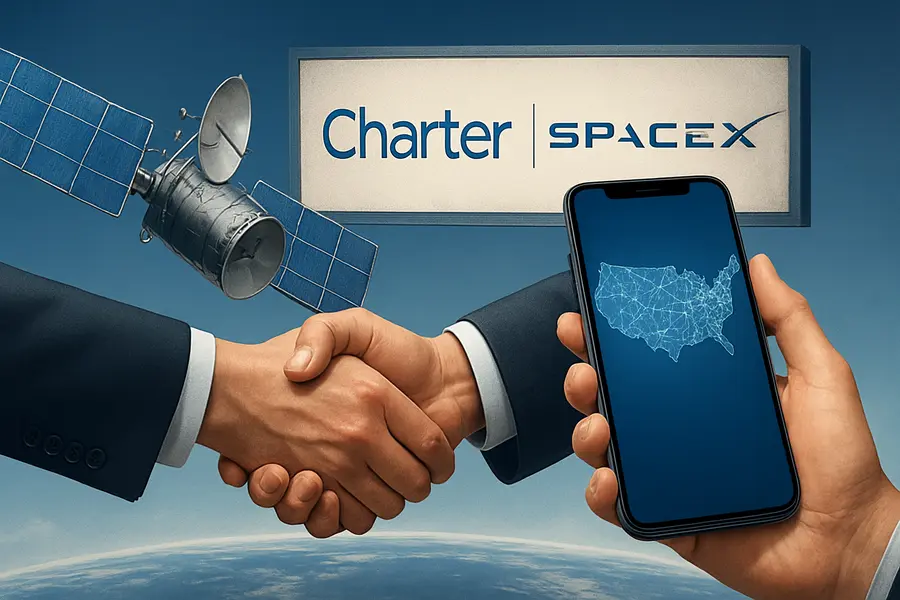
Charter Communications and SpaceX held executive-level talks on a U.S. consumer mobile deal, sending CHTR stock surging more than 12% on the SpaceX consumer phone partnership report.
- CHTR shares surged as much as 24% in premarket trading after Bloomberg reported executive-level discussions on a Charter SpaceX mobile deal.
- The arrangement would route Starlink satellite traffic through Charter's terrestrial broadband network, extending its 12.1 million Spectrum Mobile lines into satellite-assisted coverage.
- SpaceX holds FCC-approved nationwide spectrum and is advancing plans for a standalone SpaceX consumer phone service to compete directly with AT&T, Verizon, and T-Mobile.
Lead
SpaceX and Charter Communications held executive-level discussions on a potential consumer mobile partnership in the United States, Bloomberg reported on June 26, 2026 — setting off one of the largest single-session rallies in Charter's stock in years and sending shares of the incumbent wireless carriers lower. Charter, which operates the Spectrum Mobile service across 12.1 million wireless lines and 29.6 million broadband customers, and SpaceX, whose Starlink satellite network spans more than 7,000 active spacecraft, are discussing a structure that would interweave satellite coverage with Charter's existing ground-based infrastructure.What Happened
Under the terms being discussed, Charter would route a portion of SpaceX's mobile traffic through its terrestrial broadband network, mirroring the model it already operates for Spectrum Mobile — itself a mobile virtual network operator (MVNO) built atop Verizon's infrastructure. The arrangement would give SpaceX access to Charter's retail distribution, billing systems, and tens of millions of existing customer relationships, while Charter would gain satellite-based coverage capable of sharpening its position against fixed wireless rivals.
Neither company has confirmed the discussions. Charter declined to comment; SpaceX did not respond to requests for comment.
Market Reaction
CHTR stock surged as much as 24% in premarket trading on June 26 before closing more than 12% higher — a significant reversal for a stock that had shed roughly 36% of its value in the first half of 2026. SpaceX (SPCX), listed on Nasdaq following its IPO roadshow earlier this month, gained approximately 7% on the day.The opposite dynamic played out across incumbent carriers. Shares of AT&T (T), Verizon (VZ), and T-Mobile (TMUS) declined as investors weighed the prospect of a new, well-capitalized entrant in U.S. consumer wireless. The CHTR stock news represents a material pivot in how markets are pricing Charter's long-term trajectory.
Strategic Context
For Charter, the talks arrive during a period of operational strain. The cable and broadband operator has faced persistent subscriber pressure as fixed wireless access services from T-Mobile and Verizon erode its residential base. A SpaceX partnership could allow Spectrum Mobile to market seamless indoor-outdoor coverage — a capability terrestrial MVNOs cannot readily replicate — potentially reducing churn and creating a bundled service advantage that competitors would struggle to match.
For SpaceX, the rationale is structural. While Starlink Direct-to-Cell technology delivers satellite signal to unmodified handsets, SpaceX lacks the retail infrastructure, customer service operations, and terrestrial backhaul density required to launch a full-scale commercial mobile service. Charter's network and 31.7 million customer relationships would address several of those gaps in one step, accelerating the company's ambitions for an independent SpaceX consumer phone offering.
Regulatory and Spectrum Backdrop
A critical enabler of SpaceX's mobile ambitions arrived in May 2026, when the Federal Communications Commission approved SpaceX's acquisition of approximately 65 MHz of nationwide mid-band spectrum from EchoStar — frequencies compatible with standard 5G handsets. The transfer is not expected to finalize until late 2027, but the regulatory approval has already altered the competitive calculus across U.S. wireless.
SpaceX President Gwynne Shotwell, speaking to IPO roadshow investors on June 26, confirmed the company intends to launch a Starlink consumer mobile service competing directly with the three major U.S. carriers. A Charter partnership would represent a significant accelerant for that timeline.
Telecom Innovation 2026: Industry Implications
The potential deal reflects a broader transformation reshaping U.S. telecom innovation in 2026. Satellite-terrestrial integration — once limited to maritime and aviation verticals — is emerging as a mainstream competitive weapon for mobile operators. T-Mobile's T-Satellite partnership with SpaceX, which launched commercially in 2025, has already demonstrated consumer appetite for satellite-assisted connectivity at scale.
A Charter-SpaceX venture would represent a more structurally integrated arrangement: not a supplemental feature layered atop an existing carrier, but a potential standalone consumer offering blending Charter's fiber-dense footprint with Starlink's orbital layer. If executed, it would constitute one of the most significant shifts in U.S. wireless distribution since the MVNO model emerged two decades ago.
Outlook
The discussions remain at an early stage, and the path from executive-level talks to a commercial launch involves regulatory, technical, and commercial hurdles that could extend timelines considerably. The EchoStar spectrum transfer is not expected until late 2027, and building operational infrastructure for a mass-market consumer wireless business remains a substantial undertaking. Still, the market's immediate reaction underscores the scale of the perceived opportunity: a combined Charter-SpaceX entity would bring tens of millions of existing broadband subscribers, a functioning MVNO operation, and a global satellite network — a combination none of the incumbent carriers can currently replicate. Formal announcements, regulatory filings related to the spectrum transfer, and Charter management commentary at upcoming investor events represent the next milestones to monitor.