Pomegra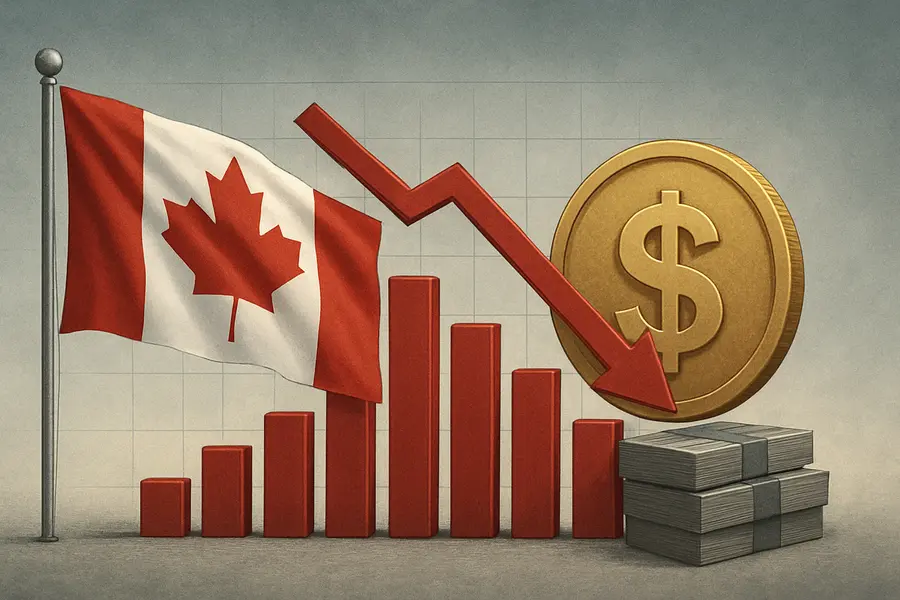
Economists slash Canada's 2026 GDP outlook to 0.7% after back-to-back contractions, as a 2.25% BoC rate and household debt at 103% of GDP strangle consumer capacity.
- Bloomberg survey economists project Canada's 2026 real GDP at 0.7%, following consecutive quarterly contractions in Q4 2025 and Q1 2026.
- Canadian household debt has reached 103% of GDP — the highest ratio among G7 nations — suppressing consumer spending nationwide.
- The Bank of Canada held its overnight rate at 2.25% for a fifth straight meeting in June, with most forecasters expecting no cuts through year-end.
Lead
Canada's 2026 growth forecast has been sharply downgraded following back-to-back contractions, with economists in a Bloomberg survey now projecting real GDP expansion of just 0.7% for the full year. Real GDP contracted 0.1% on an annualized basis in the first quarter of 2026, compounding a revised 1.0% annualized decline in the fourth quarter of 2025. The Bank of Canada's overnight rate at 2.25% — unchanged across five consecutive meetings — and household debt surpassing 103% of GDP are delivering a compounding drag on domestic consumption that most forecasters see persisting through the remainder of the year.
What Happened
The deterioration in Canada's economic outlook accelerated sharply in the first half of 2026. A Bloomberg survey of economists placed 2026 full-year Canada growth forecast at 0.7%, with RBC Economics projecting an even narrower 0.6% gain. TD Economics held a more optimistic view at 1.3%, while RSM Canada estimated 1.4%, but the majority of major forecasters now cluster at or below 1.0% — well below Canada's long-run trend growth rate.
Back-to-back quarterly contractions in Q4 2025 and Q1 2026 meet the standard textbook definition of a technical recession. The government's Spring Economic Update had penciled in a private-sector consensus of 1.1% real GDP growth for 2026, but that figure predated the Q1 data release. Downward revisions have since become the dominant direction of travel across the forecasting community.
The Debt Burden on Canadian Consumers
The Canadian debt crisis sits at the heart of the growth problem. Total household credit market debt reached $3.2 trillion at the end of 2025, equivalent to 177% of household disposable income — a ratio placing Canadian consumers among the most leveraged in the developed world. Measured against output, household debt has climbed to 103% of GDP, the highest level in the G7. The comparable figure for U.S. households stands at 76%.
Per capita household debt now exceeds $78,000. The practical consequence: 41% of Canadians report being $200 or less from financial insolvency each month, 59% expect economic conditions to worsen over the course of 2026, and 71% anticipate the cost of living to deteriorate further.
Debt servicing is crowding out discretionary spending. Households rolling over mortgages — whether variable-rate instruments or fixed-rate terms originated during the low-rate era — are absorbing payment shocks that suppress retail activity and erode confidence across income brackets.
BoC Interest Rates and the Policy Bind
The Bank of Canada held its benchmark overnight rate at 2.25% at its June 2026 meeting — the fifth consecutive hold since the rate reached its current level in October 2025. The central bank's April 2026 Monetary Policy Report had projected GDP growth of 1.2% for the year, a figure the market consensus now views as too optimistic in light of the Q1 contraction.
Inflation in April 2026 rose to 2.8% year-over-year, driven largely by energy prices, while core inflation moderated to 2.1% — within reach of the 2% target but insufficient to justify policy easing. The BoC interest rates dilemma is structural: an economy weakening under the weight of debt service costs on one side, and inflation still running above target on the other, has narrowed the central bank's room to maneuver.
RBC has characterized 2026 as a "long hold" environment, with the bank unlikely to ease policy until inflation demonstrates a sustained return to 2%. Most market participants have priced out near-term rate reductions, with any potential cut now contingent on further economic deterioration and pushed toward the end of the year at the earliest.Trade Headwinds and Structural Drag
Beyond the domestic debt dynamic, Canada economy conditions face persistent headwinds from U.S. trade policy. Tariff uncertainty has suppressed exports and capital expenditure, with business investment declining even as government spending and partial consumer outlays have cushioned the impact. Elevated global oil prices have provided a buffer for energy-producing provinces, but have simultaneously kept headline inflation above the BoC's comfort zone, complicating any pivot.
The Canada growth forecast 2026 outlook is further pressured by demographics. Net international population growth, which had supported consumer demand in prior years, has moderated following immigration policy adjustments, removing a tailwind that had softened earlier economic slowdowns. The combination of diminished household purchasing power, reduced population momentum, and uncertain export demand leaves the economy's productive base without a near-term demand catalyst.
Outlook
Canada's near-term trajectory is defined by the intersection of restrictive BoC interest rates, a household debt burden unmatched in the G7, and weakened external demand. With real GDP growth tracking at 0.7% on the Bloomberg consensus — and forecasters such as RBC at 0.6% — the economy enters the second half of 2026 with limited capacity to absorb further shocks. A sustained return of core inflation to 2% is the primary precondition for any policy easing. Until that threshold is reached, the compression on Canadian consumer capacity is expected to persist, keeping growth well below potential. The pace of mortgage renewals, household insolvency trends, and shifts in U.S. trade policy will be the primary variables determining whether Canada can exit its near-recessionary posture before year-end.