Pomegra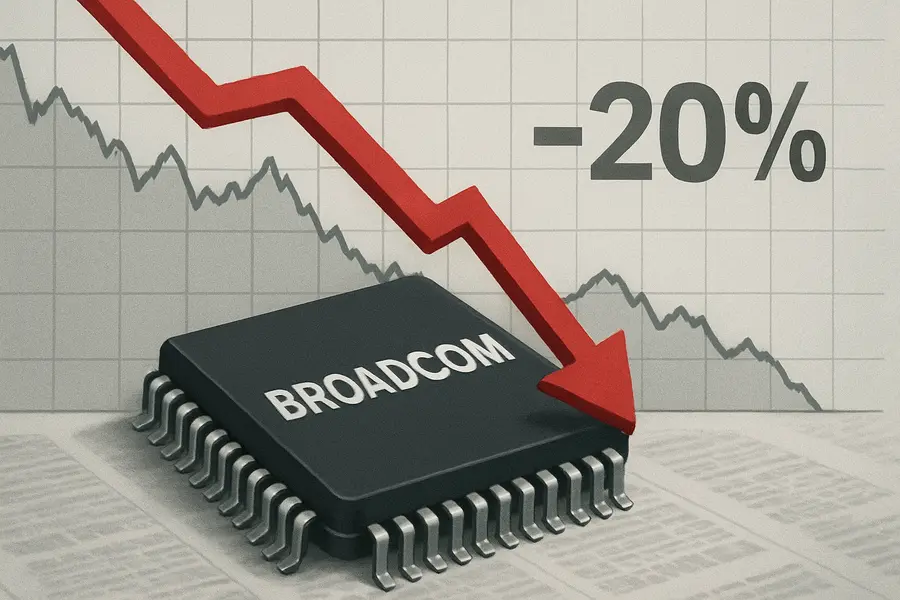
Broadcom stock slump deepens past 20% from 2026 highs as AVGO stock news sparks a sector-wide selloff, erasing $1.4 trillion in chip market value in a single session.
- The Broadcom stock slump reached nearly 24% from peak as Q3 AI chip guidance of $16 billion missed the $17.2 billion analyst consensus, despite record Q2 revenue of $22.2 billion.
- The Philadelphia Semiconductor Index fell 10.3% on June 5 — its steepest single-session decline since 2020 — wiping out approximately $1.4 trillion in sector market value.
- Chip stock forecast 2026 remains broadly constructive; global semiconductor revenues are on track to surpass $1 trillion for the first time, with AI the primary driver.
Lead
Broadcom Inc. (AVGO) has shed more than 20% from its 2026 peak since the company reported fiscal second-quarter results on June 3, triggering a broad semiconductor sector rout that erased an estimated $1.4 trillion in combined market value. Despite record quarterly revenue of $22.2 billion and AI chip sales that more than doubled year-over-year, markets punished Broadcom's decision to hold its long-range revenue target steady rather than raise it — sending the Philadelphia Semiconductor Index (SOX) to its worst single-session decline in six years.What Happened
Broadcom's fiscal second quarter delivered results that by nearly every measure qualified as exceptional. Consolidated revenue climbed 48% year-over-year to a record $22.2 billion. Adjusted EBITDA reached $15.2 billion — a 52% annual gain — representing 69% of revenue. AI semiconductor revenue for the quarter hit $10.8 billion, a 143% year-over-year surge fueled by accelerating demand for custom AI accelerators and AI networking infrastructure.
The figures themselves were not the catalyst for selling. Investors had positioned for Broadcom to lift its full-year AI revenue ambitions. Instead, Chief Executive Hock Tan reiterated the existing target of more than $100 billion in AI semiconductor revenue for fiscal year 2027 and set Q3 AI chip guidance at $16 billion — a figure implying year-over-year growth exceeding 200% but landing below the $17.2 billion that consensus models had priced in. The shortfall against elevated expectations sent shares down roughly 12% in after-hours trading on June 3.
A strong U.S. May jobs report — showing 172,000 positions added, approximately double analyst forecasts — compounded selling pressure on technology stocks the following session by reviving concerns over the interest rate trajectory.
Market Reaction
The cascade extended well beyond a single stock. On June 5, the SOX index fell 10.3% — its largest single-day loss since 2020 — as the semiconductor sector cooling spread to virtually every major chip-related name. The session erased an estimated $1.4 trillion in equity market value across AI chip positions.
The breadth of the selloff, paired with simultaneous strength in healthcare and financial stocks, pointed toward sector rotation as a material contributing factor rather than a wholesale reassessment of AI fundamentals. The Nasdaq Composite recovered approximately 0.9% in the subsequent session, consistent with repositioning rather than structural deterioration.
The AVGO stock decline accumulated to nearly 24% from pre-earnings highs before trading stabilized — among the sharpest short-term corrections in the company's post-VMware acquisition era.
Strategic Context
The central question following the Broadcom stock slump is whether the guidance shortfall signals a deceleration in custom AI chip demand or reflects conservative framing on a trajectory that remains sharply upward. Broadcom's Q3 forecast calls for consolidated revenue of $29.4 billion — 84% year-over-year growth — with AI semiconductors accounting for more than half of that total.
Custom AI accelerators — chips designed specifically for hyperscaler clients including Alphabet and Meta Platforms — are the engine behind Broadcom's AI revenue. Unlike commodity graphics processors, these application-specific integrated circuits (ASICs) are co-developed with customers over multi-year cycles, creating revenue streams that are both sticky and highly predictable. Hock Tan has consistently characterized the $100 billion FY2027 target as a floor, language that did not change on the June earnings call.
Semiconductor Sector Cooling: Broader Pressures
The semiconductor sector cooling visible in the June selloff reflects pressures beyond a single guidance miss. A growing glut in memory chips — partly the result of manufacturers prioritizing higher-margin data-center customers at the expense of smartphone-grade output — has weighed on pricing dynamics across the industry. Supply constraints in AI-critical memory components are projected to drive 50% price spikes in the second half of the year, adding a cost headwind for data-center operators.
The global chip stock forecast 2026 nonetheless remains constructive in aggregate. Industry revenue is projected to rise approximately 30% year-over-year, with the global semiconductor market crossing $1 trillion in annual sales for the first time — a milestone some projections place at $1.3 trillion, with potential to double by 2030. AI workloads for data centers are expected to represent roughly half of all sector revenue in 2026.
The Invesco PHLX Semiconductor ETF (SOXQ) had gained 99% year-to-date before the June correction, a run that left valuations exposed to any hint of guidance moderation.
What Comes Next
Broadcom's next formal guidance update arrives with its Q3 fiscal results, expected in early September. By then, investors will have additional data on hyperscaler capital expenditure commitments — the primary demand lever for custom AI chips — along with clarity on memory pricing and the rate environment.
Near-term attention shifts to rival custom silicon providers and to Nvidia's upcoming earnings cycle, which will offer a broader read on whether the AI infrastructure build-out continues to outpace even the most aggressive forecasts.
Outlook
The Broadcom stock slump of more than 20% from its 2026 highs reflects a market that had priced perfection into a company still delivering extraordinary growth. The semiconductor sector cooling that followed appears, at this stage, more consistent with valuation compression and rotational selling than with any material deterioration in AI silicon demand. With global chip revenues on track for a record year and Broadcom's AI business on an exponential trajectory, the structural case for the sector remains intact — even as near-term volatility tests investor conviction.