Pomegra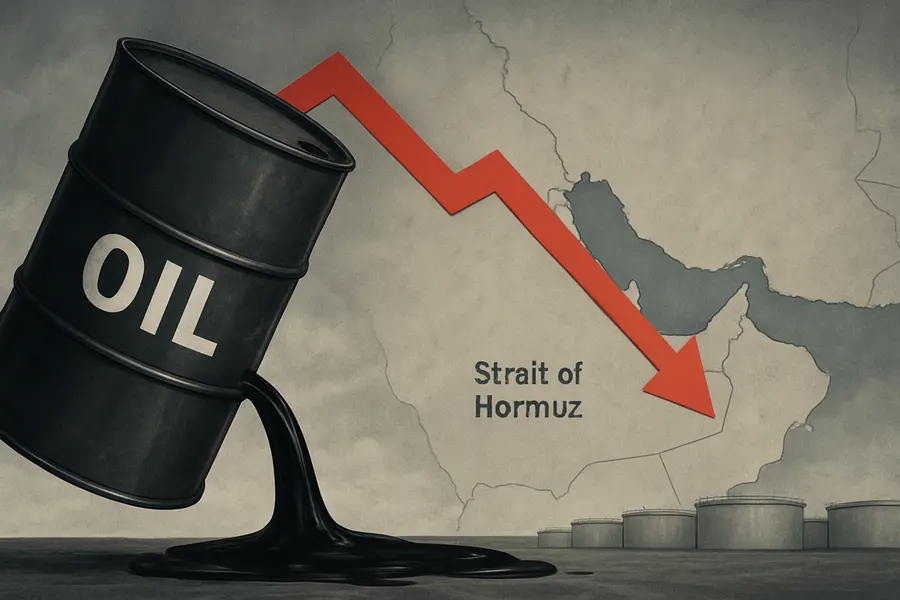
Brent crude price retreats to $69 as the Hormuz deal restores Gulf shipping while the IEA's record 4 million bpd oil oversupply caps any sustained recovery.
- Brent fell below $71 on July 3, its lowest since late February, as commercial traffic through the Strait of Hormuz recovered to more than 10 million barrels per day.
- The IEA projects a near 4 million bpd global oil oversupply in 2026 — the largest annual surplus on record — structurally capping price recovery.
- OPEC+ tripled compensation cuts to 829,000 bpd, but record non-OPEC supply from the U.S., Brazil, and Guyana limits the group's market-balancing capacity.
Lead
Brent crude retreated to near $69 a barrel on Friday, July 4, extending a sharp descent from a conflict-era peak near $100, as a ceasefire agreement between the United States and Iran progressively restored oil flows through the Strait of Hormuz — the chokepoint responsible for roughly one-fifth of global seaborne crude exports. The geopolitical tailwind, however, is colliding directly with the most pronounced structural oil oversupply the International Energy Agency has projected in its modern records, trapping prices in a narrow range and frustrating any durable recovery in energy trends.What Happened
The pivot in Brent crude price traces to June 17, when U.S. President Donald Trump and Iranian President Masoud Pezeshkian signed a memorandum of understanding ending the military conflict and committing Tehran to open the Strait of Hormuz to commercial transit free of Iranian tolls. The accord followed a 60-day ceasefire framework agreed on June 12, capping a confrontation that had seen American forces blockade Iranian ports from mid-April through late May and driven Dubai crude prices to an all-time record of $166 a barrel in March.
On June 27, the U.S. Navy's maritime coordination center widened a joint navigation corridor through the strait near Omani territorial waters, enabling coordinated two-way vessel traffic at materially higher volumes. By July 3, crude throughput had surpassed 10 million barrels per day under active American naval escort — a near-complete restoration of pre-crisis baseline flows.
Market Reaction
The directional move in oil markets is unambiguous. Brent crude has shed roughly 30% from its conflict highs as the Hormuz deal compresses the geopolitical risk premium embedded since late February. WTI tracked the decline in parallel, returning to sub-$70 territory. VLCC freight rates for Persian Gulf loadings have retreated in tandem, though insurance surcharges for Gulf-of-Oman transits remain elevated pending final diplomatic resolution.
A significant logistical overhang persists: thousands of seafarers have been stranded in the Persian Gulf for more than 100 days, and their clearance to exit is being monitored as a real-time gauge of normalization progress and residual legal complexity in the maritime corridor.
Geopolitical Dimension
Despite the headline Hormuz deal, implementation remains fragile. Iran temporarily closed the strait in late June following continued Israeli military operations in southern Lebanon, which Tehran characterized as a ceasefire violation under the agreement's broader regional architecture. Subsequent diplomatic talks in Qatar — aimed at formalizing a binding settlement — have been postponed as Iran observes national mourning for former Supreme Leader Ali Khamenei, whose funeral proceedings began July 4.
The diplomatic calendar therefore carries acute near-term price sensitivity. A collapse in Qatar negotiations or renewed interdiction of Gulf shipping would immediately reconstitute the geopolitical risk premium and push Brent back toward $80. A comprehensive final agreement — including verified neutralization of Iran's enriched uranium stockpile and permanent Hormuz toll removal — would instead cement the current bearish trajectory.
Strategic Context: The Oversupply Architecture
Even under full geopolitical normalization, structural oil oversupply dominates the medium-term outlook. Global supply is projected to exceed demand by close to 4 million barrels per day across 2026 — the widest annual surplus on record — with inventories at risk of rising by up to 5 million barrels per day in the sharpest quarters, placing sustained downward pressure on the Brent crude price benchmark.
The glut is supply-led. The United States, Brazil, Canada, Guyana, and Argentina are collectively driving record non-OPEC+ output growth as offshore projects commissioned between 2022 and 2024 reach plateau production rates. U.S. crude output has held near historic highs. Energy trends on the demand side compound the picture: global consumption growth in 2026 is running below the long-run average, squeezed by a challenging macroeconomic backdrop, accelerating electric-vehicle adoption across major economies, and sustained gains in industrial energy efficiency.
OPEC+ Faces a Structural Bind
The producer alliance is attempting to manage the imbalance but faces deepening constraints. The UAE, Iraq, Kazakhstan, and Oman committed to combined reductions of 829,000 barrels per day — triple their prior compensation pledge — effective through June. The group also paused the planned rollback of its 2.9 million bpd voluntary cut program, keeping that volume off market through the first half of the year.
Production discipline has prevented a more severe oil oversupply collapse, but it has not reversed the downward trajectory. Iran's own potential return to full export capacity under any final nuclear settlement — Tehran pumped approximately 3.4 million bpd before sanctions were tightened — represents a further supply overhang that OPEC+ math cannot easily absorb without deeper sacrifices from core Gulf members.