Pomegra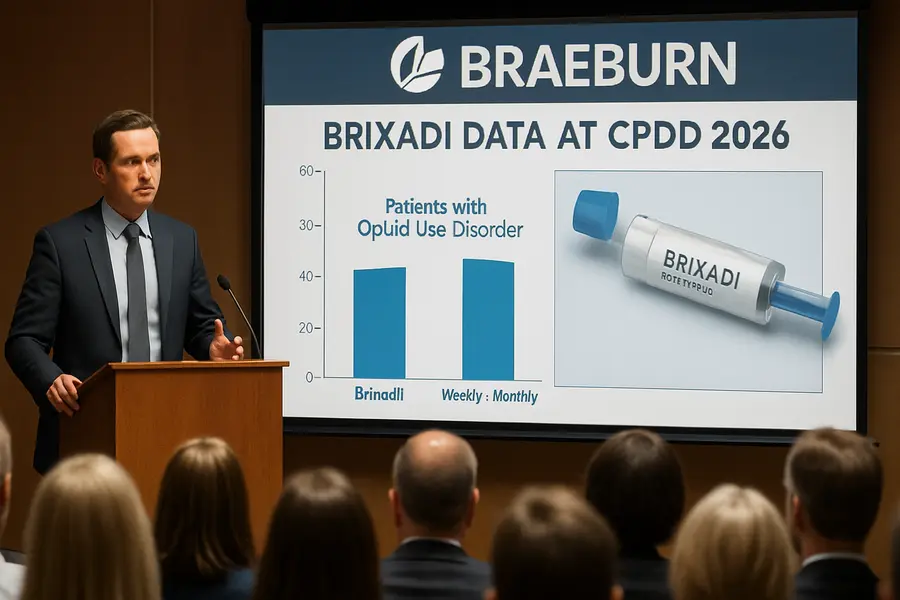
https://upload.wikimedia.org/wikipedia/commons/thumb/b/b0/Buprenorphine.svg/800px-Buprenorphine.svg.png
- Brixadi achieved 20.4% six-month retention vs. 7.2% for sublingual buprenorphine in patients with fentanyl use (P<0.001).
- Opioid withdrawal was suppressed even at buprenorphine plasma concentrations below 0.5 ng/mL, challenging prior dosing assumptions.
- Braeburn presented two oral sessions and two posters at the 88th CPDD Annual Scientific Meeting in Portland, Oregon.
Lead
Braeburn Inc. unveiled four presentations at the 88th Annual Scientific Meeting of the College on Problems of Drug Dependence (CPDD), running June 13–17, 2026, in Portland, Oregon, delivering clinical and real-world evidence for its BRIXADI® (buprenorphine) extended-release injection in the treatment of moderate to severe opioid use disorder (OUD). The data, drawn from tens of thousands of patients, reinforce the case for long-acting injectable therapies as the fentanyl era reshapes addiction medicine practice.What Happened
Braeburn's headline oral presentation, designated a late-breaking session, reported a retrospective analysis of electronic medical records comparing BRIXADI against sublingual buprenorphine in patients with OUD and confirmed recent fentanyl use. The six-month observation showed a stark gap in treatment retention: Day 30 retention stood at 51.9% for the BRIXADI cohort versus 25.5% for sublingual users; at Day 90, the split was 31.5% against 11.7%; and at Day 180, 20.4% versus 7.2% — all differences statistically significant at P<0.001 on a log-rank test.
A second oral presentation examined first-dose pharmacodynamics, presenting a post hoc analysis showing that withdrawal suppression occurred after single doses of the 32 mg weekly and 128 mg monthly formulations and was sustained throughout dosing intervals — including in patients with buprenorphine plasma concentrations below 0.5 ng/mL. Critically, no meaningful correlation was found between measured plasma concentration and the degree of opioid withdrawal suppression at any study timepoint, a finding that may prompt recalibration of dosing assumptions that have anchored clinical practice.
Supporting Data
Two poster presentations broadened the evidence base. A real-world utilization analysis drawing on specialty pharmacy records covering 30,038 patients and more than 234,000 dispensed units documented how clinicians are deploying the drug in practice. Among weekly doses, the 24 mg strength accounted for the largest share (36.1%) of 61,087 units; among monthly doses, the 128 mg formulation was most prescribed at 44.4% of 173,082 units. Nearly 61% of patients who started on a weekly formulation ultimately transitioned to monthly dosing, reflecting real-world titration toward lower treatment burden.
A fourth presentation offered a cross-sectional analysis of urine drug testing data spanning 2016 to 2025 among fentanyl-using OUD patients, mapping polysubstance use patterns that increasingly define the addiction medicine population clinicians encounter.
Strategic Context
Braeburn's conference push arrives as the opioid crisis has structurally shifted from prescription pills toward illicitly manufactured fentanyl, a transition that has complicated treatment because fentanyl's pharmacokinetics differ meaningfully from heroin and legacy opioids. The company's data directly address that gap, positioning BRIXADI as a formulation tailored for a harder-to-treat patient population.
Extended-release subcutaneous buprenorphine addresses a persistent structural weakness in medication-assisted treatment: adherence. Sublingual films and tablets require daily self-administration, creating daily diversion risk and exposing patients to missed doses during periods of instability. Weekly and monthly injections administered in a clinical setting remove that variable. The retention rate advantage demonstrated at Day 30 — more than double the sublingual comparator — is particularly significant because the first 30 days following treatment initiation represent the highest-risk window for dropout and overdose.
The 30,038-patient real-world dataset also signals broad commercial uptake since BRIXADI's U.S. approval and launch, providing payers, policymakers, and health systems with observational evidence to complement controlled-trial data.
Addiction Medicine Landscape
The CPDD gathering, the field's premier academic forum, draws addiction researchers, federal health officials, and clinicians who shape prescribing norms. Presentations there carry weight that propagates into treatment guidelines and formulary decisions. Braeburn's four-slot presence — two oral sessions, including a coveted late-breaking designation, and two posters — positions Brixadi at the center of the conference's clinical dialogue.
Competing long-acting buprenorphine products occupy the same market space, making differentiation through clinical data a core strategic lever. Evidence of superiority in a fentanyl-specific cohort addresses the most clinically urgent segment, as fentanyl now drives the overwhelming majority of opioid overdose deaths in the United States.
Outlook
The convergence of a robust real-world dataset, pharmacodynamic findings that question low-concentration dosing thresholds, and sharply improved retention in fentanyl-using patients positions Braeburn to build the evidence base required for broader formulary inclusion and guideline integration. How health systems and payers respond to the retention data — particularly the Day 180 gap — will determine the near-term commercial trajectory of BRIXADI in the fast-evolving addiction medicine market.
Mentioned tickers: N/APharma