Pomegra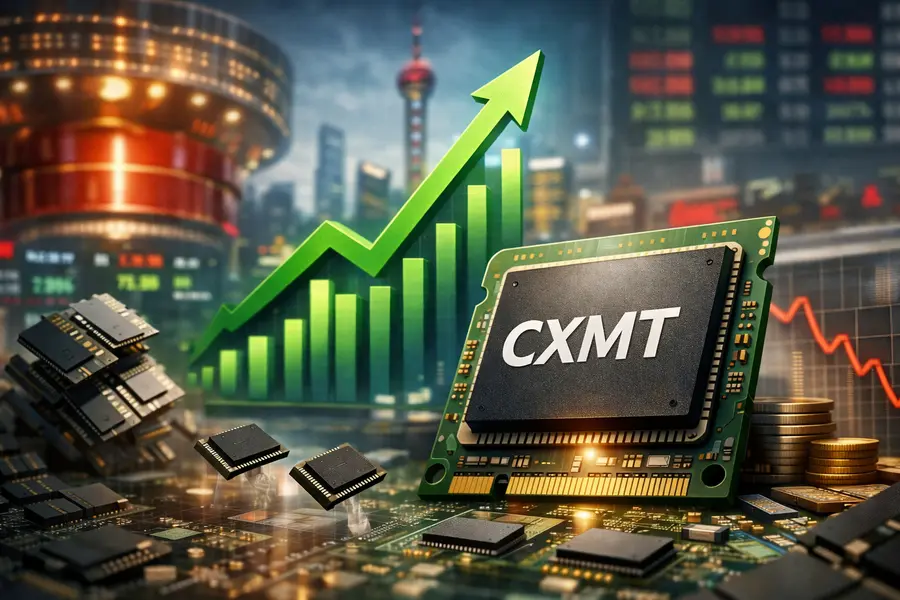
ChangXin Memory's $8.6 billion Shanghai debut surged 466% on July 27, crowning it China's most valuable listed company while pressing Micron, SK Hynix, and SanDisk sharply lower.
- CXMT closed at 49 yuan on first-day trading volume exceeding 140 billion yuan, up 466% from its 8.66 yuan IPO price.
- The $8.6 billion raise is Asia's largest IPO of 2026, giving CXMT a 3.3 trillion yuan ($488 billion) market cap.
- Micron fell 5%, SK Hynix dropped 8%, and SanDisk sank 12% on fears of intensifying Chinese DRAM competition.
Lead
ChangXin Memory Technologies surged 466% on its first day of trading on the Shanghai Stock Exchange's STAR Market on Monday, July 27, closing at 49 yuan per share after pricing its initial public offering at 8.66 yuan. The Hefei-based DRAM maker raised 57.92 billion yuan ($8.6 billion) in what ranks as Asia's largest IPO of 2026, vaulting the company to a 3.3 trillion yuan ($488 billion) market capitalization and displacing Industrial and Commercial Bank of China as the most valuable company listed on mainland Chinese exchanges. The debut sent immediate shockwaves through global memory chip markets, pulling Micron Technology down 5% to $871, SK Hynix down roughly 8% to $145, and SanDisk down 12% to $1,270 in a single session.What Happened
CXMT opened at 49.50 yuan on the STAR Market, reached an intraday high of 55.03 yuan, and settled at 49 yuan by the close — a gain of 466% over its IPO price. First-day volume exceeded 140 billion yuan, the first mainland-listed stock to cross the 100 billion yuan single-session threshold. The offering was oversubscribed 212 times, signaling a level of retail and institutional appetite rarely seen outside China's hottest technology listings. The deal ranks as mainland China's second-largest IPO in history, surpassed only by Agricultural Bank of China's $22.1 billion offering in 2010.
The surge was the largest first-day move among the world's ten biggest IPOs of 2026 by deal value, and the sharpest debut among Chinese new listings valued at $5 billion or more since 2006.
Market Reaction
The immediate spillover into DRAM module peers reflected investor concern that a well-capitalized Chinese memory champion, now flush with $8.6 billion in fresh capital, could accelerate capacity additions and erode the pricing discipline that has underpinned a historic rally in dynamic random-access memory contract rates. DRAM contract prices surged 93–98% quarter-over-quarter in the first quarter of 2026, a windfall that turbocharged earnings at Micron (MU), SK Hynix, and SanDisk alike. The prospect of a better-funded CXMT compressing those gains proved sufficient to trigger broad selling across the memory sector in a single session.
Strategic Context
ChangXin Memory Technologies holds a 7.67% share of the global DRAM market as of the fourth quarter of 2025, ranking fourth worldwide behind Samsung, SK Hynix, and Micron. The company produces DRAM modules for smartphones, PCs, and AI servers, competing directly with the incumbent trio in mainstream DDR5 segments. Its customer base is expanding: Apple is reportedly evaluating CXMT's DRAM for devices sold within China, a development that would mark the company's first penetration into premium smartphone supply chains.The Shanghai IPO transforms CXMT's financial position. Pre-listing, the company carried an estimated valuation of approximately $85.5 billion. Post-debut, its market capitalization stands at roughly $488 billion — a near six-fold increase — giving CXMT access to the public equity markets and a currency for future capital raises that its private-company peers cannot match.
Geopolitical Dimension
CXMT's public debut is inseparable from China's decade-long campaign to build domestic semiconductor independence. The Chinese government has directed significant state capital toward the company as part of a broader push to reduce reliance on foreign-made memory chips, which remain critical to consumer electronics, data centers, and military systems. The STAR Market listing deepens that alignment, channeling domestic retail and institutional savings into a national champion.
U.S. export controls remain the principal constraint on CXMT's technical ambitions. The company cannot access the most advanced lithography equipment — particularly extreme ultraviolet systems from ASML — or a range of deposition, etching, and metrology tools that the incumbent memory producers rely upon for cutting-edge nodes. Those restrictions limit CXMT's near-term ability to produce the most advanced DRAM variants, including high-bandwidth memory for AI training clusters, and analysts broadly expect the export control regime to remain intact and potentially tighten. In that context, Monday's selloff in Micron, SK Hynix, and SanDisk likely overstates the near-term competitive threat: CXMT's $8.6 billion windfall cannot readily purchase the technology needed to eliminate the performance gap with leading-edge Western and South Korean DRAM.
What Comes Next
The more consequential question for memory markets is how CXMT deploys its new capital. If the proceeds flow into capacity expansion at existing nodes — the most accessible path given export restrictions — additional supply entering a market already sensitive to pricing cycles could compress DRAM contract rates over a 12–24 month horizon. Micron, SK Hynix, and SanDisk would be the primary recipients of that margin pressure.
Conversely, if CXMT focuses on deepening its penetration of domestic Chinese OEMs and locking in long-term supply agreements with Chinese smartphone and server makers, the effect on global spot pricing may be more muted, redirecting supply rather than growing the total pool.