Pomegra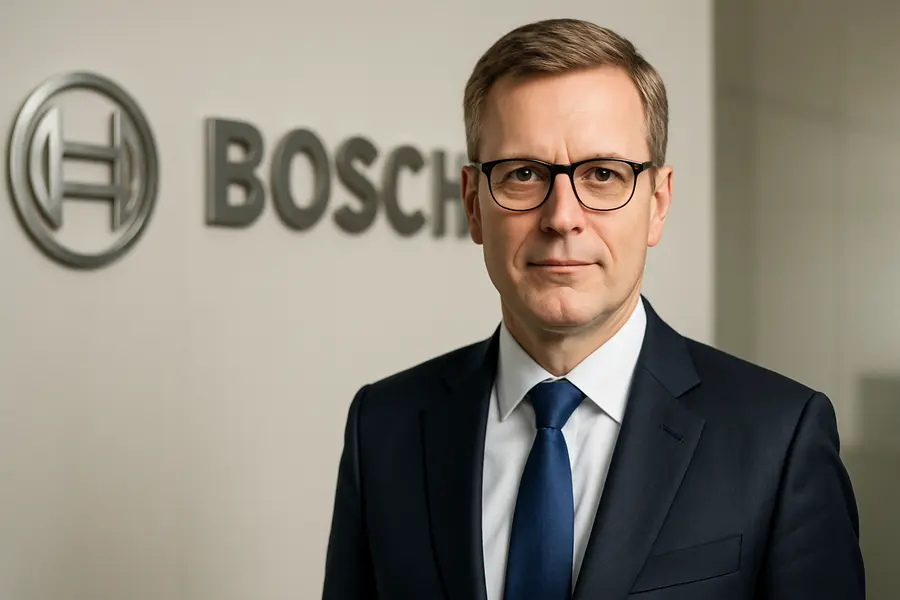
Christian Fischer, an economist and longtime Bosch insider, takes the chairman's seat on July 1, 2026, succeeding Stefan Hartung as the industrial conglomerate accelerates a margin recovery and operational transformation.
- Christian Fischer, 58, becomes Bosch's eighth chairman since founder Robert Bosch, effective July 1, 2026.
- Stefan Hartung exits at his own request after roughly 4.5 years leading the €91 billion-revenue German supplier.
- Bosch posted an EBIT margin of approximately 2% in 2025 and targets 4–6% in 2026 and 7% by 2027.
Lead
Robert Bosch GmbH completed a significant Bosch leadership change on July 1, 2026, as Christian Fischer assumed the chairmanship of the company's board of management. Hartung stepped down on June 30 at his own request after roughly four and a half years in the role — one of the shortest tenures for a Bosch chief executive in the company's modern era. The transition arrives as Bosch works to recover profitability following a 33% collapse in operating profit in 2024 and years of structural strain tied to the global automotive industry's uneven shift toward electrification.What Happened
The Bosch supervisory board approved the succession and an accompanying reshuffle of the executive tier. Markus Forschner, the group's chief financial officer since 2022, and Markus Heyn, who oversees the Mobility division, have been elevated to deputy chairmen alongside Fischer's promotion.
Fischer, 58, holds a doctorate in economics and is a native of Hamburg. He rejoined Bosch in 2018 after earlier stints at the company and has served as deputy chairman since January 2022, with oversight of consumer goods, strategic growth initiatives, and the Africa business. He is the eighth chairman in the group's history since Robert Bosch founded the company in 1886 — and, notably, an economist in a seat historically occupied by engineers.
Strategic Context
The Bosch new CEO inherits a company under acute financial pressure. After revenue held essentially flat at €91.0 billion in 2025 — marginally up from €90.3 billion in 2024 — the group's EBIT margin from operations compressed to approximately 2%, well short of the 7% target management had originally set for 2026. That target has now been pushed to 2027 at the earliest.
The deterioration reflects a convergence of headwinds: a weakened European industrial economy, accelerating Chinese competition in automotive components, rising tariff costs, and provisions for deep structural adjustments. Bosch announced approximately 7,000 job cuts concentrated in German automotive supply plants, a workforce reduction Hartung framed as unavoidable to restore competitiveness.
The group invested roughly €12 billion in research and development and capital expenditure in 2025, underscoring its commitment to transformation even as margins suffered. For 2026, management has set a guidance range of 2–5% sales growth and an EBIT margin of 4–6% from operations — a recovery trajectory that Fischer now owns.
Fischer's Mandate
In early public remarks, Fischer signaled a shift in organizational tempo rather than a change in strategic direction. He cited the need for faster internal decision-making and a shorter runway from innovation to market. The messaging reflects a broader diagnosis at Bosch: the company's scale and complexity have slowed its response to competitive and technological disruptions, particularly in automotive software and electrification.
Fischer's economics background may prove an asset in a period that demands hard capital-allocation choices, workforce restructuring, and portfolio rationalization rather than primarily technology bets. His experience running consumer goods and strategic growth units within Bosch also positions him to evaluate the group's non-automotive businesses — from power tools to home appliances — with fresh urgency.
Forschner's elevation to deputy chairman cements the CFO's influence over the pace and shape of restructuring, signaling that financial discipline will be a defining characteristic of the new leadership team.
Industrial News Context
The transition at Bosch reflects broader pressures across the industrial news landscape in German manufacturing. Several of Europe's largest industrial suppliers — facing the combined weight of Chinese competition, US tariff volatility, and slowing electric-vehicle adoption — have moved to refresh leadership and accelerate cost programs in 2025 and 2026. Bosch, as the world's largest automotive supplier by revenue, is seen as a bellwether for the sector's ability to manage that transition without sacrificing long-term investment capacity.