Pomegra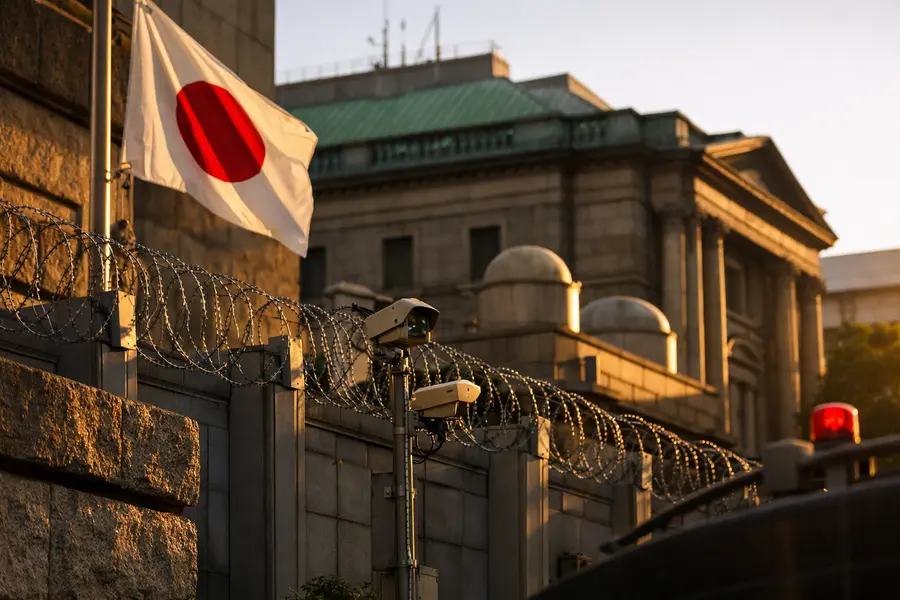
Bank of Japan rate-hike odds have reached near-100% ahead of its September 18 meeting as Japan's 10-year bond yield surges to 3% for the first time since 1996, amplifying global bond pressure alongside simultaneous ECB and Fed moves.
- Rate futures embed near-100% probability of a 25bp BOJ hike on September 18, taking Japan's policy rate from 1.00% to 1.25%, its highest level since 1995.
- Japan's 10-year JGB yield breached 3.0% on September 1 for the first time since 1996 before retreating, pressuring sovereign bond markets globally.
- The ECB raised its deposit rate to 2.50% on September 10 and the Fed faces roughly 60% odds of a hike on September 16, marking a rare three-way synchronized global tightening.
Lead
The Bank of Japan is set to raise interest rates by 25 basis points to 1.25% at its September 17-18 policy meeting - the highest level since 1995 - with futures markets embedding near-100% odds of the move after Governor Kazuo Ueda declared on September 2 that the central bank would "decide on policy with upside price risks in mind." The decision arrives as Japan's 10-year JGB yield hits generational highs, the European Central Bank executes a simultaneous rate increase, and the Federal Reserve confronts growing pressure to tighten within days of the BOJ action - producing the most concentrated synchronized global central bank tightening episode in decades.
Why Is the BOJ Raising Rates Now?
Japan's inflation trajectory has converged near the 2% target the BOJ spent three decades chasing. Governor Ueda cited three overlapping forces: elevated energy costs tied to the ongoing Middle East conflict, the inflationary drag of a depreciating yen, and structural upward price pressure from AI-linked capital investment. BOJ board member Kazuyuki Masu reinforced that framing on September 10, stating the bank will continue lifting its benchmark to prevent the prevailing price trend from exceeding 2%. Internal projections expect core inflation to accelerate to a level "clearly above" 2% from the second half of Japan's fiscal 2026, beginning in September.
The consensus behind the September 18 move is near-absolute. A Reuters poll completed September 1-8 found 66 of 68 surveyed economists expect a hike this month, with more than one-third anticipating a follow-on move to 1.50% in either October or December. An economic adviser to Prime Minister Sanae Takaichi confirmed that quarterly increases running through at least January 2027 are the government's working assumption, with Bank of America projecting the policy rate reaching 2% by July 2027.
What Does Japan's 3% JGB Yield Signal for Global Bond Markets?
Japan's 10-year government bond yield breached 3.0% on September 1 - its first visit to that level since 1996 - before retreating to approximately 2.88% by September 10. The crossing of the 3% threshold carries outsized importance because Japanese institutional investors are among the largest holders of foreign debt globally, and for decades their overseas allocations were partly anchored on near-zero domestic yields. Higher JGB yields erode that calculus, threatening capital repatriation that would exert additional upward yield pressure on U.S. Treasuries, European bunds, and emerging-market sovereign paper.
The transmission is already evident. Germany's 10-year Bund yield climbed toward 2.9%, near its highest level since early 2025, while the U.S. 10-year Treasury yield surged above 4.2%. The broader global bond selloff reflects a re-establishment of term premiums - a structural repricing that accelerates when all three of the world's major monetary anchors are moving in the same direction simultaneously.
A Three-Way Synchronized Tightening
The compression of BOJ, ECB, and Fed action into a single September week has no clear modern precedent in its speed. The ECB raised all three of its key interest rates by 25 basis points on September 10, taking the deposit facility rate to 2.50% effective September 16. Eurozone headline inflation averaged 3.0% across 2026, driven primarily by energy-cost pressures linked to Middle East supply disruptions, and the ECB framed the move as the second in what it characterized as a short insurance campaign.
The Federal Reserve enters its September 15-16 FOMC meeting with markets pricing roughly 60% odds of a 25bp increase - a dramatic shift from earlier in 2026 when rate cuts were the consensus expectation. Hawkish signals from Chair Kevin Warsh, combined with a July headline CPI print of 3.4% year-over-year and a labor market holding near 4.1% unemployment, have shifted the Fed debate from whether to hike to whether this move is one-and-done. The last time the BOJ, ECB, and Fed were simultaneously tightening was during the post-pandemic inflation campaign of 2022-2023, but that episode unfolded over months with staggered pacing. The September 2026 convergence collapses the repricing into days.
The ecb policy rate Cascade and Carry Trade Fallout
The simultaneous shift across major central banks has catalyzed a sharp unwinding of the yen carry trade - the long-running strategy in which investors borrowed cheaply in yen to fund positions in higher-yielding global assets. The USD/JPY rate dropped to 152.89 in early September as BOJ tightening expectations triggered repatriation and carry-trade liquidation, with the dollar falling more than 4% against the yen across the month. Leveraged positions funded in yen are being unwound through forced selling of global equities and credit instruments, widening spreads and introducing volatility across asset classes. SOXL and other leveraged semiconductor vehicles experienced pronounced swings as discount-rate repricing hit high-multiple tech exposures hardest.
Outlook
The BOJ's September 18 decision will cement Japan's exit from the ultra-loose monetary era that defined its economy for nearly three decades. For global investors, the three-way tightening of the world's three largest central banks within a single week reinforces a regime of structurally elevated borrowing costs and wider term premiums. The ECB has signaled September may mark its final hike for the near term, and the Fed has framed any move as insurance rather than the opening of a new cycle, suggesting the pace of simultaneous global tightening will moderate as 2026 closes. But with Japan's 10-year yield still close to 3% and carry-trade unwinding still in progress, the repricing of global fixed income across currency zones is unlikely to stabilize quickly.
Mentioned tickers: SOXL