Pomegra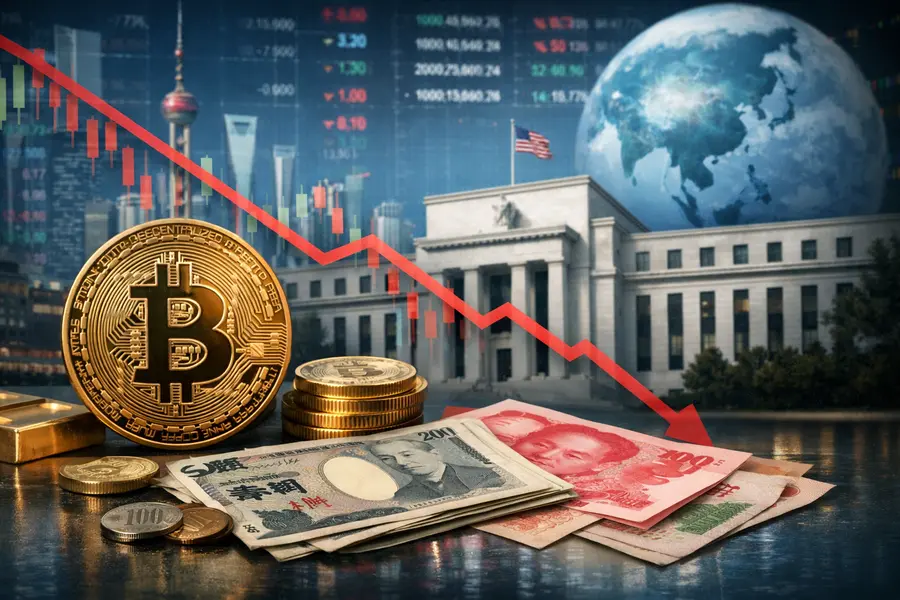
Bitcoin retreated in Asia trading to the $63,400–$64,000 range on July 28 as a Korean chip-sector rout deepened risk aversion and traders squared positions before the Federal Reserve's July 29 rate decision.
- Bitcoin fell as much as 2.3% to $63,414 during Asia trading on July 28, hitting an 11-day low by 9 a.m. Singapore time.
- South Korea's KOSPI plunged roughly 11%, triggering its eighth circuit breaker of 2026, pulling crypto lower alongside global tech equities.
- CME FedWatch odds for a July 29 rate hike reached 46.5%, up sharply from 34% on Sunday, keeping risk sentiment subdued.
Lead
Bitcoin slid to its weakest level in nearly two weeks during the Asia trading session on Tuesday, July 28, as a broad retreat from risk assets swept through markets following a severe selloff in South Korean technology stocks. The largest cryptocurrency by market capitalization touched $63,414 in early Singapore hours — a 2.3% intraday decline — before partially recovering as U.S. equity futures opened. The move came less than 24 hours before the Federal Open Market Committee is scheduled to announce its July 29 rate decision at 2:00 p.m. Eastern Time, a meeting where hike probabilities have risen materially through the week.What Happened
The catalyst on Asia screens was a collapse in South Korean semiconductor equities. The KOSPI fell as much as 11% on Tuesday — triggering the index's eighth circuit breaker of 2026 and its worst single-day decline in years — closing at 6,012.68. Samsung Electronics shed 13.4% and SK Hynix dropped 9.7% as investors reacted to reports that China has made material advances in domestically produced deep ultraviolet (DUV) lithography equipment, raising the prospect that AI hardware supply chains and export-control moats may erode faster than previously modeled.
The contagion spread rapidly across global risk assets. Crypto markets lost approximately $24 billion in total market capitalization over the 24-hour period. AI-linked and layer-1 tokens bore the sharpest losses, with FET, NEAR, and HYPE each declining as much as 10%. Bitcoin and Ethereum showed greater relative resilience but still tracked the broader risk-off pattern that dominated Asia trading.
The Fed Overhang
Macro uncertainty compounded the semiconductor shock. The FOMC meets July 28–29, with Fed Chair Kevin Warsh scheduled to hold a press conference at 2:30 p.m. Eastern on July 29. Economists widely expect the committee to hold the federal funds target range steady at 3.50%–3.75% for a fifth consecutive meeting, but market-implied hike probabilities have climbed sharply. Per the CME Group's FedWatch tool, the probability of a 25-basis-point increase reached 46.5% ahead of the decision, up from 34% on Sunday and from the mid-20s earlier in the month.
That repricing reflects a hawkish shift that has been building since June. The committee's most recent dot-plot revision placed the median projected year-end 2026 federal funds rate at 3.8%, up from 3.4% in March — effectively reversing earlier market expectations for a cut. U.S. inflation is running at 4.2%, and the committee's updated projections flagged persistent price pressures that could justify further tightening.
The sensitivity of bitcoin screens to Fed rhetoric has been acute in 2026. Market participants have consistently treated the token as a high-beta risk asset in environments where real rates are rising or the policy path is uncertain. A straightforward hold on Wednesday with a neutral statement could relieve near-term pressure. A hold accompanied by hawkish guidance — or the surprise of an outright hike — would likely reintroduce downward momentum across the digital asset complex.
Market Reaction
Despite the weakness, bitcoin recovered partially from its Asia-session lows before the close of European hours, suggesting the move was amplified by thin liquidity rather than a decisive structural break. A technical level of $68,500 has emerged as a key breakeven concentration point for options positioning; the distance from current prices to that threshold indicates the market is not yet pricing a swift recovery.
Ethereum and broader altcoins followed a similar pattern: lower on the session, then stable, with trading volumes suggesting institutional participants largely held positions while retail flows skewed toward risk reduction.
An additional headwind for crypto sentiment arrived via Washington. The U.S. Senate postponed floor consideration of the Crypto Clarity Act to prioritize a Russia sanctions package and pending executive nominations, leaving fewer than two weeks of legislative calendar before the August 8 recess. The delay reduces the probability of regulatory clarity on digital asset classification before year-end, an outcome the market had partially priced in.
Strategic Context
The convergence of a technology supply-chain shock, a contested Fed decision, and legislative setbacks represents an unusually dense cluster of macro and policy risks for bitcoin at a moment when the token had been consolidating near multi-month support. The Asia trading session served as the pressure valve: lower liquidity relative to New York hours amplified moves that began after the U.S. close on Monday.
The China DUV development is structurally significant beyond the one-day Kospi collapse. If domestic Chinese lithography production advances to volume, the premise underpinning much of the AI infrastructure investment cycle — including the chip stocks and power-demand trade that has indirectly supported bitcoin mining economics and crypto market sentiment in 2026 — faces reassessment. That reframing, if it proceeds, would place sustained pressure on AI-adjacent tokens even if the Fed holds rates.
Outlook
Bitcoin enters the Fed decision at $63,400–$64,000, testing a band of support that has held through multiple intraday tests in recent weeks. The critical variable is forward guidance from Chair Warsh: a neutral-to-dovish statement could stabilize the token and allow a retest of the $65,000–$66,000 range, while any indication the committee is prepared to tighten further would likely push BTC toward the $60,000 level that options markets treat as a structural floor. The semiconductor sell-off and Senate delay on the Clarity Act add layers of uncertainty that are unlikely to resolve before the FOMC announcement. Volatility across bitcoin screens and Asia trading sessions is expected to remain elevated through the week.