Pomegra
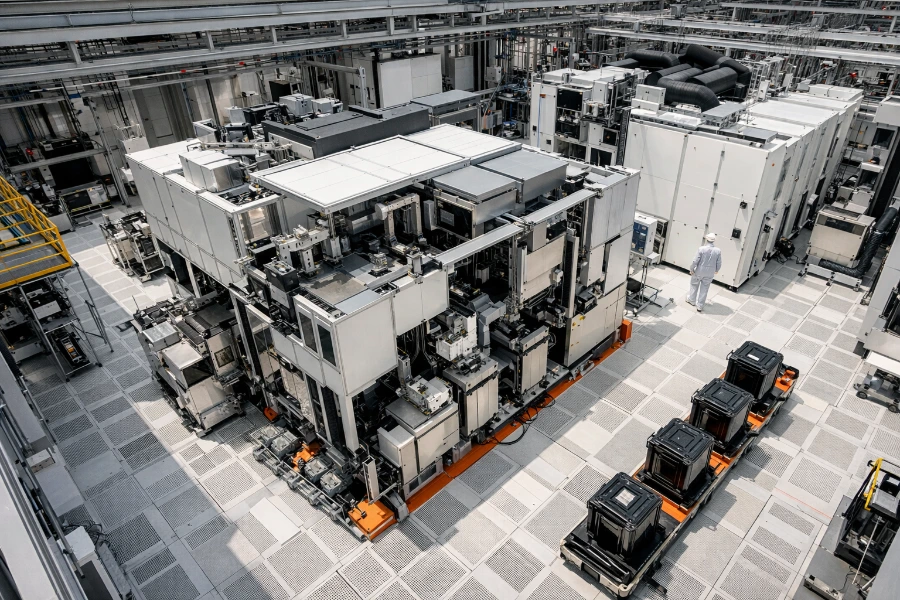
ASML shares fell about 7% even after the chip-equipment maker lifted its 2026 sales outlook to €44-45 billion, its third raise this year, on AI demand.
- ASML (ASML) raised 2026 sales guidance to €44-45 billion from €43-45 billion and gross margin to about 56%.
- Q3 net sales reached a record €11.7 billion with a 57.5% gross margin; Q4 is guided to €14.2-15.2 billion.
- Shares fell about 7% in a sell-off that left the stock down roughly 12% in October, as ai stocks reset on spending worries.
Lead
ASML Holding (ASML) shares dropped about 7% despite the company raising its 2026 sales outlook for the third time this year. The Dutch maker of extreme ultraviolet (EUV) lithography machines now expects net sales of €44-45 billion, with gross margin around 56%, up from a prior 54-56% range. The guidance followed record third-quarter results reported on October 14, and the shares have struggled to hold gains since. The episode shows how far expectations for ai stocks have run ahead of even strong company results.What Did ASML Report?
ASML reported record third-quarter net sales of €11.7 billion, towards the high end of its own guidance, with net income of €5.0 billion and a gross margin of 57.5%. Installed base management, which covers servicing and upgrades of machines already in the field, contributed €3.29 billion. The company sold 113 new lithography systems in the quarter.
Fourth-quarter net sales are guided at €14.2-15.2 billion with a gross margin of about 57%. That implies the full-year range of €44-45 billion, roughly 36% growth on 2025.
Capital returns stayed generous. ASML bought back €4.1 billion of its shares in the quarter and set an interim dividend of €1.88 per ordinary share, payable November 4.
Why Did the Shares Fall After a Raised Outlook?
The shares fell because investors had priced in strong numbers and are now focused on how long AI-related capital spending can keep growing. Valuations in the sector were already stretched, and the sell-off reflected worries about returns on AI investment, higher government bond yields that compress premium multiples, and continuing scrutiny of export controls on advanced chip tools sold to China.
Peers felt the same pressure. Lam Research (LRCX) flagged supply-chain constraints that capped its December-quarter guidance, and Applied Materials (AMAT) fell despite record quarterly results. ASML shares lost about 12% in October and are down roughly 20% from their levels three months earlier, which leaves them well below their 52-week high.
The pattern is one in which good news is treated as the baseline. Management's message on demand was unambiguous, but a stock that had rallied strongly through 2026 needed more than a higher range.
How Strong Is the AI Demand Behind the Guidance?
Demand is running ahead of ASML's ability to supply it. President and CEO Christophe Fouquet said customers are "asking us every single day to get more tools." The company said that its planned supply for 2027 and 2028 will not fully meet customer demand.
ASML has already planned a 30% capacity increase for 2027 across EUV and its older deep ultraviolet (DUV) systems. It is now studying additional expansion for 2028 beyond the 30% increase it previously communicated. Some customers have expressed interest in placing orders for 2029 and even 2030, extending the visibility of the order book well beyond the usual cycle.
Because ASML is the only supplier of EUV systems, which print the most advanced AI chips, its order book is a leading indicator for the whole chip supply chain. Leading-edge logic and memory makers are expanding capacity to serve AI accelerators, and ASML's tools are a prerequisite for that expansion.
What Are the Risks to the Outlook?
The main risks lie in the timing of customer spending and in policy. Capacity that is sold out through 2028 supports revenue visibility, but a pause in AI infrastructure budgets would first show up in order timing, not in the current-year sales figure. Net bookings can be uneven from quarter to quarter, and a soft reading would test the premium multiple the stock carries.
Export controls remain the second variable. Restrictions on advanced lithography sales to China are set by governments in the Netherlands and the United States, and any tightening or relaxation changes the mix of ASML's shipments. Rising bond yields add a third pressure by raising the discount rate applied to long-dated growth.
What Comes Next for ASML?
The next milestones are the fourth-quarter results in January, when ASML will report against the €14.2-15.2 billion guidance, and any update on the 2028 capacity plan. Those will show whether the order book continues to extend toward 2029 and 2030, as customers have signaled.
Outlook
ASML entered the final stretch of 2026 with a higher sales range, a record quarter, and a supply shortfall forecast through 2028. The roughly 7% share-price drop reflects sector-wide anxiety about AI spending and valuations, not a deterioration in the company's own numbers. The stock is likely to trade on bookings, customer capital-expenditure plans and export-control developments, which will determine whether the market's caution or management's demand outlook proves closer to the mark.
Mentioned tickers: ASML, LRCX, AMAT