Pomegra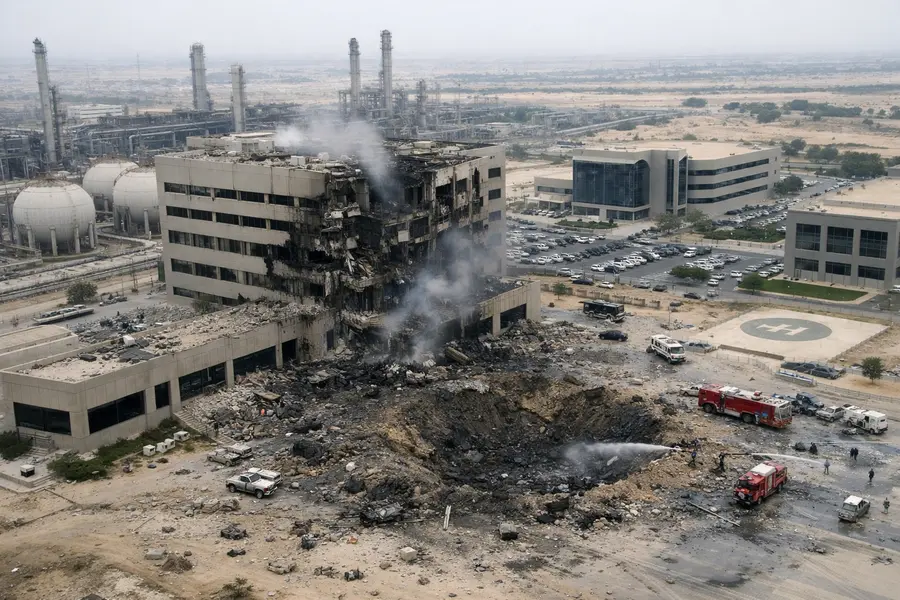
A Houthi missile hit Saudi Aramco's Dhahran headquarters on October 13, damaging three floors and lifting Brent crude above $106 as Gulf tensions escalate.
- A Houthi ballistic missile struck an office tower at Aramco's Dhahran complex on October 13, damaging its top three floors.
- The fire was limited and no injuries were reported. Brent crude traded near $106 a barrel on October 14.
- The strike follows a week of Houthi missile and drone attacks on Saudi sites and a coalition strike in Sanaa.
Lead
Iran-backed Houthi forces struck the executive headquarters of Saudi Aramco (2222.SR) in Dhahran, eastern Saudi Arabia, with a ballistic missile on Tuesday, October 13. The missile hit an office tower and caused a fire that damaged its top three floors. The kingdom's energy ministry said the blaze was limited, that no one was hurt, and that it has been extinguished. The attack is the most direct hit yet on the corporate core of the world's largest oil exporter. It pushed the Houthis and Riyadh closer to open confrontation.
What Happened at Aramco's Dhahran Headquarters?
A Houthi ballistic missile hit the Dhahran complex on October 13, striking an office tower and igniting a fire on its upper floors. The complex hosts a major operations centre that oversees Aramco's onshore and offshore oil rigs, pipelines, refineries and export terminals. Aramco is also the kingdom's largest corporate employer, and Dhahran is the historic base of its management.
The strike came hours after the Saudi-led coalition hit a fuel depot and oil facility in Sanaa and ordered its evacuation. Houthi spokesperson Yahya Saree had warned earlier that day that any Saudi attack on the Yemeni capital would draw a "harsh and painful" response. He named the Dhahran headquarters and a Riyadh refinery as potential targets.
Why Did the Houthis Target Aramco?
The Houthis targeted Aramco because it is the financial and logistical centre of Saudi Arabia's economy, and striking it carries maximum signalling value at minimal cost. For a week, the group has fired ballistic missiles and drones at key Saudi sites. It describes the campaign as retaliation for Riyadh's backing of government forces in Yemen's reignited civil war.
Hitting the headquarters differs in kind from earlier attacks on pipelines, pumping stations and storage depots. An administrative tower carries little direct barrel capacity. It does show that Saudi Arabia's command infrastructure sits within reach of Houthi missiles, despite layered air defences. The attack also echoes the 2019 strikes on Abqaiq and Khurais and the 2022 attacks on Jeddah. Each time, Yemen-based forces demonstrated they could reach core Saudi energy assets.
Geopolitical Dimension
Iran's role frames the escalation. The Houthis operate within Tehran's regional network, and the attack arrives as two more commercial vessels were struck in the Strait of Hormuz, through which roughly a fifth of global oil consumption passes. Attacks on both the Red Sea and Gulf approaches stretch Saudi Arabia's security posture across several fronts.
Riyadh spent recent years reducing its exposure to the Yemen conflict through de-escalation channels. The renewed exchange of strikes signals that this arrangement has broken down. Saudi Arabia now faces a choice between a wider air campaign in Yemen, which risks further retaliation against energy sites, and a restrained response, which risks signalling vulnerability.
How Did Oil Markets React?
Oil markets reacted with a modest rise in prices, driven by risk premium rather than lost supply. Brent crude futures rose 63 cents, or 0.6 percent, to $106.32 a barrel by 03:45 GMT on Wednesday, October 14. In other measures, Brent gained as much as 0.9 percent to $106.60, while West Texas Intermediate rose 1.8 percent to $95.79.
The moves were measured because no barrels have left the market. Saudi export terminals and production fields continue to operate. Traders are pricing the probability of a subsequent strike on production or shipping assets rather than an actual outage. The headquarters attack lifts that probability, particularly with Hormuz shipping already under pressure.
What Comes Next for the Crude Oil Price?
The crude oil price depends on whether the Houthi campaign shifts from symbolic targets to production and export infrastructure. Three scenarios define the near-term range over the next three to twelve months.
- Contained exchange: Strikes remain limited to administrative sites and military targets. Brent holds near current levels, with risk premium fading as flows continue.
- Infrastructure escalation: Attacks hit processing plants, pipelines or loading terminals, repeating the 2019 pattern. A temporary supply loss would send prices sharply higher, with Saudi spare capacity the key buffer.
- Diplomatic reset: Mediation by regional states or Washington restores the earlier de-escalation. Prices ease, although Hormuz shipping risk would remain.
Saudi Arabia holds most of the world's spare production capacity, so any damage to its own facilities removes the cushion that normally absorbs shocks elsewhere. That feature makes Aramco-related headlines more price-sensitive than most.
Strategic Context for Aramco
For Aramco, the physical damage is limited to an office tower, and operations are not affected. The larger issue is security and insurance costs, along with investor perception of the company's exposure. The company anchors Saudi public finances through dividends and taxes, and the kingdom's budget benefits from oil above $100. Elevated prices cushion revenue in the short term even as security spending rises.
Outlook
The Dhahran strike marks a new phase in the Saudi-Houthi confrontation, moving from peripheral targets to the heart of the kingdom's energy establishment. Oil prices have so far priced in risk, not disruption. The next signals are Riyadh's response in Yemen, any attack on production or export assets, and the security of Hormuz shipping lanes. Each will determine whether Brent's position above $106 reflects a temporary premium or the start of a sustained supply shock.
Mentioned tickers: 2222.SR