Pomegra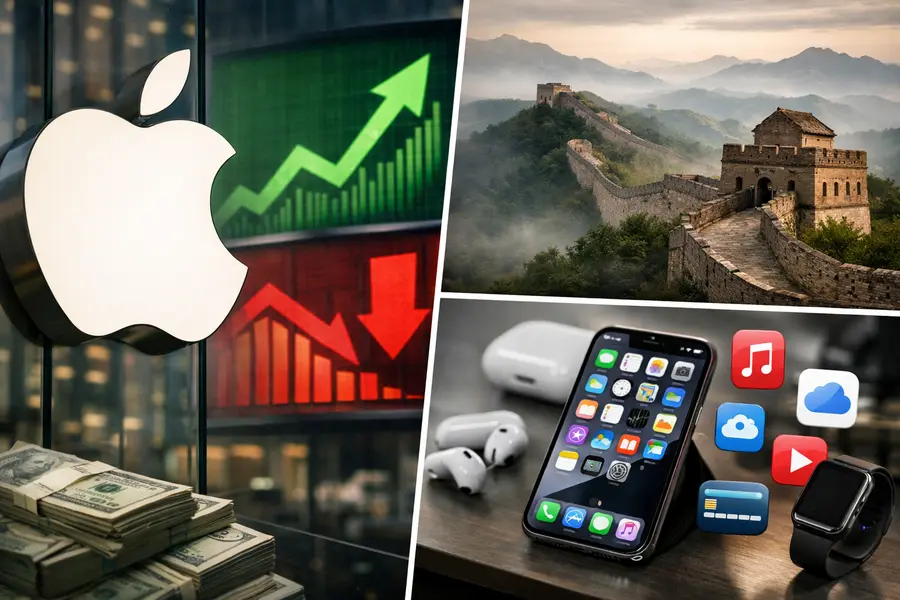
Apple's third-quarter revenue rose 16% to a record $109.4 billion, but a miss on services revenue and Greater China sent shares down more than 4% after hours.
- Record Q3 revenue of $109.4B (+16% YoY) and EPS of $2.02 (+29%) both surpassed Wall Street consensus estimates.
- Services revenue of $30.7B and Greater China revenue of $18.8B each fell short of analyst forecasts.
- Q4 guidance of 9–11% growth and Mac supply constraint warnings prompted an extended-hours selloff.
Lead
Apple (AAPL) delivered record fiscal third-quarter revenue of $109.4 billion on July 30, a 16% year-over-year increase, while diluted earnings per share climbed 29% to $2.02 and net income rose 27% to $29.8 billion — all ahead of consensus. Yet soft services revenue of $30.74 billion and Greater China revenue of $18.82 billion, each below analyst projections, dominated investor reaction and drove the stock down approximately 4% to 5% in after-hours trading.What Happened
iPhone revenue led the quarter at $54.3 billion, up 22% from $44.6 billion a year earlier, establishing a record for the June period. Mac revenue surged 29% to $10.4 billion, though Chief Executive Tim Cook cautioned that supply constraints will worsen into the September quarter due to a spike in memory costs he described as a "100-year flood." iPad revenue declined 6% to $6.2 billion. Wearables, Home and Accessories rose 7% to $7.9 billion.The services revenue segment expanded 12% to $30.74 billion, missing the $31.22 billion consensus. The category — encompassing the App Store, Apple Music, iCloud+, Apple TV+, and financial products — has been the primary margin driver and a focal point for investors tracking Apple's transition toward software and recurring income. Foreign exchange headwinds of roughly 2.5 percentage points and softer digital-advertising trends weighed on the segment. Gross margin expanded to 50.1% from 46.5% a year ago, one of the broadest improvements in recent company history.
Greater China and the Apple Store China
Greater China revenue rose 22% to $18.82 billion — reversing two years of regional pressure — but fell well short of the $19.6 billion analysts had forecast. iPhone posted a June-quarter record in the region, and Mac achieved its best quarter in Greater China in company history. Even so, the apple store china digital marketplace remains a contested arena: ongoing regulatory scrutiny of in-app payment practices, localization requirements, and intensifying domestic smartphone competition from Huawei and other local brands continued to create structural friction for Apple's ecosystem business there, limiting the upside from otherwise strong hardware sales.Market Reaction
Apple's shares fell roughly 4% to 5% in after-hours trading following the July 30 release. The decline reflected investor concern that the two key long-term growth levers — services and China — failed to deliver despite a strong headline print. The margin expansion offered some offset, but the combination of conservative guidance, supply-chain risk, and twin revenue misses outweighed the positives.
Strategic Context
The quarter marks the final full reporting period under Tim Cook, who has led Apple since 2011. The transition arrives as the company navigates a complex operating environment: rising memory costs forcing price increases on iPad and Mac, unresolved questions around generative AI feature adoption as a driver of iPhone upgrade cycles, and continued regulatory pressure on the App Store across the United States, European Union, and Asia. CFO Kevan Parekh noted that the installed base of active devices reached an all-time high across all major product categories — underscoring the depth of Apple's ecosystem even as individual revenue lines face crosscurrents.
Outlook
Apple guided for Q4 2026 revenue growth of 9% to 11% year-over-year, below the double-digit consensus expectation, with a 2.5 percentage point foreign exchange headwind and a gross margin range of 47% to 48%. Mac supply constraints are expected to intensify through the September quarter, pressuring the highest-margin hardware segment. Re-accelerating services revenue and recapturing the Greater China narrative will define the immediate agenda for Apple's incoming leadership.